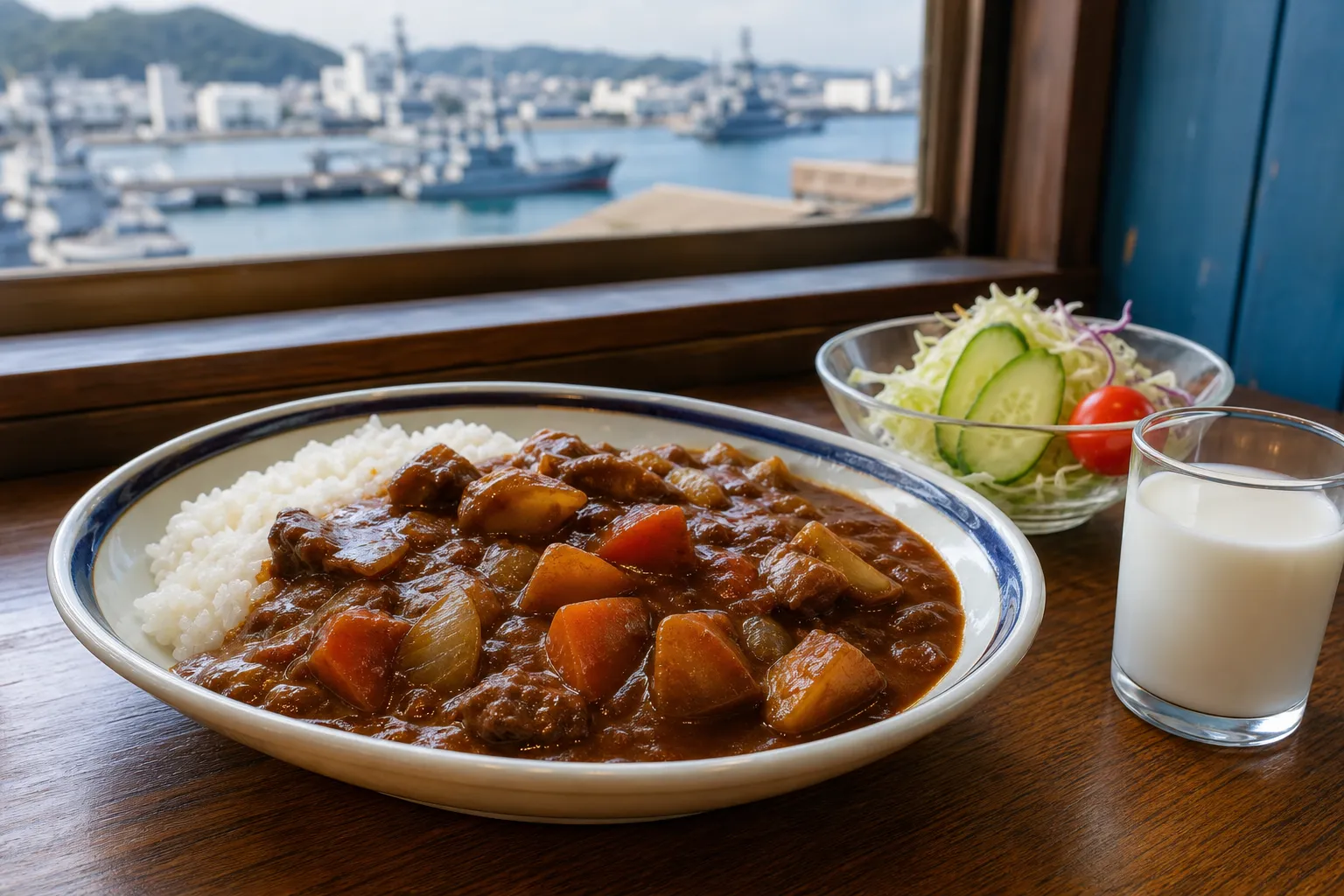
Glass of milk. Next to a curry. On purpose.
Share this dish


A whole naval fleet's worth of comfort on one plate — beef curry, a glass of milk, and a salad, standing at attention like it's inspection day.
🍜 Planning a food trip to Kanagawa?Add this dish to my Food Trip →
 Add this dish to my Food Trip →
I sat there for a solid ten seconds just staring at it before I picked up the spoon. Every instinct I have says milk does not belong next to a plate of dark, glossy, black-pepper-fragrant beef curry. And yet here I am, in a wood-panelled dining room overlooking a harbor full of actual warships, drinking milk with my lunch like a very well-behaved sailor. Because that's exactly the point.
This is Yokosuka Navy Curry — the curry the Imperial Japanese Navy served its sailors more than a century ago, and the curry the Japan Maritime Self-Defense Force still serves today, every single Friday, on ships anchored right outside that window. It's not a spice bomb. It's not trying to impress you. It's a thick, mellow, deeply savory beef-and-vegetable curry over rice, delivered as a full "set" — curry, a small side salad, and yes, a glass of milk — because that's how the Navy decided, generations ago, sailors should eat a balanced meal on a boat with no calendar. Curry Friday told everyone what day it was. That's not a metaphor I made up for the article — that's a literal historical hack for keeping track of time at sea, and I find that oddly moving every time I think about it.
Why a warship base runs on curry
Back in the late 1800s, the British Royal Navy — which the fledgling Japanese Navy studied closely — was serving a curry-and-rice dish to combat sailors' vitamin deficiencies from a diet too heavy on plain rice and not enough protein or vegetables. Japan's Navy adopted the idea and adapted it: thicker, milder, closer to a beef stew than an Indian curry, built to stretch precious meat across a full crew and to survive rocking seas without sloshing everywhere. It worked well enough that "Curry Friday" (Kin'yōbi Karē) became naval tradition, and it's stayed that way to this day aboard JMSDF vessels.
Yokosuka, the base city where the fleet still docks, eventually turned that shipboard habit into a full civic identity. In the early 2000s the city standardized an official recipe — a real one, submitted by the actual Navy, verified and licensed — so that any restaurant serving "true" Yokosuka Navy Curry has to hit specific criteria: no ready-made roux blocks, a proper beef-and-vegetable base, and that milk-and-salad side setup. I love that a curry recipe has an inspection standard. It suits the whole town.
What actually makes it good
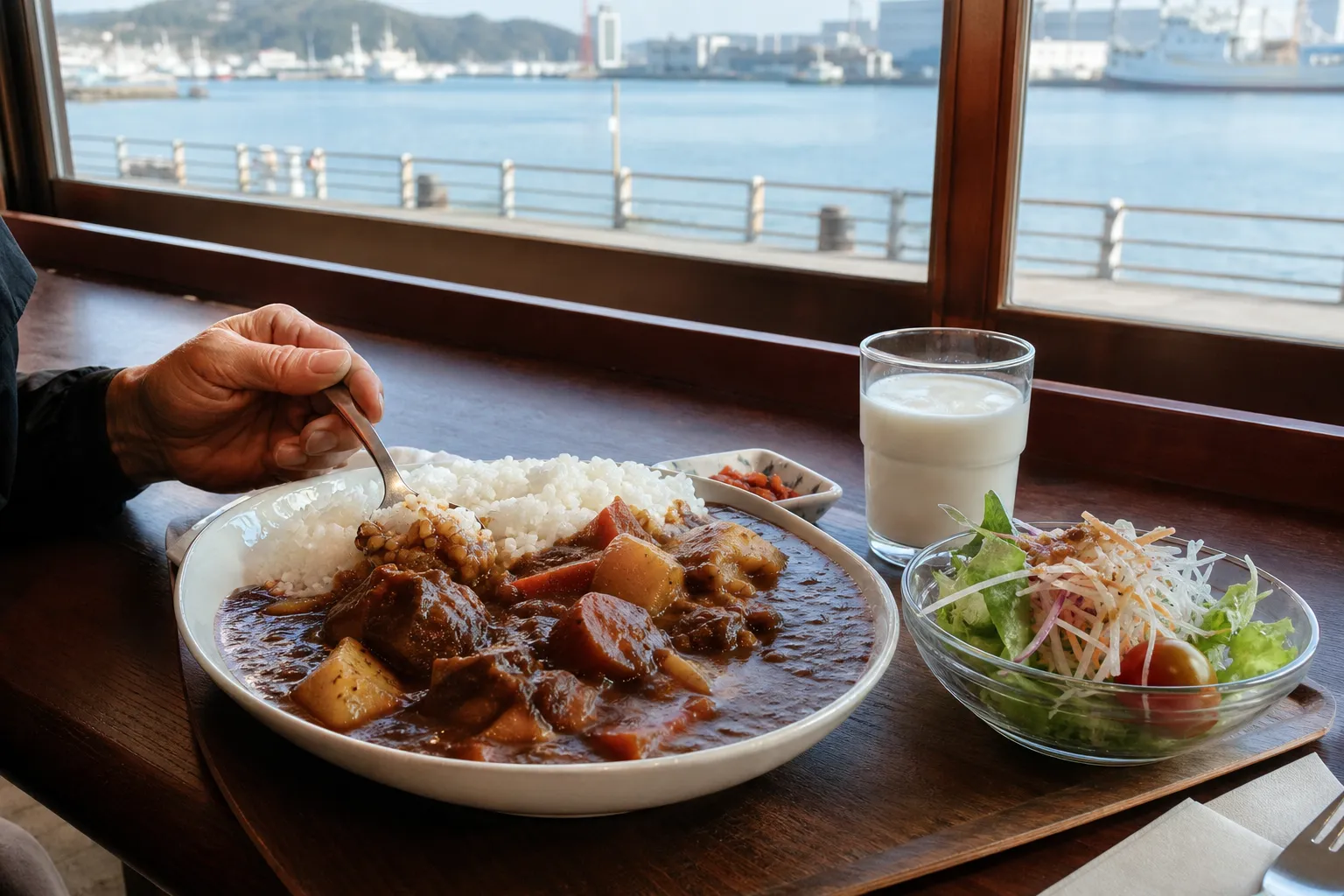
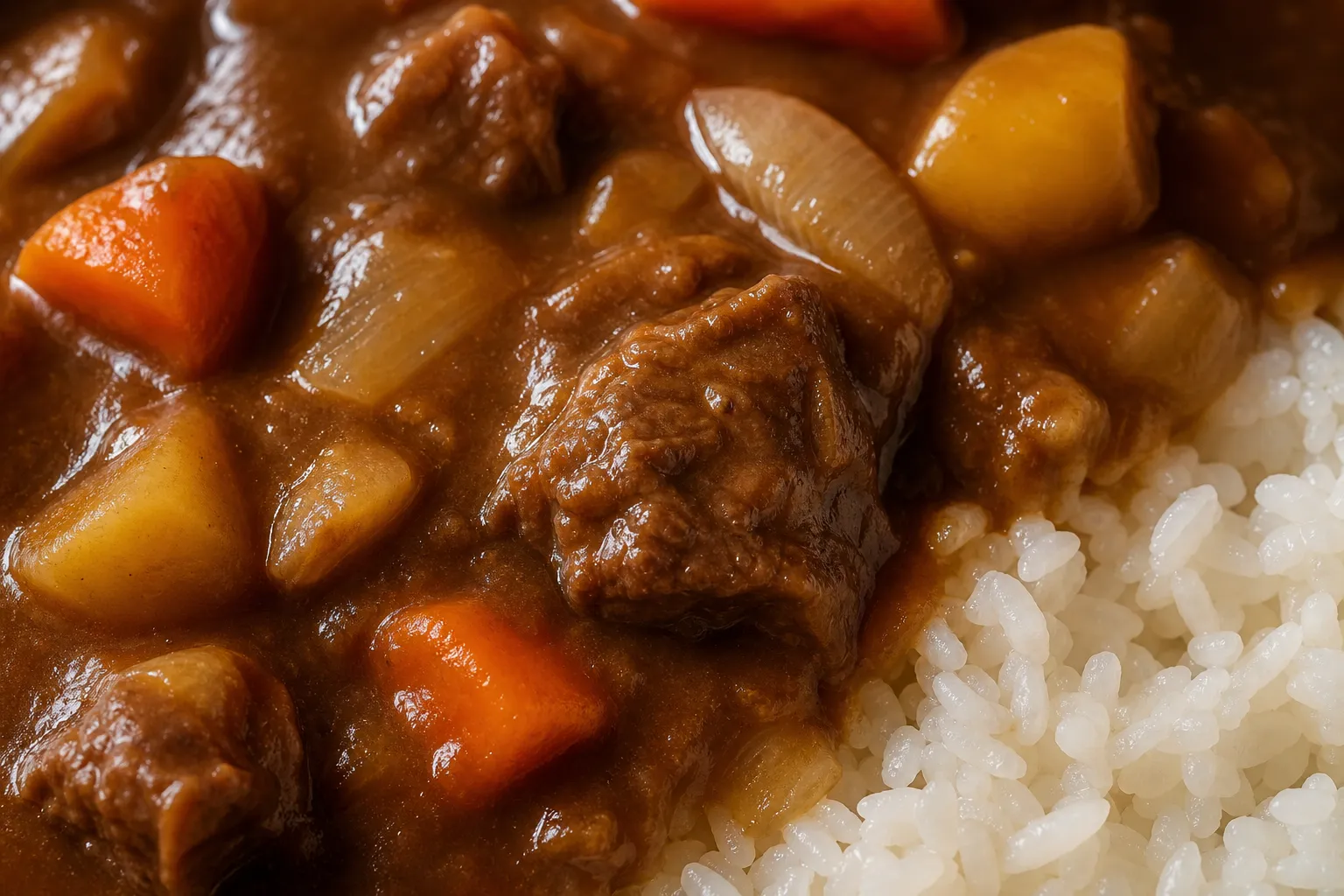
This is not the curry you're picturing if "Japanese curry" makes you think of convenience-store instant packs. It's darker, richer, and more savory than sweet — long-simmered beef, big soft chunks of carrot, potato, and onion, all folded into a glossy brown sauce that clings to the rice instead of pooling around it. The first spoonful is pure umami with a slow, warming pepper-and-spice hum underneath — no chili heat, just depth.
And then the milk. I want to be honest: I doubted it. But a cold sip between bites resets your palate completely, cools the richness, and — this is the part that got me — it's exactly what you'd want if you'd just come off a watch shift in the cold sea air. It's comfort food engineered by people who actually needed comfort. That context changes how it tastes. Genuinely.
How the fleet actually makes it
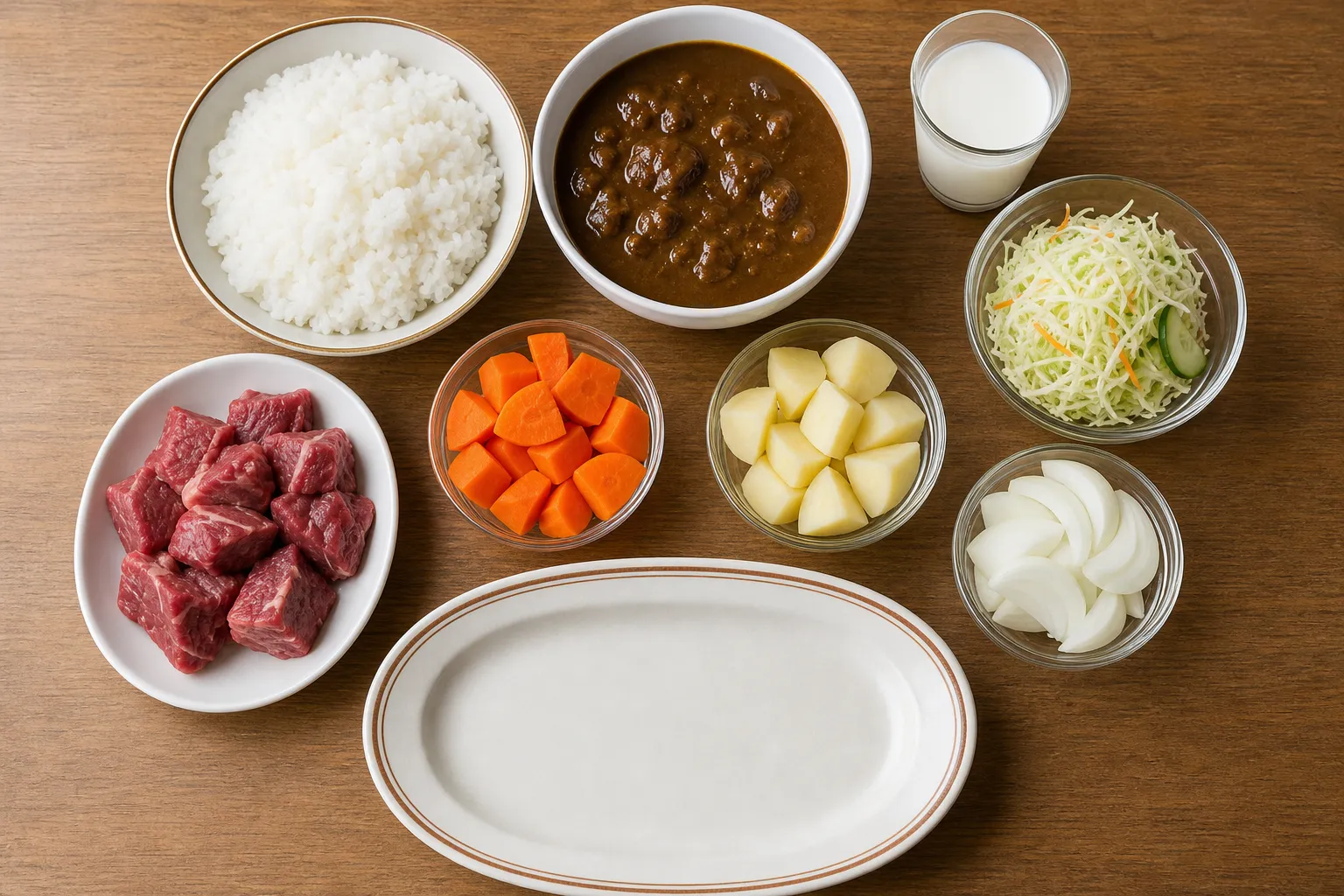
The "official" Yokosuka recipe is public and restaurants proudly follow it:
- Brown cubed beef (or pork, in some ship variants) well before adding anything else — this is where the depth comes from
- Sauté onion, carrot, and potato until the onion turns translucent and sweet
- Add water or stock and simmer everything low and slow until the beef is fork-tender
- Stir in curry roux (or a from-scratch roux of flour, butter, and curry powder for the "true" recipe) until thick and glossy
- Serve over rice with a small side salad and a glass of milk, always as a set — never just the curry alone
Simple on paper. The whole art is in step 1 and step 3 — patience, basically. The Navy had time between ports. So do you, probably, so don't rush this one.
Before you go — the stuff that actually matters
Your questions, answered honestly
"Do I actually have to drink the milk?" — No one will stop you if you skip it, but it's part of the whole "set" for a reason, and it's genuinely a nice contrast. Try it once before you decide it's not for you.
"Is it spicy?" — Not really. It's built for mildness and depth, not heat. If you want a kick, some shops offer a "karakuchi" (spicy) option — ask.
"Beef or pork?" — The city-certified recipe is beef-based, matching the historical Navy version, but you'll see pork variants too. If you want the "authentic" one, look for a shop displaying the official Yokosuka Curry emblem/certification.
"Why is there a salad on the side?" — Same reason as the milk: it's part of the original nutritional balance the Navy designed the meal around. Eat it first, last, whenever — just eat it.
"Can I get it on a ship?" — Not casually, no — but some special events and harbor cruises out of Yokosuka do serve JMSDF-style curry to the public. Worth checking local tourism listings if the timing lines up with your trip.
What the staff will ask you
| You'll hear | Romaji | Meaning | Just say |
|---|---|---|---|
| ルーは辛口にしますか? | Rū wa karakuchi ni shimasu ka? | "Want the spicy roux?" | Futsū de (regular) / Karakuchi de (spicy, please) |
| お肉は牛と豚どちらに? | Oniku wa gyū to buta dochira ni? | "Beef or pork?" | Gyūniku de (beef) |
| ライスの量はどうしますか? | Raisu no ryō wa dō shimasu ka? | "How much rice?" | Futsū de (normal amount) |
| お飲み物は牛乳でよろしいですか? | Onomimono wa gyūnyū de yoroshii desu ka? | "Milk okay for your drink?" | Hai, onegaishimasu (yes, please) |
| サラダのドレッシングは何になさいますか? | Sarada no doresshingu wa nani ni nasaimasu ka? | "What dressing for the salad?" | Osusume de (whatever you recommend) |
To order, just say "Yokosuka kārē kudasai" (よこすかカレーください) — "Yokosuka curry, please."
Where to eat it
- Curry restaurants throughout central Yokosuka near JR Yokosuka Station and the Mikasa Park / Verny Park waterfront — many display the official "Yokosuka Navy Curry" certification plaque.
- The Mikasa Park area, right by the harbor, has multiple shops within walking distance of where the actual JMSDF ships dock — eating here with the fleet in view is the full experience.
- Souvenir/retort versions are sold at Yokosuka Station and around the city if you want to bring the flavor home, though nothing beats the fresh, milk-and-salad full set.
Shop lineups and hours change, so check current listings before you go — and look for the certified Yokosuka Curry logo if you want the "official" version.
Soul Score
Local Roots5/5
First-Timer Friendly5/5
Adventure Level3/5
Comfort Level5/5
Travel Worthy4/5
These scores are one obsessed eater's gut feeling — not a verdict. A low number isn't a bad mark, just a different kind of adventure.
Know someone planning Japan?
← All Articles
Local Food · Yokosuka, Kanagawa
Still hungry?
Eat more from Kanagawa
Local FoodYokohama, Kanagawa
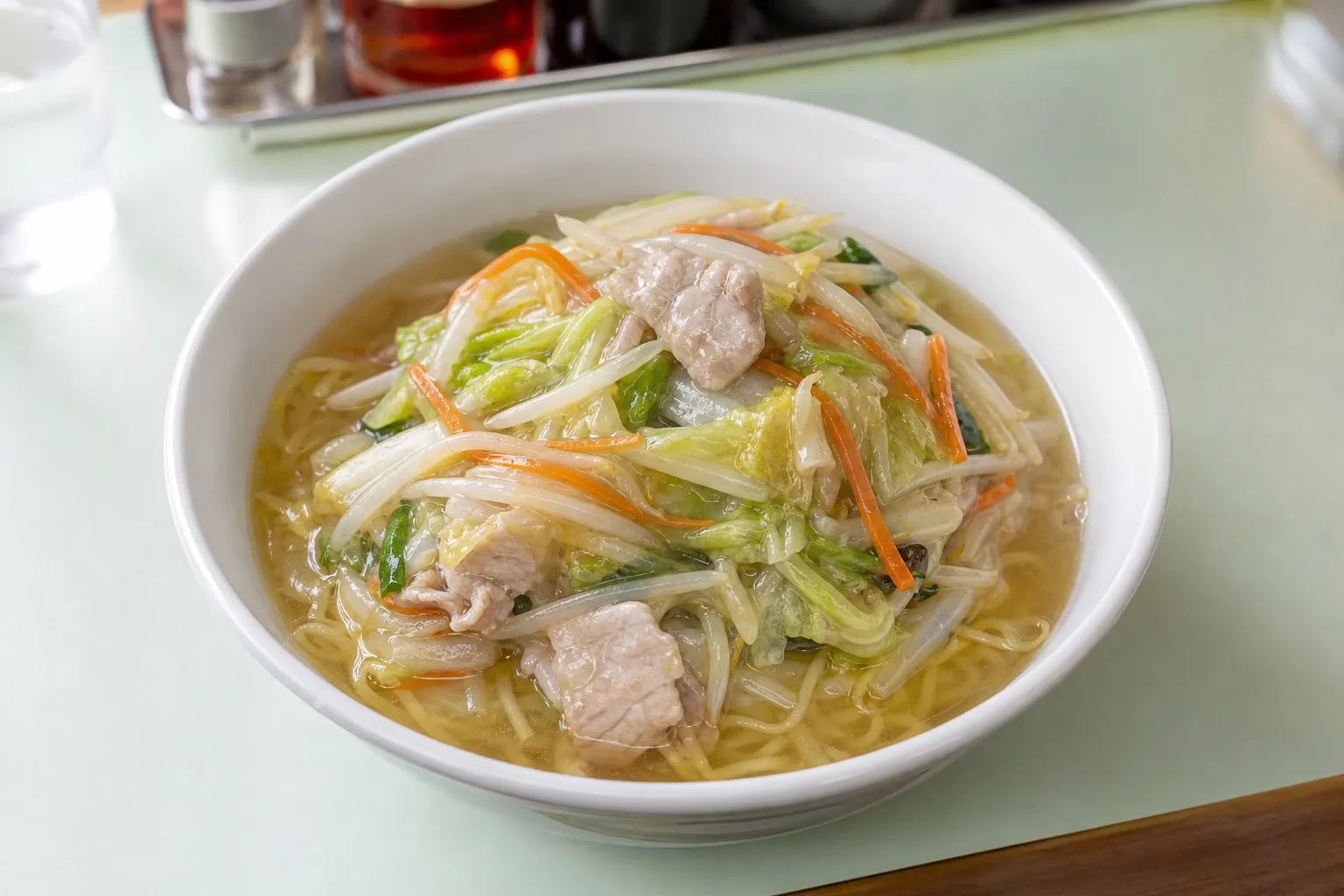
Yokohama Sanma-men (サンマー麺)
No, it's not the fish. Yes, everyone asks. And once you get past that, this is the noodle bowl I quietly crave more than the famous ones.
August 2, 2026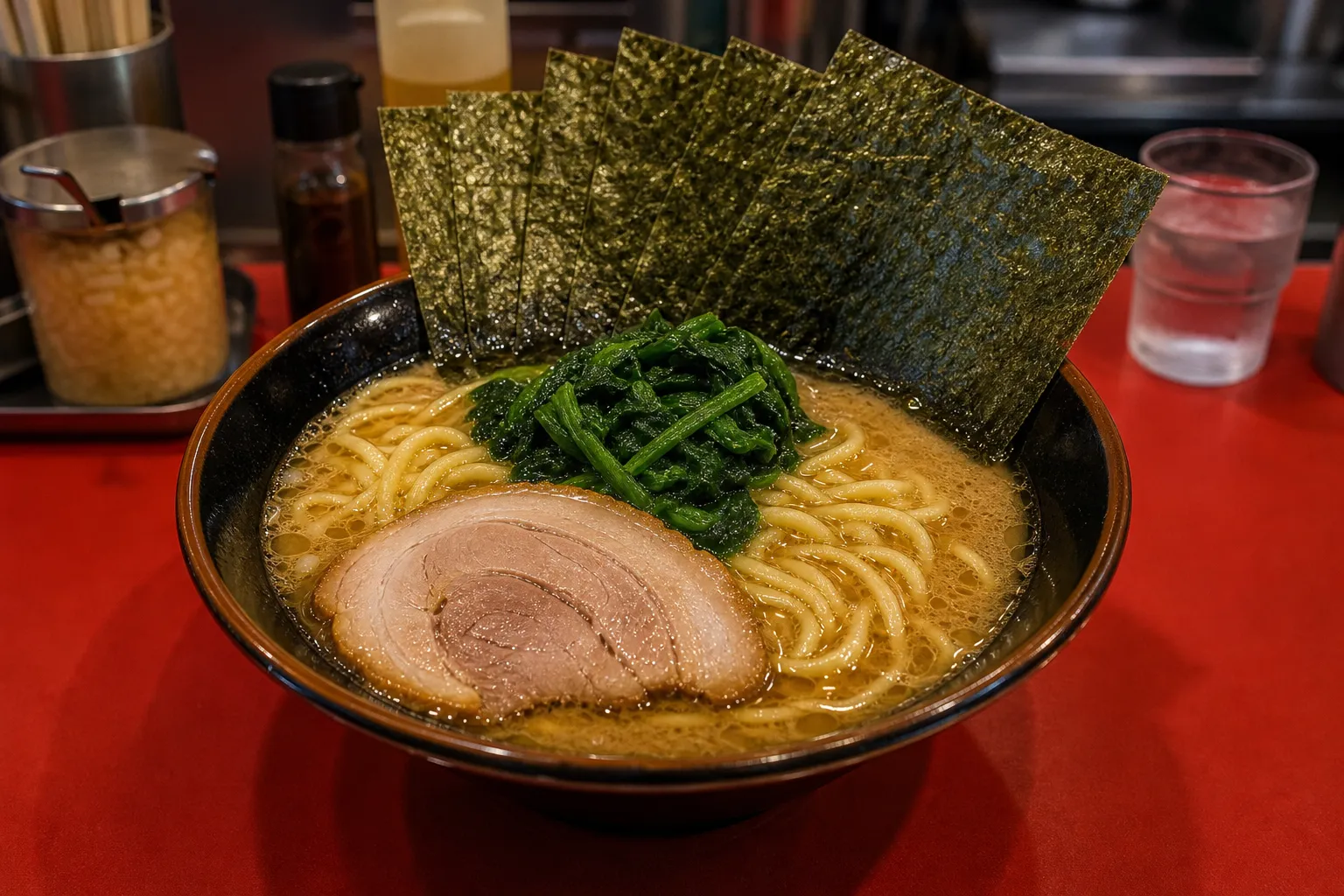
Local FoodYokohama, Kanagawa
Iekei Ramen (家系ラーメン)
Thick noodles in a pork-and-soy powerhouse, crowned with spinach and giant sheets of nori — and a bowl of white rice standing by as its secret weapon. Yokohama's build-it-your-way monster.
July 9, 2026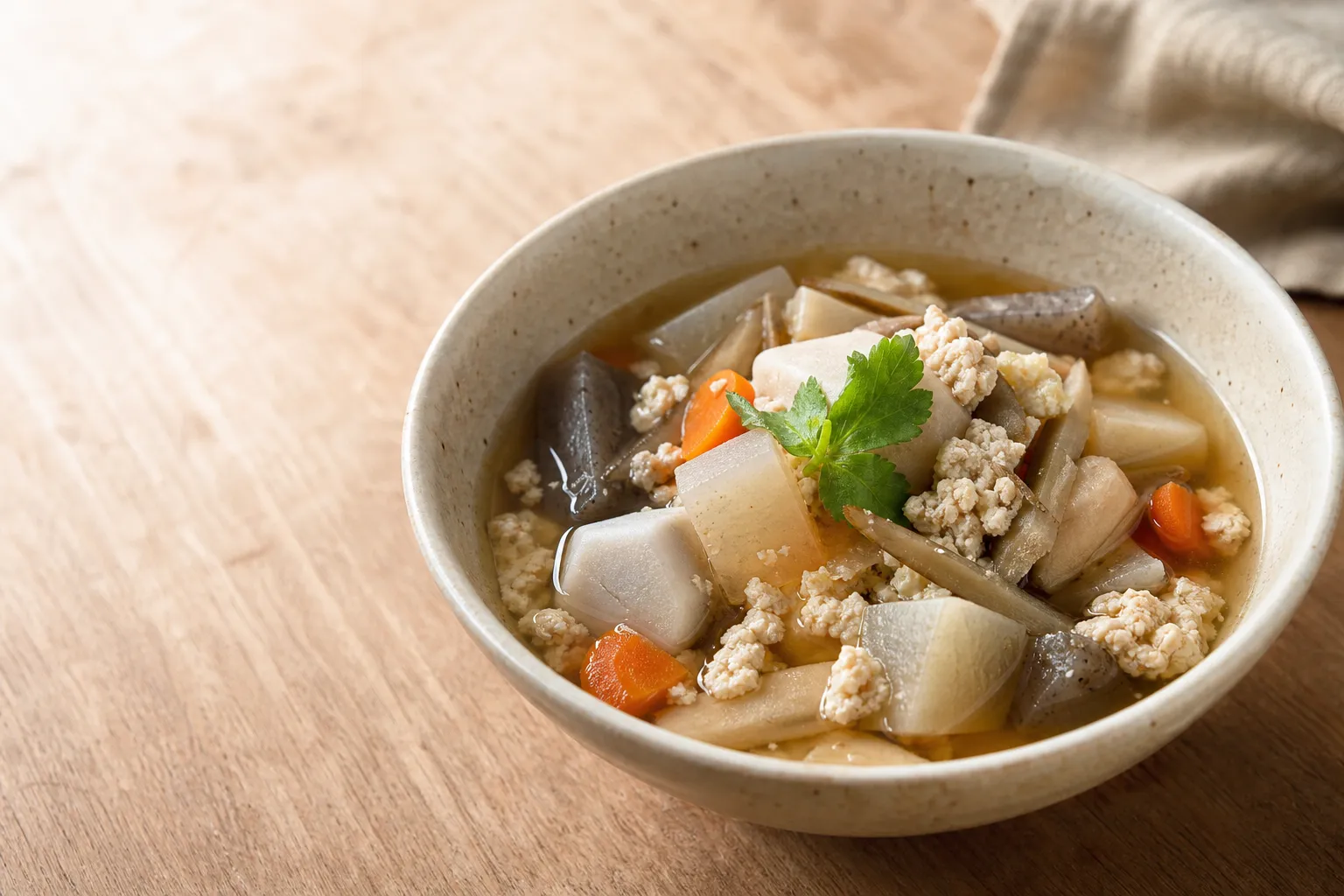
Local FoodKamakura, Kanagawa
Kenchin-jiru (けんちん汁)
A monk broke a block of tofu apart with his bare hands instead of throwing it away, sautéed it with root vegetables, and accidentally invented one of Japan's most comforting soups.
July 5, 2026