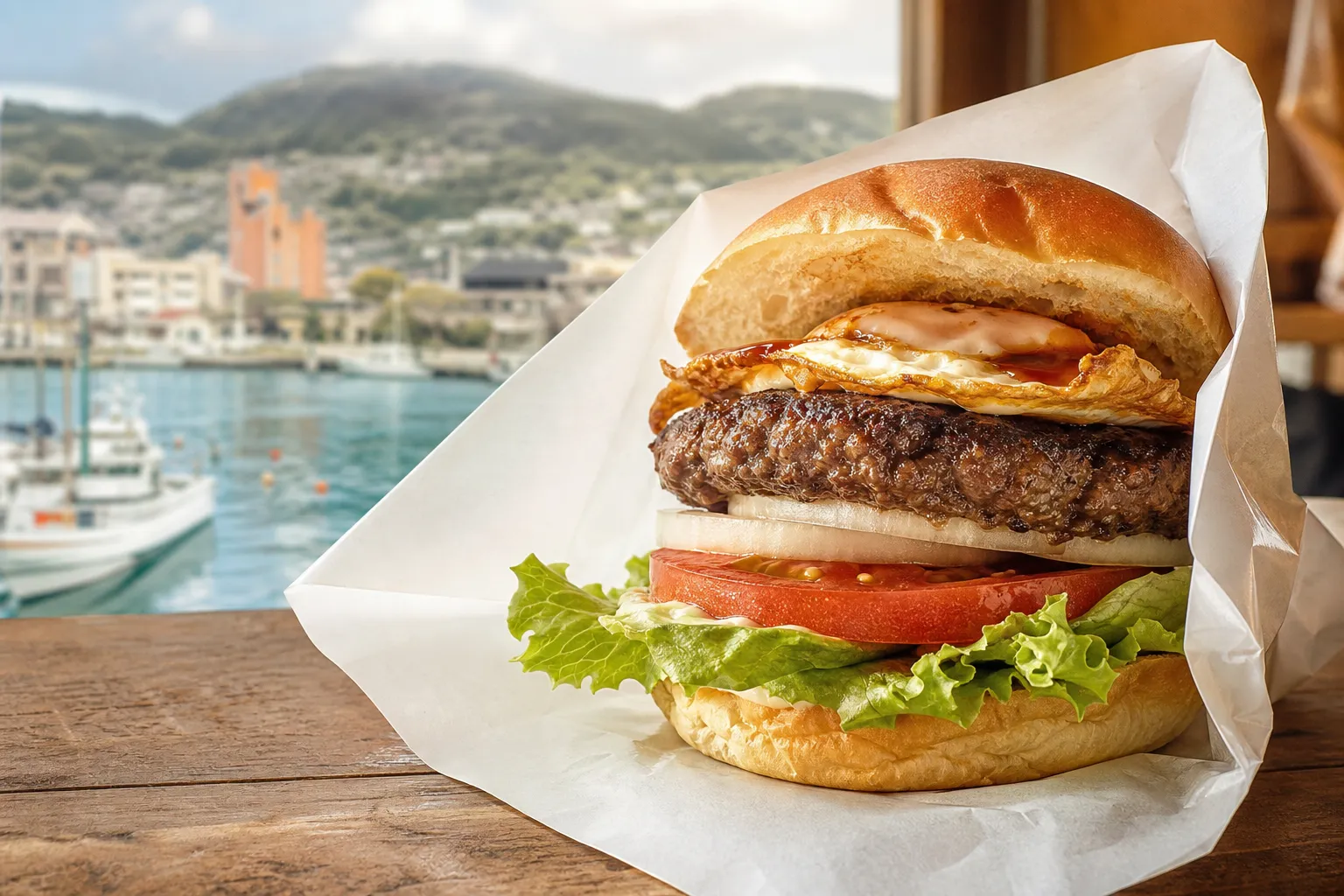
They hand it to you and your arms just... adjust. Both hands, wide grip, elbows out — your body knows before your brain does that this is not a two-bite situation. It's warm through the paper. It's slightly too big for the bun holding it. And somewhere under all that lettuce and grilled onion and a fried egg staring up at you like it's daring you to start, there's a patty that was made, by an actual human, about four minutes ago.
Share this dish


It arrives the size of your face, wrapped in paper like a gift you didn't earn, and you will need both hands and possibly a moment alone with it.
Would you try this dish?
Rate how much you would like to try it.
🍜 Build your Nagasaki food trip around Sasebo Burger.Add to Food Planner →
 Add to Food Planner →
I have eaten a lot of hamburgers in my life, in a professional and unashamed capacity. This is the one that made me stop mid-bite and just... look at it for a second.
Sasebo burgers — from Sasebo, a port city in Nagasaki Prefecture — grew out of the American naval base that's been there since the end of World War II. Local cooks learned to make hamburgers for U.S. sailors in the 1950s, and instead of copying the drive-thru version, they kept doing it their own way: fresh bakery buns, a thick patty griddled to order, real vegetables stacked high, wrapped in paper by hand. No two shops make it quite the same, and none of them are in a hurry.
A base town's fifty-year side project
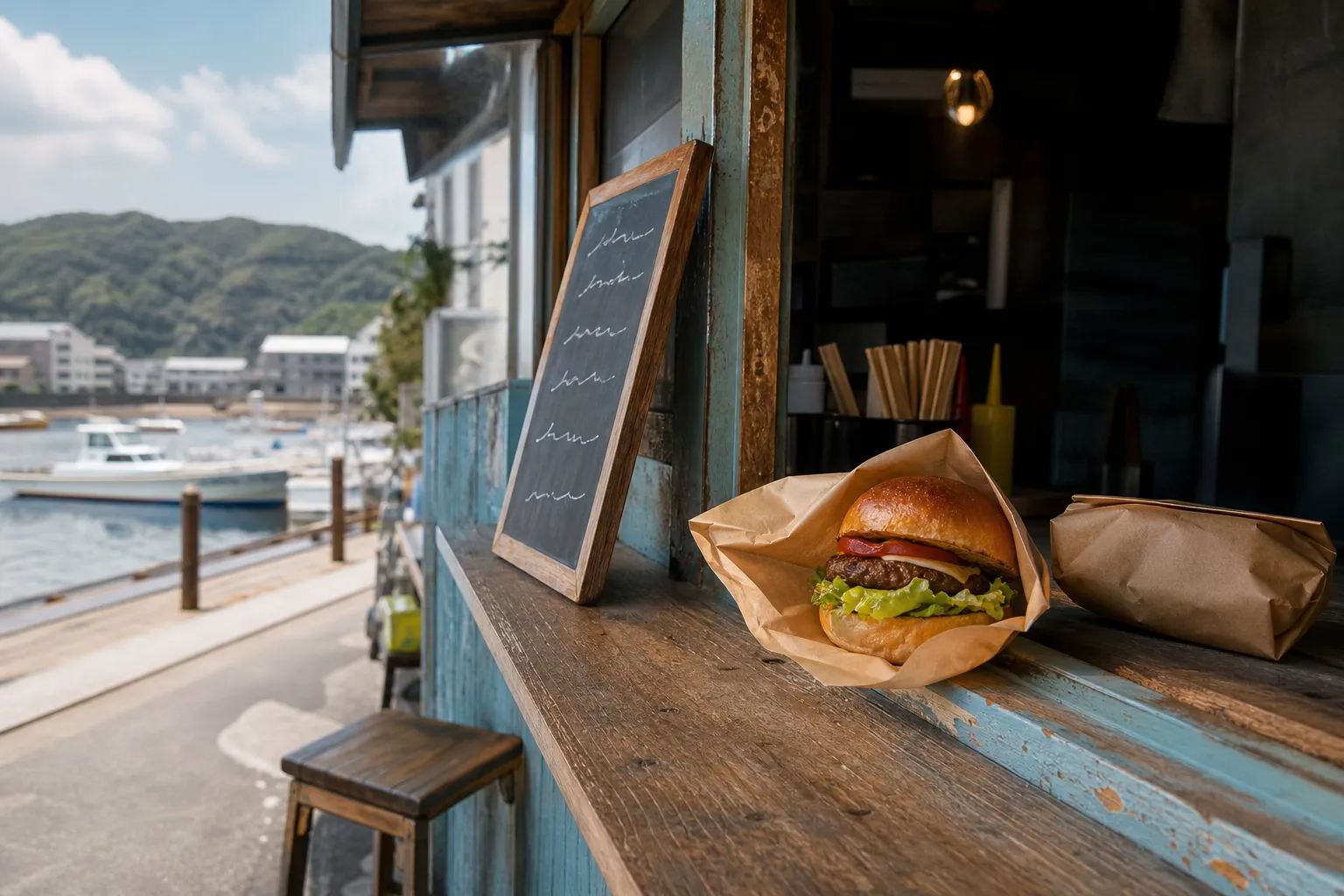
Sasebo has been a naval town for well over a century — first Imperial Japanese Navy, then, after 1945, the U.S. Navy, whose base is still there today. American sailors wanted hamburgers, and local diners near the base started making them from scratch, since there was no supply chain of frozen patties and no corporate recipe to follow. They used what they had: local bakeries for the buns, local butchers for the beef, whatever fresh vegetables were in season.
That improvised, made-to-order approach never went away, even after burger chains eventually did arrive in Japan. By the 2000s, the city leaned into it as an identity — a "Sasebo Burger Association," a stamp rally between shops, a proud insistence that this is not the same thing as what's sold under golden arches. I find that kind of civic stubbornness genuinely charming. A whole town decided its hamburgers were worth defending, and honestly, after one bite, so did I.
Why it hits different
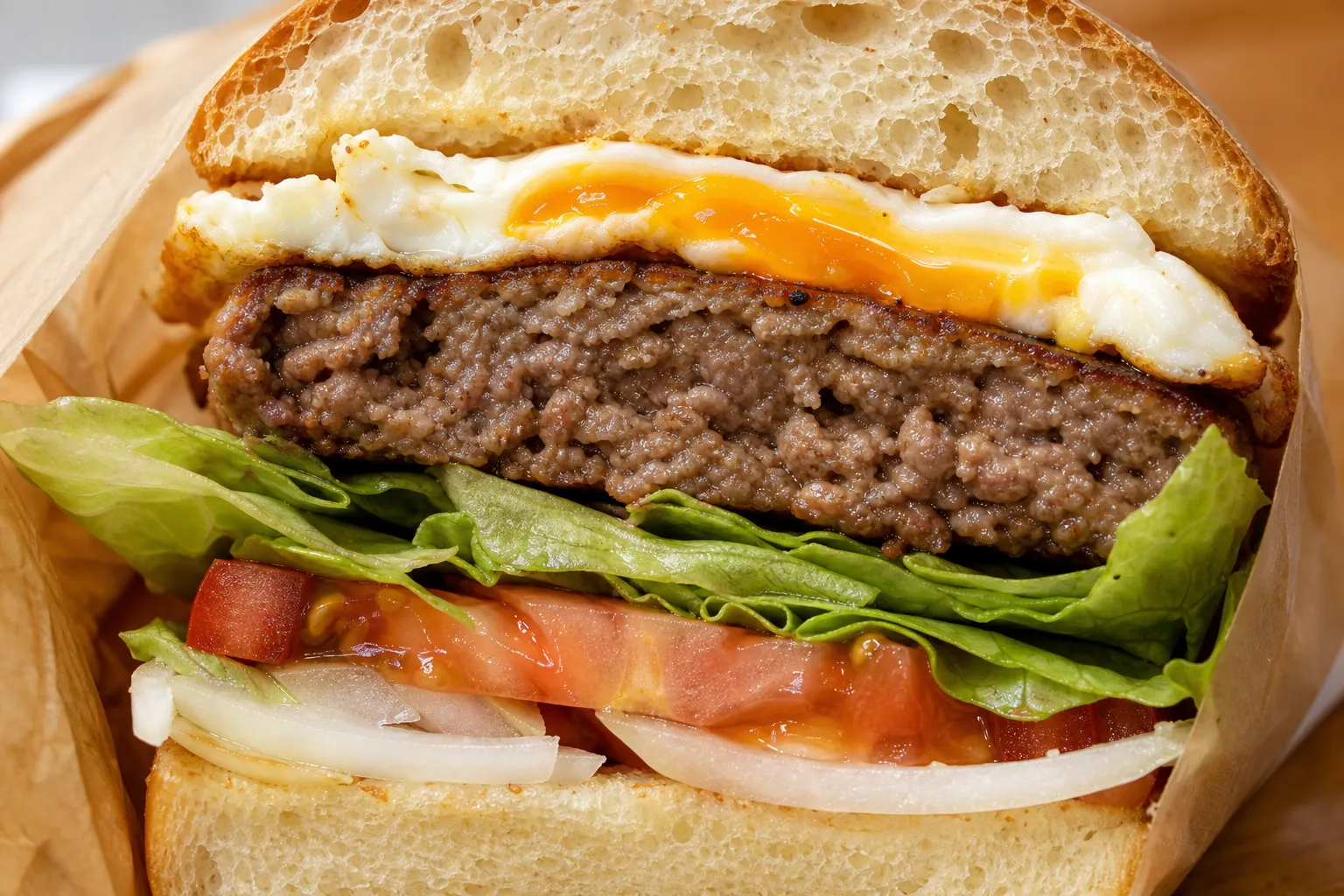
The difference is scale and honesty. The bun is soft and slightly sweet, clearly baked that morning, not trucked in. The patty is thick — like, "wait, is this actually a burger or a small steak with a bun problem" thick — and grilled fresh per order, so you sometimes wait ten minutes for it, which I now consider a feature. Then the vegetables: whole lettuce leaves, not shreds, a full disc of tomato, raw onion rings that still have some bite to them, and very often a fried egg with a yolk that's going to break the second you commit to your first bite. Which you should. Commit, I mean.
It's messy in the good way — the way that tells you nothing here was pre-portioned in a factory. Sauce runs, egg drips, lettuce escapes. I made a small noise the first time the yolk broke. No one at the table acknowledged it, which I appreciated.
How they build it
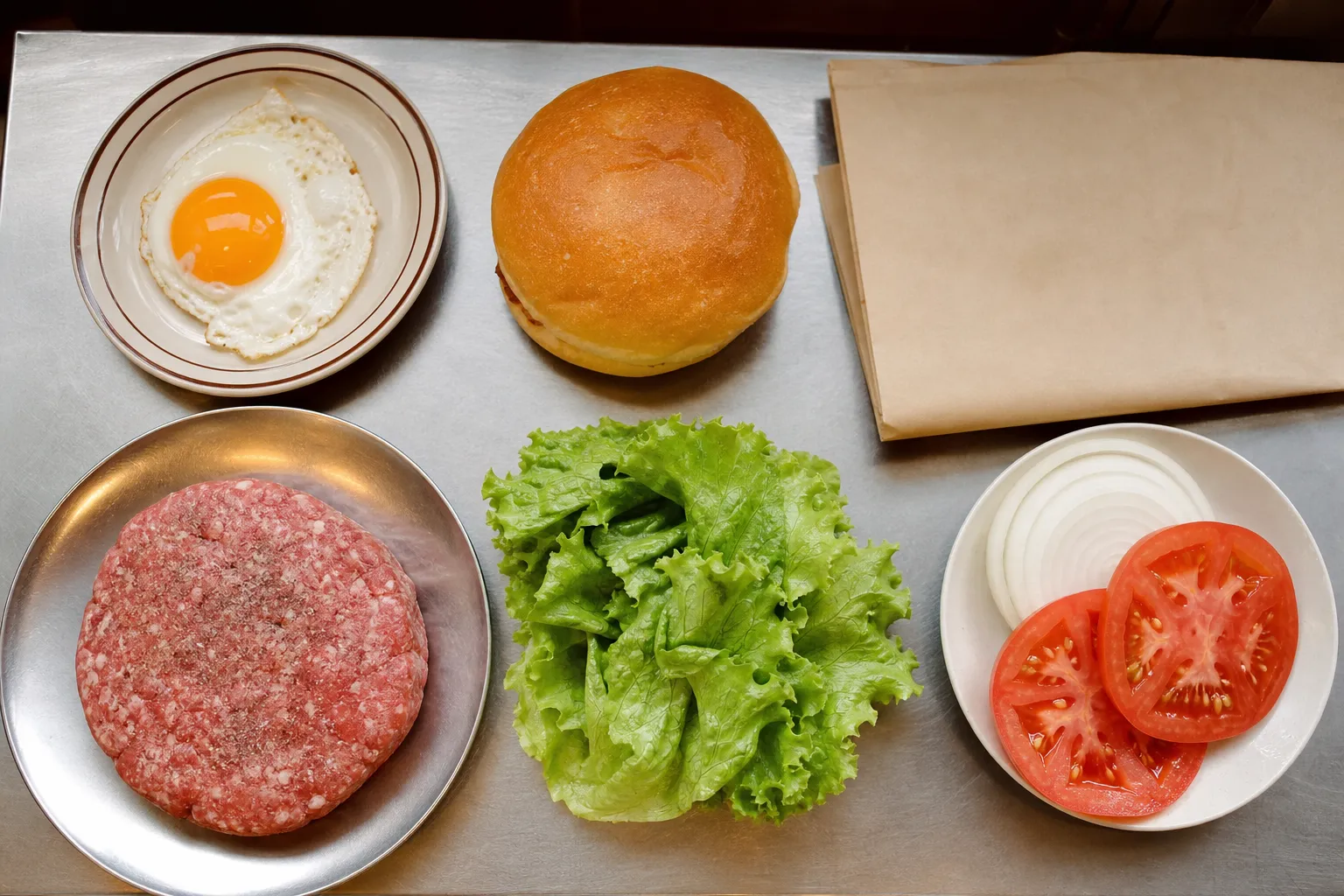
Every shop has its own order, but the basic build is roughly this:
- Toast the cut sides of a fresh, slightly sweet bun on the griddle
- Grill a thick hand-formed beef patty to order — no pre-cooking, no holding under a lamp
- Fry an egg, ideally with a yolk that's still soft
- Layer whole lettuce leaves, a thick tomato slice, raw onion, sometimes bacon, then the patty and egg
- Add sauce (often a tangy tonkatsu- or mustard-mayo-style sauce, shop-dependent)
- Wrap the whole thing tightly in paper, both to hold it together and to hand it to you warm
Step 6 matters more than it sounds like it should. That paper is doing structural work. Do not unwrap it fully before your first bite. I learned this the hard way, on a dock, in front of strangers.
Before you go — the stuff that actually matters
Your questions, answered honestly
"Is this basically just a fancy fast-food burger?" — No, and don't say that near a Sasebo local. The bun-to-chain-restaurant ratio alone tells you this is a different animal — handmade, griddled fresh, built by someone who's been doing it for decades.
"Egg or no egg?" — Get the egg. Always get the egg. If it's optional, it is not actually optional.
"How do I even hold this thing?" — Two hands, low grip near the base, lean your torso forward over the paper. Let gravity be your friend, not your enemy.
"Is it going to be a disaster to eat?" — A little, yes. That's part of the ritual. Bring napkins, lower your expectations of staying clean, and enjoy the chaos.
"Can I get it to go?" — Yes, most shops will wrap it for takeout, but it's honestly best eaten fresh and warm within a few minutes, ideally somewhere you can lean over a table.
What the staff will ask you
| You'll hear | Romaji | Meaning | Just say |
|---|---|---|---|
| たまごは入れますか? | Tamago wa iremasu ka? | "Want the egg in it?" | Hai (yes) |
| ベーコンも入れますか? | Bēkon mo iremasu ka? | "Add bacon too?" | Hai (yes) / Kekkō desu (no thanks) |
| ソースはどうしますか? | Sōsu wa dō shimasu ka? | "What sauce would you like?" | Osusume de ("recommend one for me") |
| こちらで召し上がりますか? | Kochira de meshiagarimasu ka? | "Eating here?" | Koko de (here) / Mochikaeri de (to go) |
| お会計はご一緒ですか? | Okaikei wa go-issho desu ka? | "Paying together?" | Hai / Betsu de (separately) |
To order, just say "Sasebo bāgā kudasai" (佐世保バーガーください) — "Sasebo burger, please."
Where to eat it
- Big Man (ビッグマン) — one of Sasebo's most famous original burger shops, near the harbor area.
- Log Kit (ログキット) — a longtime favorite with a loyal local following.
- Hikari (ヒカリ) — another classic Sasebo burger stop, often mentioned alongside the above two.
Hours, exact locations, and menus change, so double-check before you go — and if a shop has a line of locals outside, that's usually the right call.
Soul Score
Local Roots4/5
First-Timer Friendly5/5
Adventure Level3/5
Comfort Level5/5
Travel Worthy4/5
These scores are one obsessed eater's gut feeling — not a verdict. A low number isn't a bad mark, just a different kind of adventure.
Know someone planning Japan?
← All Articles
Local Food · Sasebo, Nagasaki
Still hungry?
Eat more from Nagasaki
Local FoodNagasaki
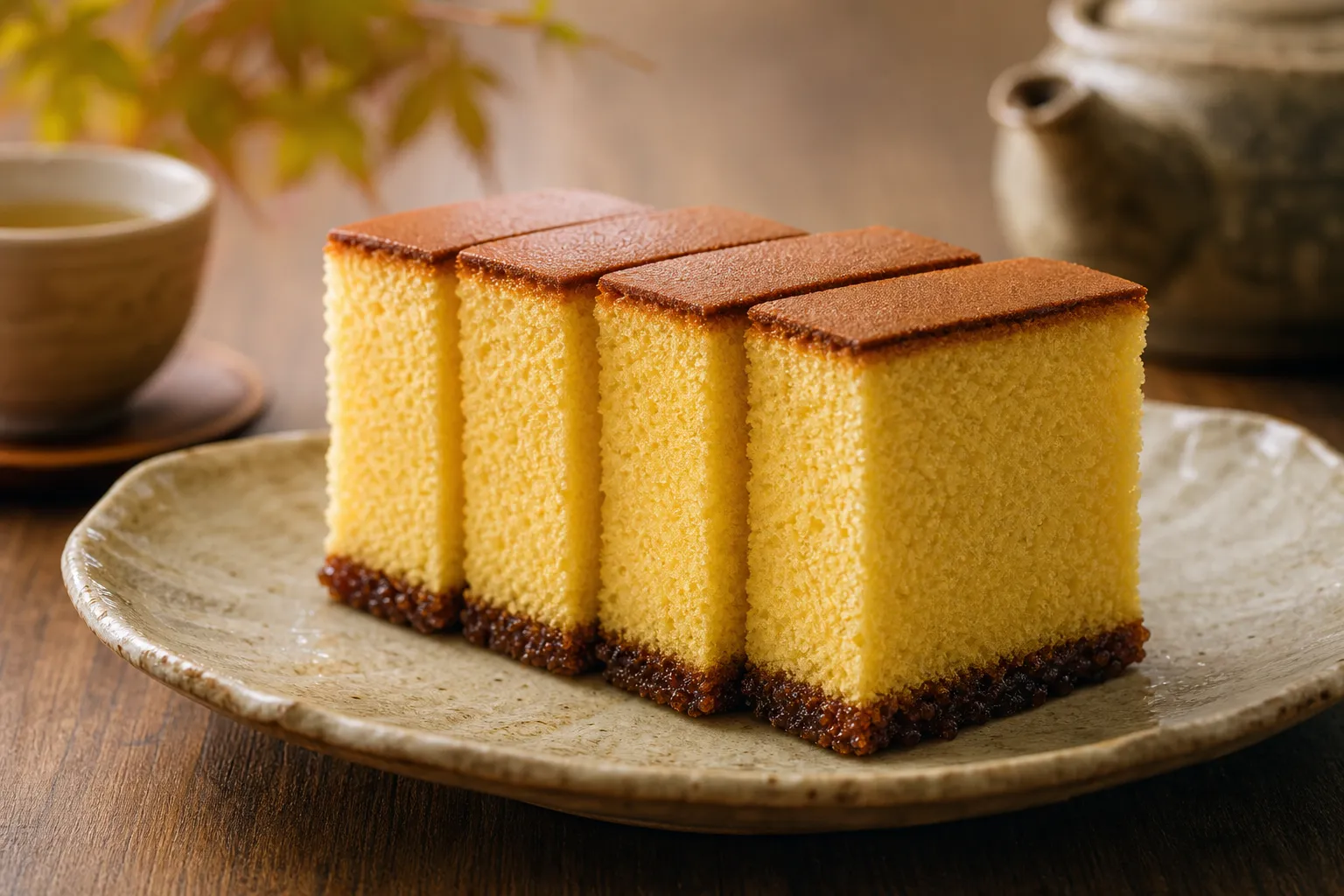
Castella (カステラ)
The moment my teeth hit the bottom crust I felt those sugar crystals crunch — and I sat there in the Nagasaki shop grinning like I'd found treasure, because in a way I had.
July 5, 2026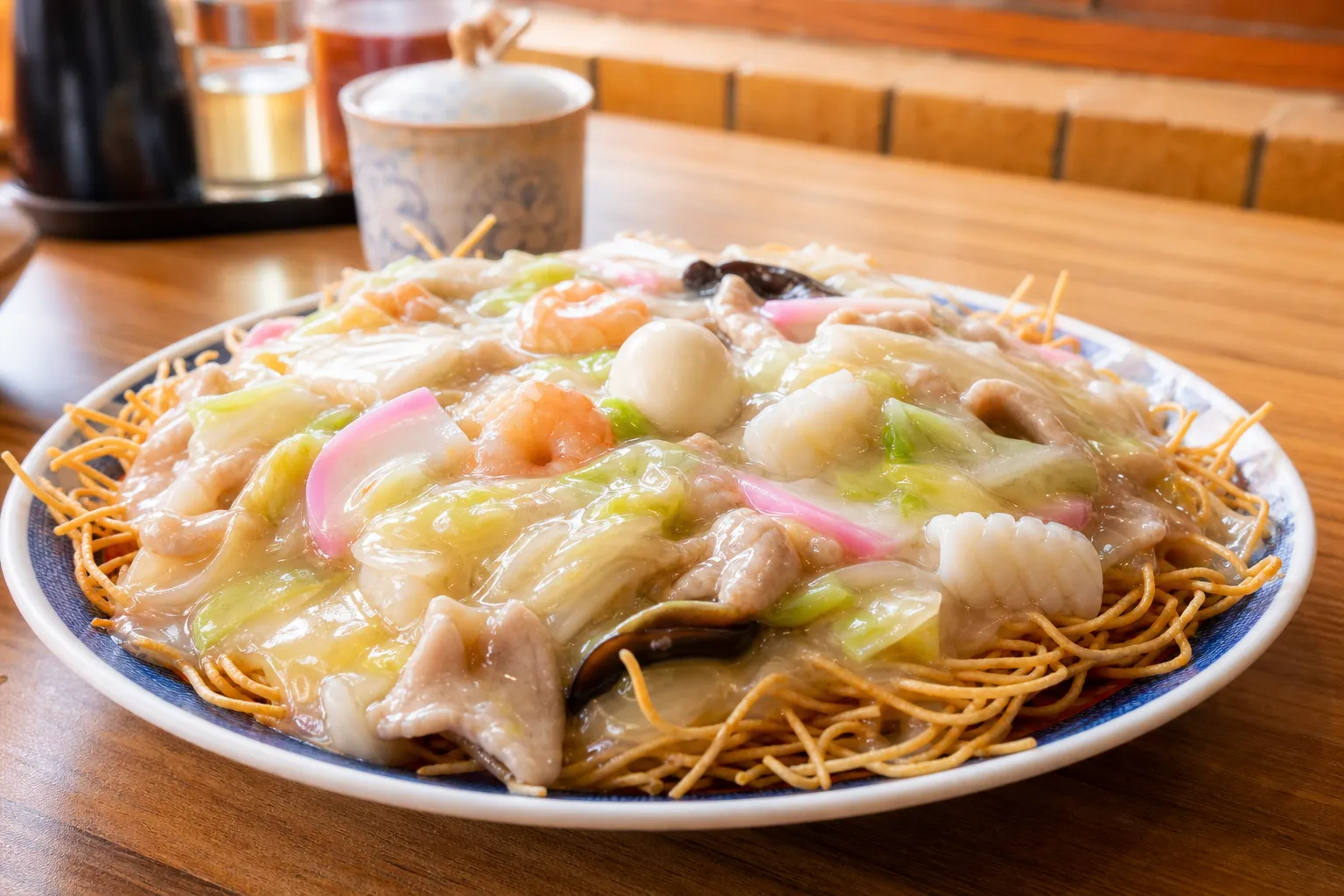
Local FoodNagasaki
Sara Udon (皿うどん)
A mountain of noodles fried until they shatter like glass, then drowned in a sauce so glossy it looks lacquered. I attacked it with chopsticks and lost the first round.
July 4, 2026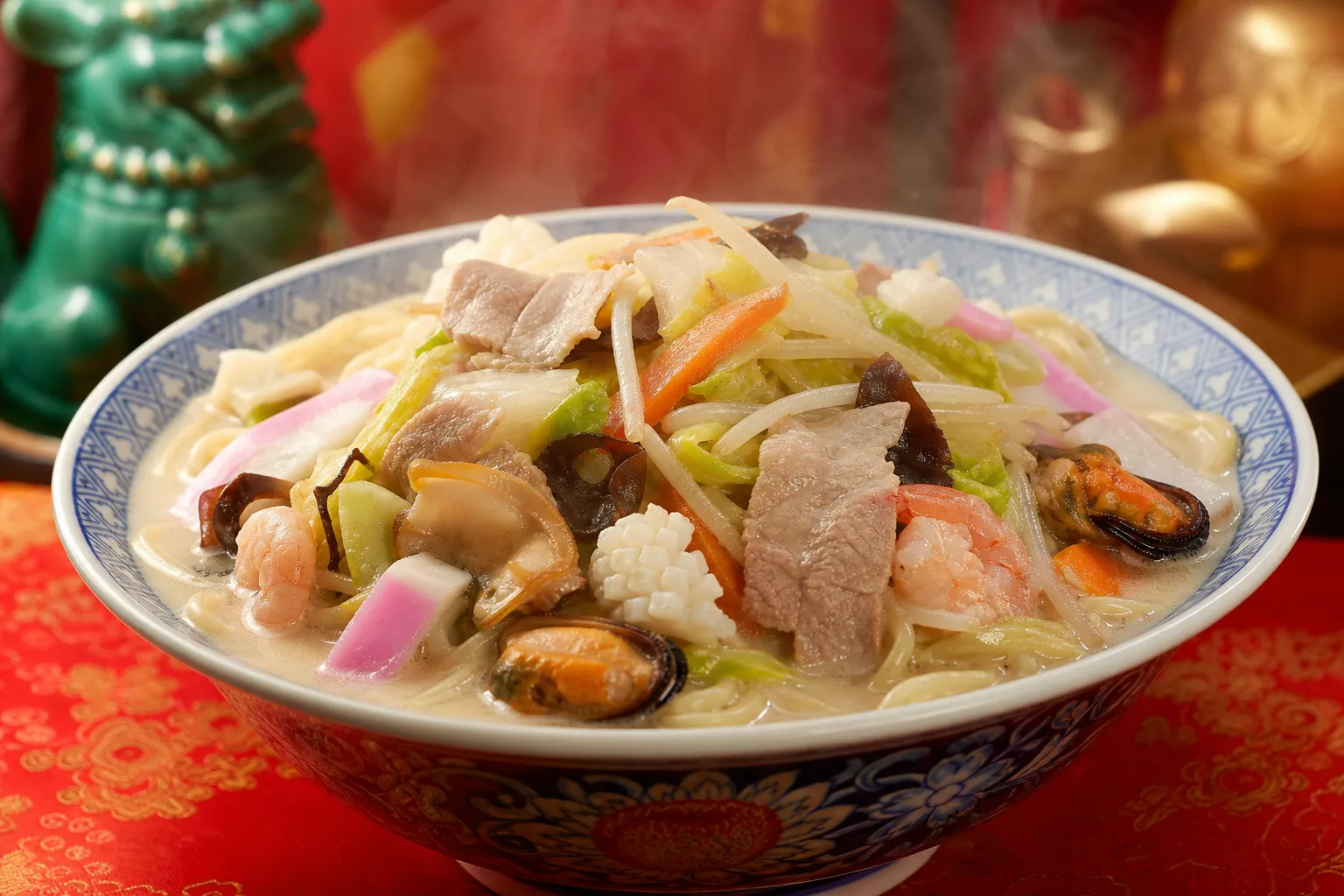
Local FoodNagasaki, Nagasaki
Nagasaki Champon (長崎ちゃんぽん)
Thick noodles in a milky pork broth buried under a stir-fried mountain of pork, squid, shrimp, cabbage, and fish cake — all cooked in one pan. Invented to feed broke students, perfected into one of Japan's great bowls.
June 26, 2026