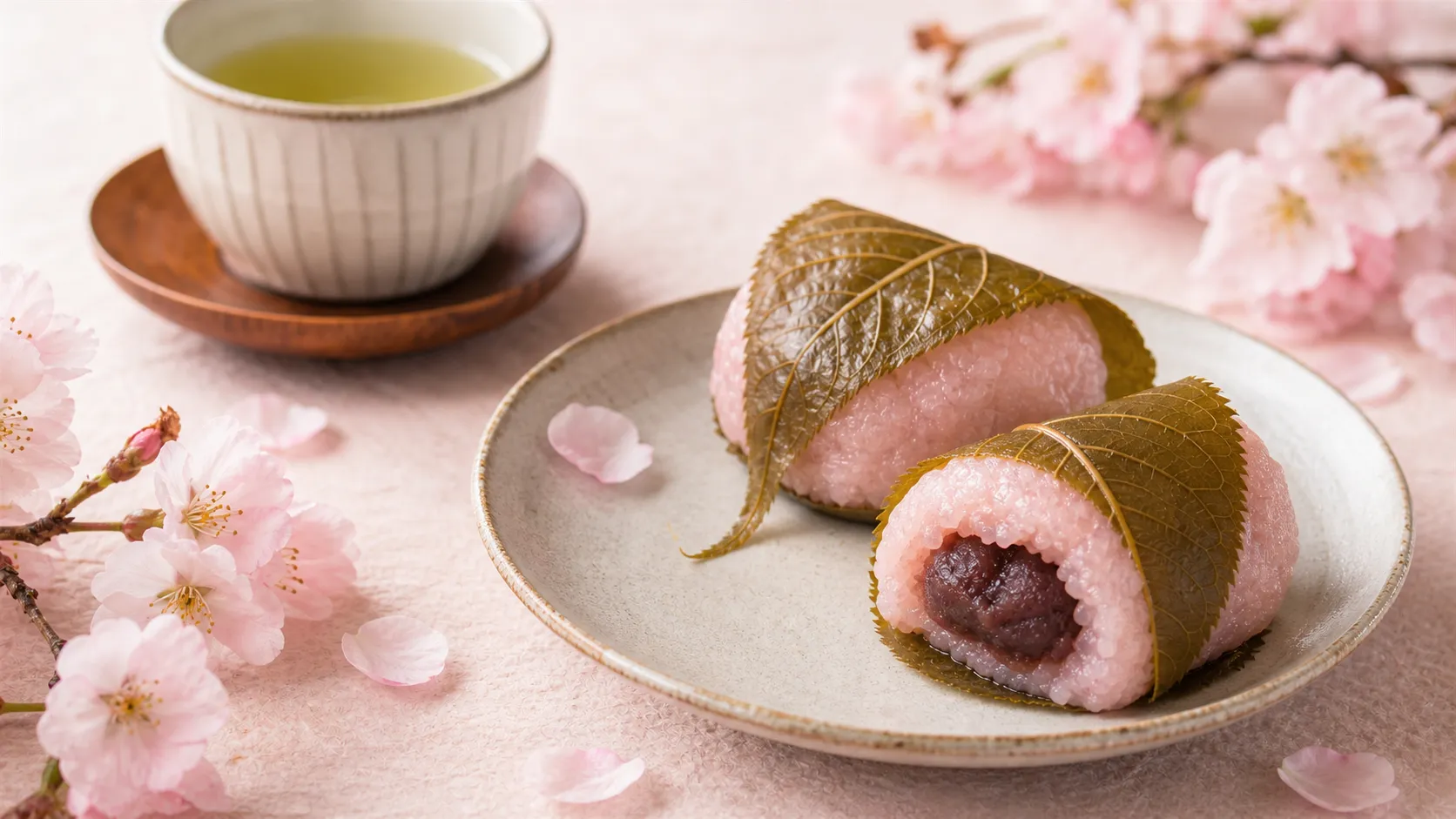
It's spring, the blossoms are out, and someone hands you a small pink cake wrapped in a leaf. You hesitate — do you eat the leaf? — and then you just go for it, whole, and it's this perfect little collision: sweet red bean, soft pink mochi, and then the leaf hits, salty and faintly floral and cherry-blossom-scented, cutting the sweetness in the most unexpectedly lovely way. And suddenly the entire feeling of a Japanese spring is happening in your mouth. That's sakura mochi, and it might be the most seasonal bite in all of Japanese sweets.
Share this dish


A pink mochi filled with sweet red bean and wrapped in a real, salted cherry-blossom leaf you're meant to eat — the taste of Japanese spring in a single, faintly floral, sweet-and-salty bite.
Here's what it is: sakura mochi (桜餅) is a pink-tinted sweet rice cake filled with red bean paste (anko) and wrapped in a salted, pickled cherry-blossom leaf (sakura leaf). The pink mochi, the anko, and — crucially — that edible salted sakura leaf are what make it sakura mochi and not a plain daifuku or a leaf-wrapped kashiwa-mochi (which uses a non-edible oak leaf). It's the sweet of Japanese spring, sold in the blossom season, and it famously comes in two completely different regional styles.
Two cities, two totally different sweets, one name
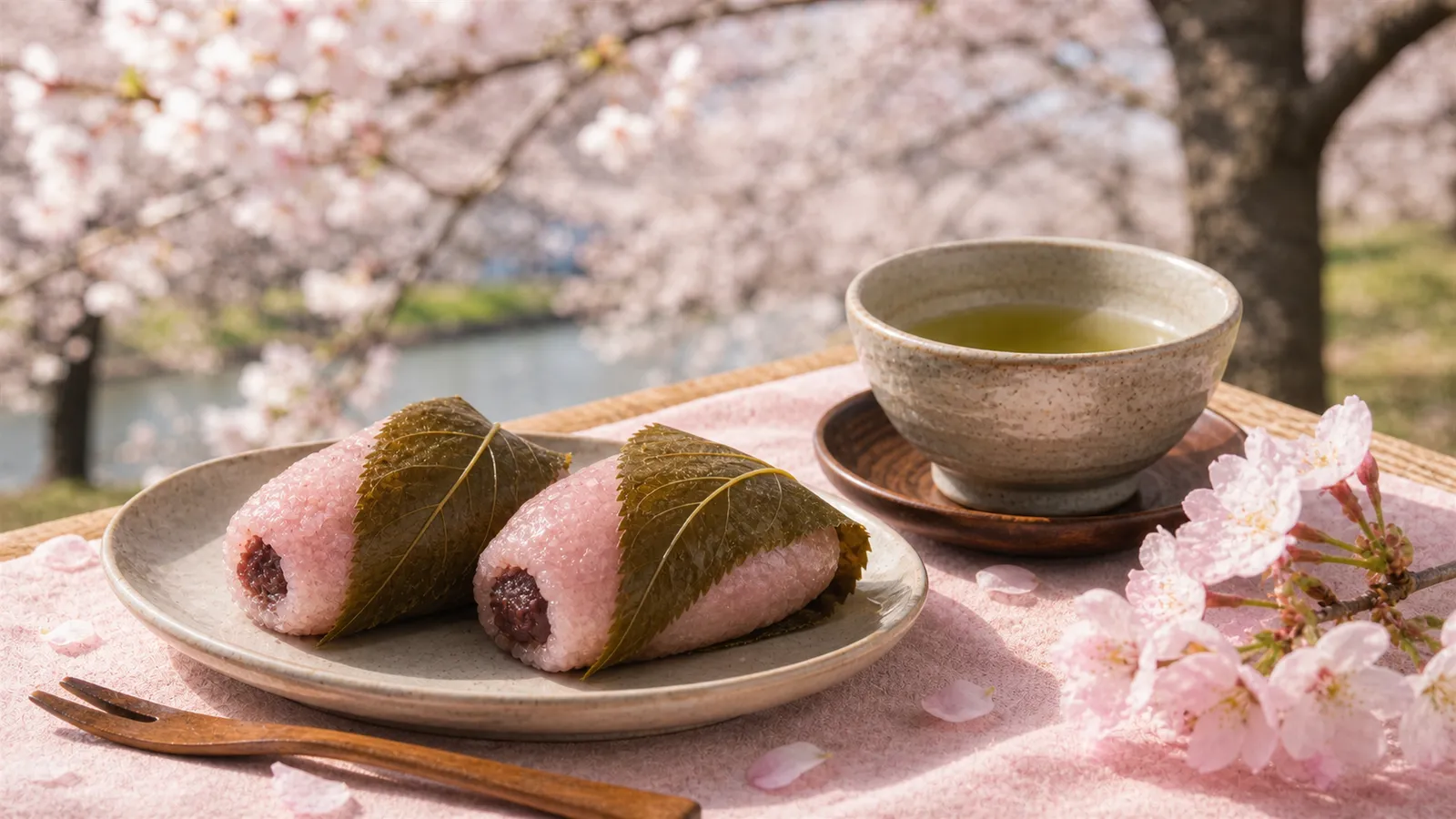
Here's the great fork in the road: Kanto-style sakura mochi (Chomeiji, from a Tokyo temple) wraps the red bean in a thin, crepe-like pink pancake of glutinous flour — smooth and flat. Kansai-style (Domyoji) uses coarse, steamed glutinous rice (domyoji flour) for a bumpy, chewy, more rice-forward dumpling around the bean. Same name, same salted leaf, same spring spirit — but bite into one in Tokyo and one in Osaka and they're visibly, texturally different sweets. It's one of Japan's most charming east–west food splits.
I find that duality wonderful — a sweet so tied to a fleeting season that two regions independently made their own version and both stuck. Sakura mochi belongs to hanami, to blossom-viewing, to the brief pink window when everyone in Japan looks up at the trees. Eating one under the blossoms, salted leaf and all, is a small seasonal ritual, and it tastes like the most beautiful, transient couple of weeks of the year. I get a little sentimental about it, honestly.
What makes the eating experience different
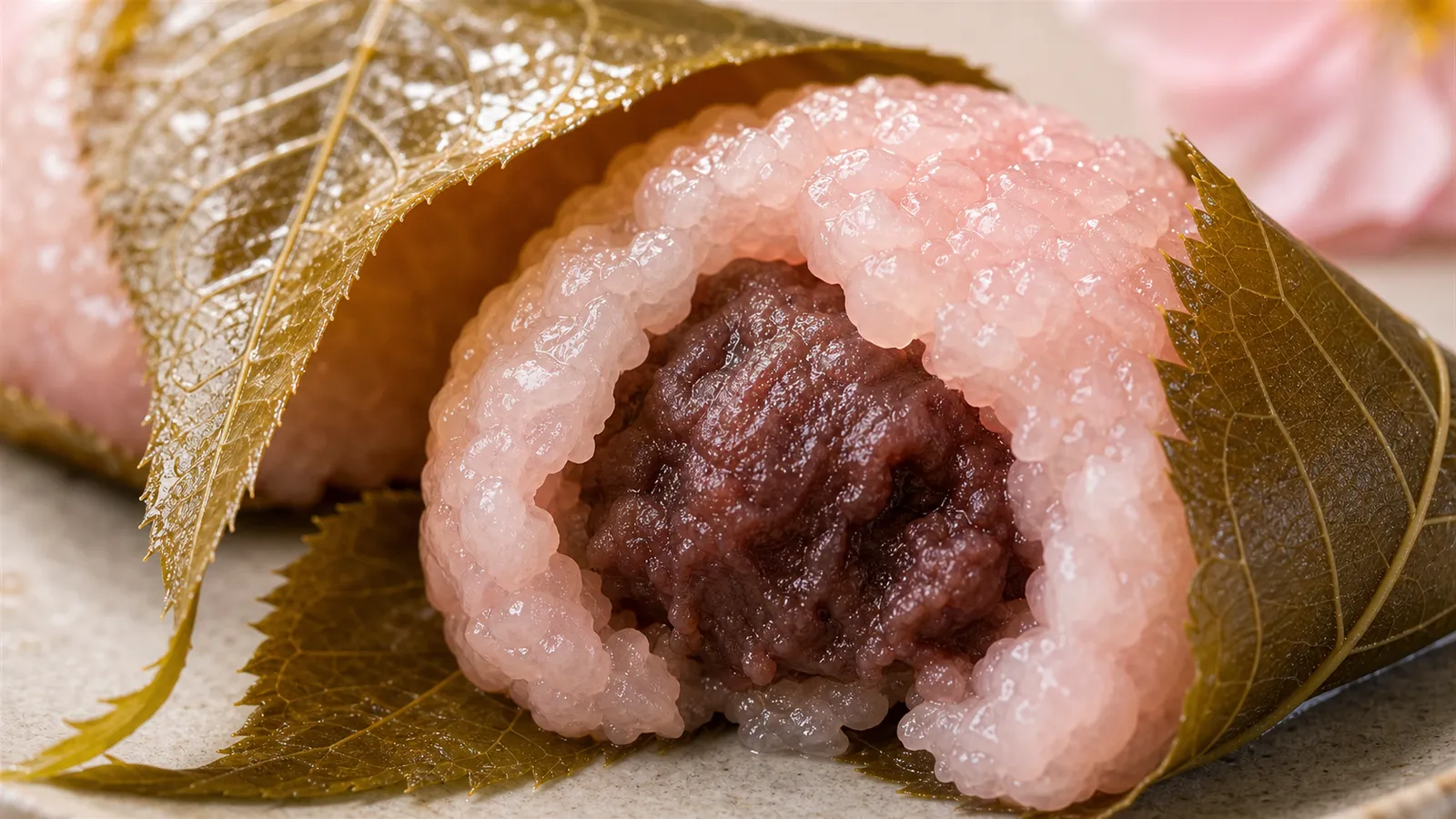
- The salted cherry leaf is the magic — floral, saline, cherry-scented, it cuts the sweetness and perfumes the whole bite in a way nothing else does
- Sweet red bean paste inside gives the mellow, rounded sweetness at the core
- The pink mochi — flat and crepe-like (Kanto) or bumpy and rice-chewy (Kansai) — gives soft, chewy body and that spring color
- The overall balance is sweet-and-salty with a floral top note — more complex and grown-up than most simple sweets
- It's utterly seasonal — eating one in blossom season, ideally outdoors, is half the pleasure
How it's made
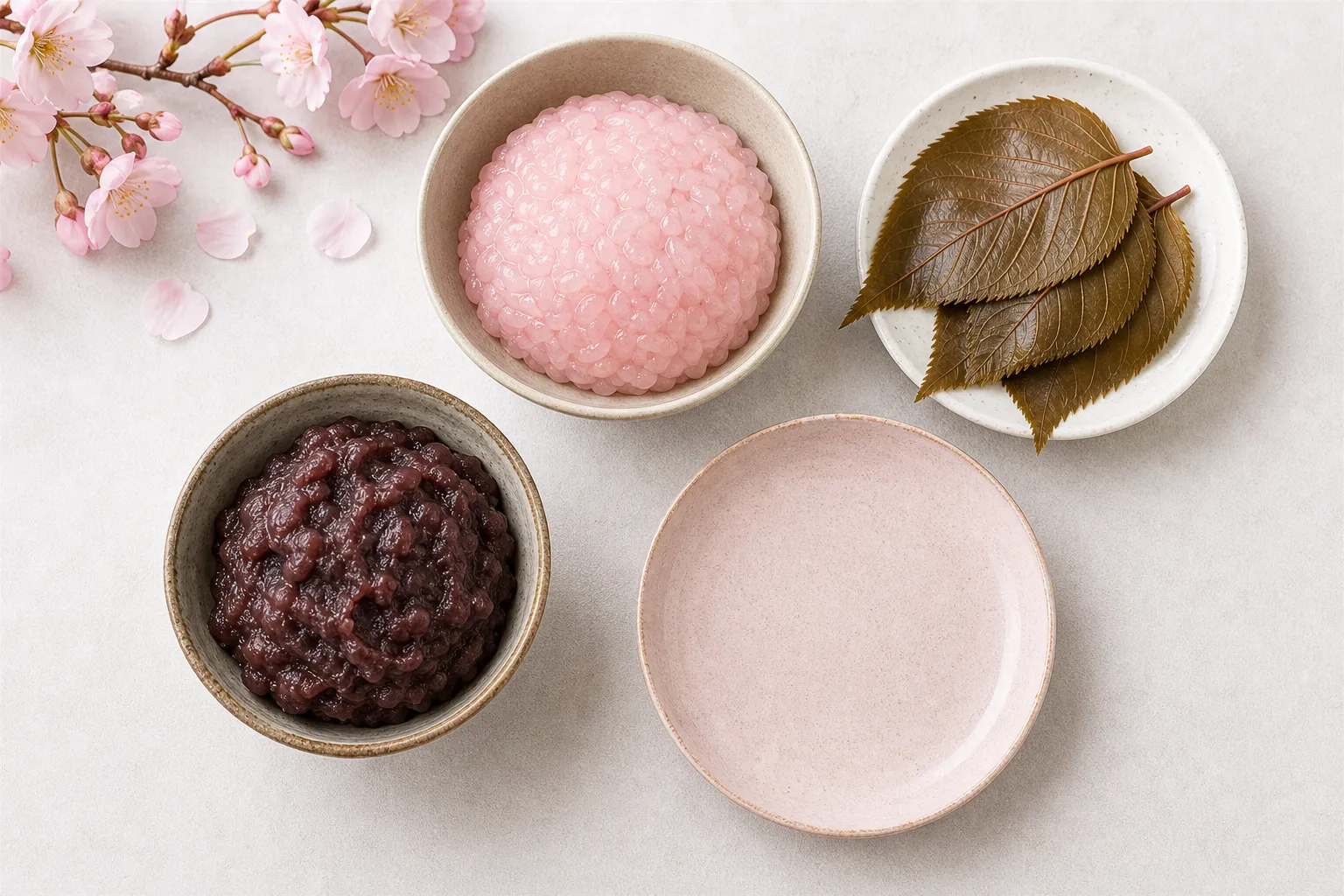
- Salt-cure the cherry leaves. Cherry-blossom leaves are pickled in salt (and sometimes plum vinegar), which gives them their edible, savory-floral character.
- Make the pink dough or rice. Kanto-style: a thin batter of glutinous flour, tinted pink, cooked into a small crepe. Kansai-style: coarse steamed glutinous rice (domyoji), tinted pink.
- Wrap the red bean. Sweet red bean paste is enclosed in the pink crepe or rice.
- Wrap in the leaf. Each cake is wrapped in a salted cherry leaf, which flavors and scents the mochi.
- Serve. Eaten as is — leaf on or off, your call (see below). Best in spring, with tea.
The salted leaf is the quiet genius of the whole thing — it's not just decoration, it's a seasoning, turning a simple bean-and-mochi sweet into something floral, savory-edged and unmistakably spring.
Before you go — do you eat the leaf?
Your questions, answered honestly
"Do I eat the leaf or not?" — This is the great sakura mochi debate, and there's no wrong answer. The leaf is salted and edible, and eating it whole gives you that signature sweet-salty-floral hit — that's how I do it. Others peel it off and enjoy just the scent it left behind, especially if they find it too salty or fibrous. Try it on the first time; you can always peel the second.
"Why does it taste salty and floral?" — That's the pickled cherry leaf doing its work. It's cured in salt, which gives the whole sweet a saline edge and a distinctive cherry-blossom aroma. That sweet-salty-floral combination is the entire personality of sakura mochi.
"Kanto or Kansai style — what's the difference?" — Kanto (Chomeiji): the bean is wrapped in a smooth, thin, crepe-like pink pancake. Kansai (Domyoji): the bean is wrapped in bumpy, chewy, coarse steamed rice. Both are 'sakura mochi.' If you can, try both and pick your side — it's a fun regional comparison.
"When can I get it?" — Mainly spring, around cherry-blossom season, which is when wagashi shops and supermarkets stock it. Some places sell it more widely, but it's fundamentally a seasonal sweet — part of why it feels special.
What the staff will ask you
| You'll hear | Romaji | Meaning | Just say |
|---|---|---|---|
| 何個にしますか? | Nan-ko ni shimasu ka? | "How many?" | Hitotsu kudasai (one, please) |
| 関東風と関西風、どちらにしますか? | Kantō-fū to Kansai-fū, dochira ni shimasu ka? | "Kanto or Kansai style?" | Osusume de (your recommendation) |
| 葉は付けたままでよろしいですか? | Ha wa tsuketa mama de yoroshii desu ka? | "Leave the leaf on?" | Hai, onegaishimasu (yes, please) |
To order, just say "Sakura mochi o kudasai" (桜餅をください) — "Sakura mochi, please."
Where to eat it
- Wagashi (traditional sweet) shops nationwide, in spring — the classic source; the best shops make beautiful seasonal sakura mochi during blossom season.
- Under the cherry blossoms at hanami — buying one to eat while blossom-viewing is the ideal, most seasonal way to enjoy it.
- Supermarkets and department-store sweet counters — reliable spring stock, often offering both Kanto and Kansai styles so you can compare.
Sakura mochi is a spring-seasonal sweet with two regional styles; availability, style and prices vary by shop and season — look for it in cherry-blossom season.
Soul Score
Local Roots5/5
First-Timer Friendly4/5
Adventure Level3/5
Comfort Level4/5
Travel Worthy3/5
These scores are one obsessed eater's gut feeling — not a verdict. A low number isn't a bad mark, just a different kind of adventure.
Know someone planning Japan?
← All Articles
Sweets & Snacks · Nationwide
Still hungry?
You might also like
Sweets & SnacksSaga
Maruboro (丸ぼうろ)
It looks like the most boring biscuit in Japan. Then you bite it and it's soft, and honey-warm, and about four hundred years of Portuguese sailors arrive all at once.
September 2, 2026
Sweets & SnacksYamanashi
Shingen Mochi (信玄餅)
There is a correct way to eat this and I did not know it, so I made a mess in front of several Yamanashi locals who were extremely kind about it and absolutely watching.
September 2, 2026
Sweets & SnacksTokyo
Anpan (あんパン)
A soft little bun, one bite in, and suddenly it's dense, dark, sweet red bean all the way through — the bread that talked 1870s Japan into eating Western-style bread at all.
July 27, 2026