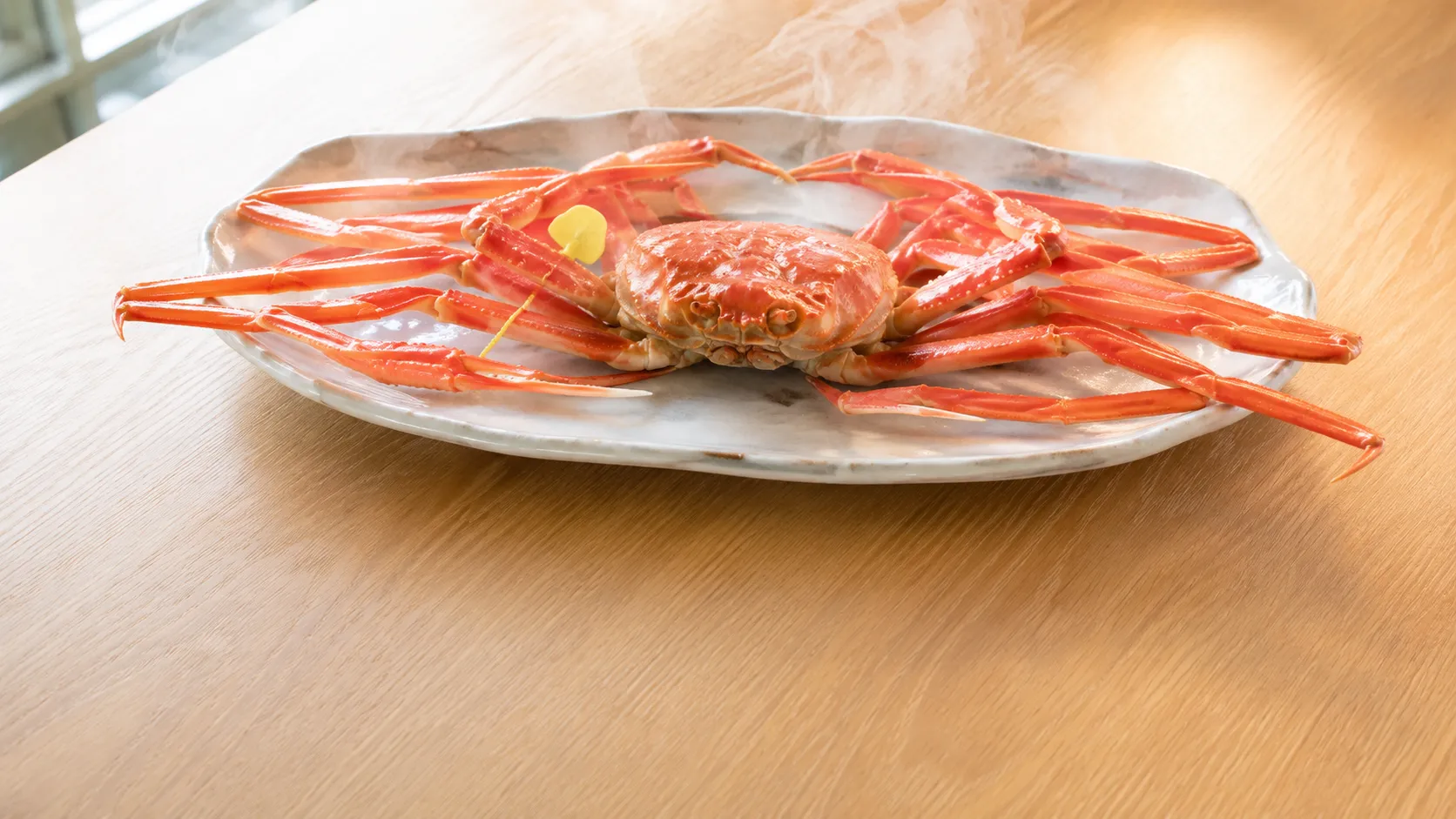
There was a small plastic tag clipped around one of its legs. Like a name badge. On a crab.
Share this dish


There's a small plastic tag clipped to the crab's leg like a name badge, and once someone explains what it means you will never look at a crab the same way again.
🍜 Planning a food trip to Tottori?Add this dish to my Food Trip →
 Add this dish to my Food Trip →
I pointed at it, in the way you point at something when you've run out of Japanese, and the man behind the counter picked the whole crab up and turned it so I could see the tag properly and started talking with the specific energy of someone who has been waiting all morning for somebody to ask. Which port. Which day. Which boat. The tag is a passport — it says this animal is a male snow crab, landed here, in season, above the size line, and it is therefore permitted to be called by this name.
And I stood in the cold at a market in Sakaiminato in November realising that I was, technically, looking at a certified document with legs.
Then I ate one and stopped caring about paperwork entirely. Sweet — properly sweet, in a way that made me suspicious there was sugar involved — with dense fibrous meat that pulled out of the shell in one long piece, and a richness in the body cavity that I was not remotely prepared for.
Matsuba-gani is the San'in coast's name for a male snow crab caught in its own waters during a tightly regulated winter season. Same species as crab landed elsewhere in Japan under different regional names — but here, in Tottori, it is not far off a civic religion.
A crab with a name, a season, and a lot of rules
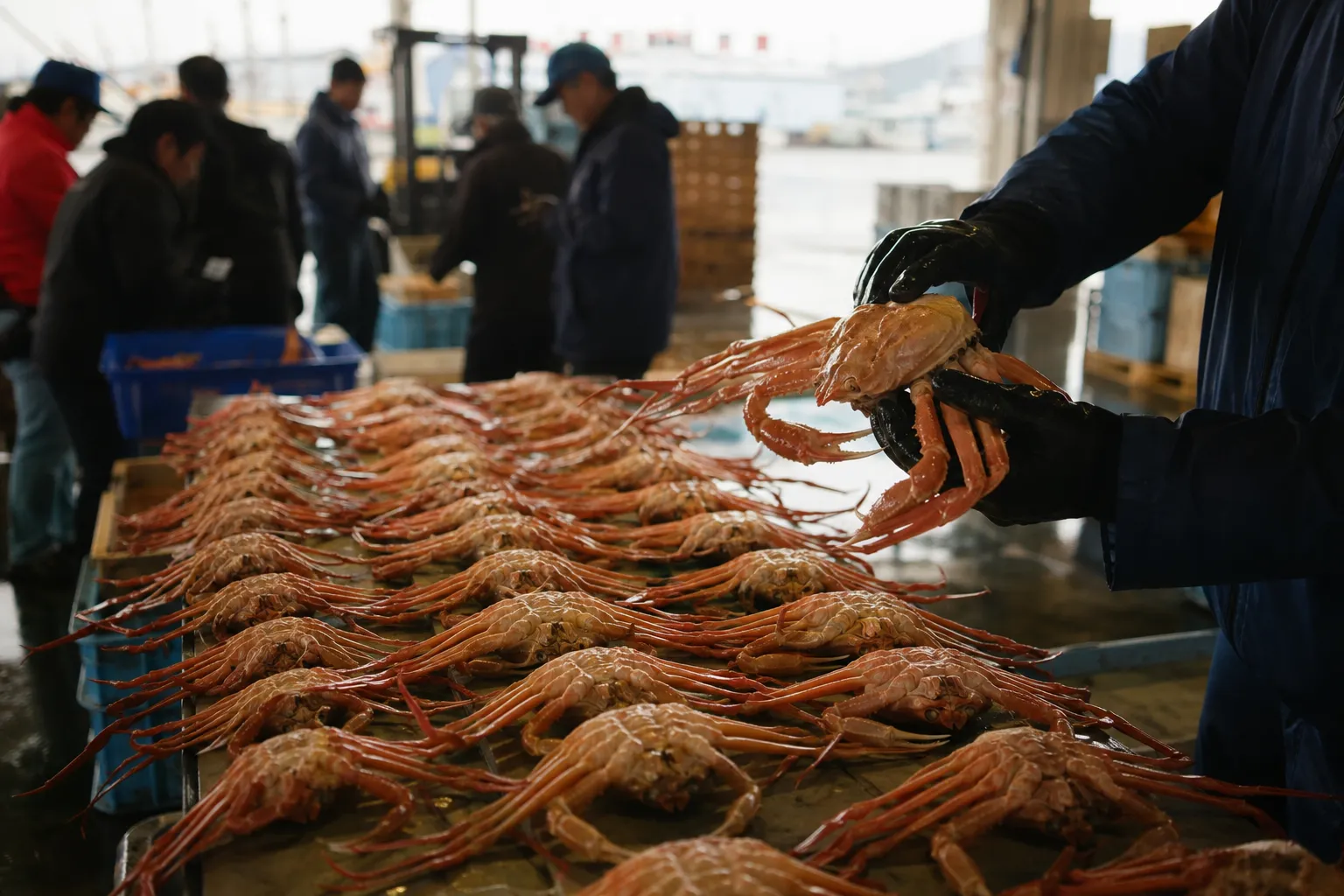
Snow crab lives in cold deep water off the San'in coast, and Tottori has been pulling it up for a very long time. What makes the modern version interesting is how hard the rules bite.
The season is fixed — it opens in early November and closes in March, and outside those dates you cannot buy a fresh local one, full stop. The males and the females are separate categories with separate, shorter seasons and separate names; the smaller egg-carrying female, sold as seko-gani, has a season that shuts before the end of December. There are size limits. There are catch quotas. And that leg tag ties an individual crab back to the boat and port that landed it.
Tottori has taken this further than anyone. The prefecture grades its very best crabs into a top-tier brand, and the first one auctioned each season goes for numbers that make national news — figures in the millions of yen for a single crab, bid up by restaurants who want the story as much as the meat. Sakaiminato is regularly Japan's biggest crab landing port. This is a small prefecture — the least populous in Japan — and this is what it is famous for, and it knows it.
I love that a place with no big city and no bullet train decided that its identity would be an animal that's only available for four months a year. That is a genuinely nervy way to build a regional economy, and it worked.
Why winter crab tastes different
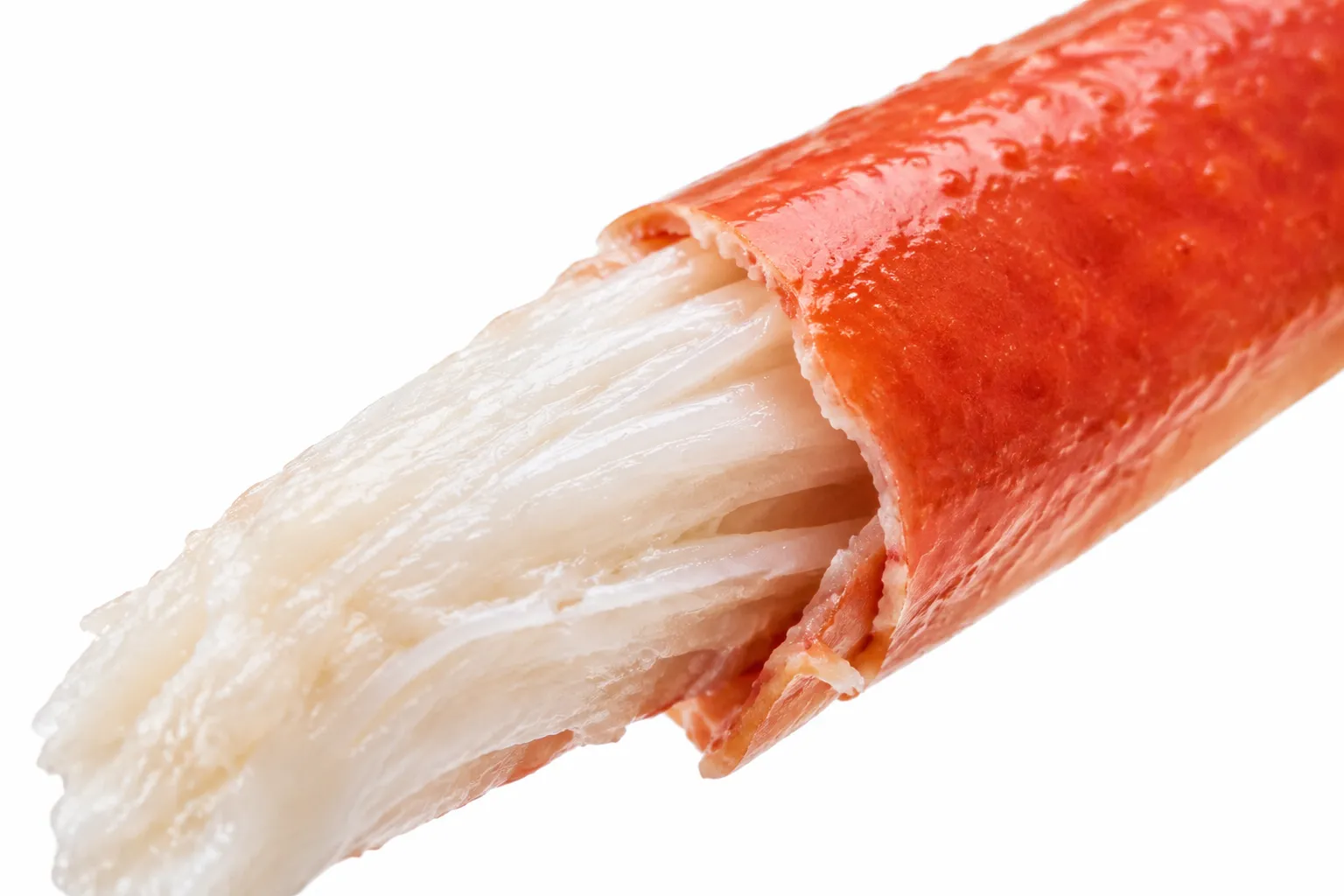
Cold water is the short answer. Snow crab in deep winter water is dense and sweet in a way that isn't marketing — the meat has a clean, almost sugary finish and a fine fibrous structure that separates into threads rather than flaking.
The legs are the famous part and the easy part: crack, pull, eat, repeat, in a silence that descends over a table of people who were talking a minute ago. Boiled is the purest version. Grilled over charcoal is my favourite — the surface caramelises slightly and the sweetness concentrates. Sashimi, if the crab is fresh enough off the boat to allow it, is translucent and faintly sticky and tastes like the sea in a way cooked crab doesn't.
Then there's the body. Inside the shell is the kani-miso — the crab's hepatopancreas, khaki-green, custardy, and staggeringly rich. This is the part that divides people down the middle, and I'm firmly on the side that says it's the best thing in there. Mix a little leg meat into it and eat it straight from the shell. If you want the full local move, pour a splash of hot sake into the empty shell after, swirl it, and drink it.
The sweetness, the richness, the fact it's cold outside and you're inside working through a crab with your hands and a small metal pick — the whole thing is an event, not a meal.
How it comes together
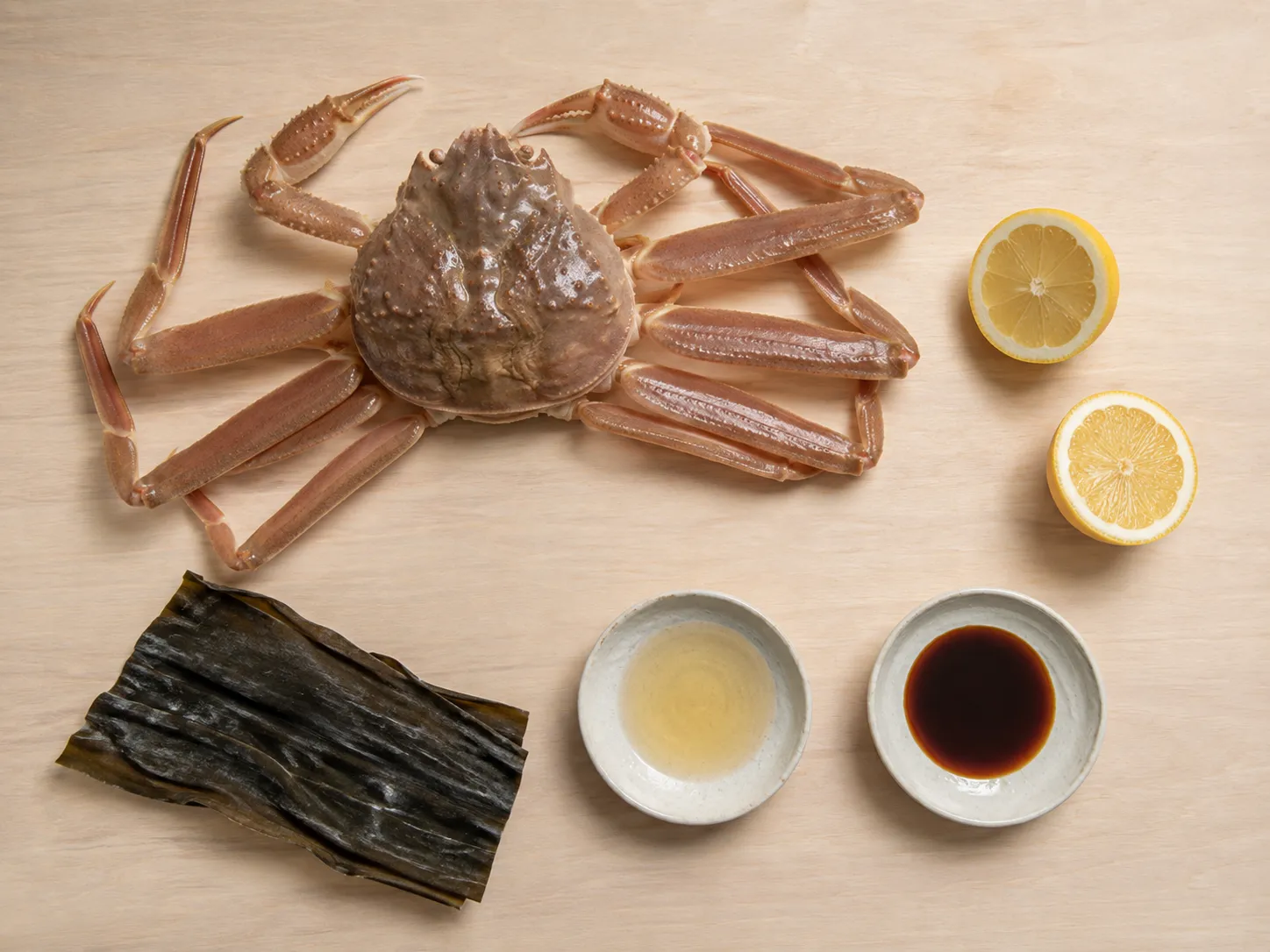
- Crabs are landed at port and immediately graded by size, shell condition and meat fullness, then tagged
- Boil in heavily salted water — enough salt that it approximates seawater — for a set time based on size, then cool
- Or grill: split the crab, lay the legs and body over charcoal, and cook until the shell colours and the meat firms
- Crack the shell along the soft underside of each leg with scissors or a shell cutter rather than smashing it, so the meat comes out whole
- Serve simply — a wedge of citrus at most, and the body shell set aside for the miso and, later, the hot sake
Step 2 is where restaurants earn their reputation. Overboil a snow crab by even a couple of minutes and the delicate meat turns watery and loses the sweetness that justified the price. There's very little to hide behind here — this is an ingredient dish, and the cooking is mostly a matter of not ruining it.
Before you go — the stuff that actually matters
Your questions, answered honestly
"When exactly can I eat it?" — Roughly early November through March, with the female seko-gani season closing much earlier, around the end of December. Outside the season you'll find frozen and imported crab, which is fine but is not this. If you're planning a trip around it, plan it for winter or plan something else.
"Is it as expensive as people say?" — A whole graded matsuba-gani is a genuine splurge — often ¥10,000 to ¥30,000 and considerably more for top-brand specimens. But you have cheaper doors in: a crab rice bowl at a port market runs a fraction of that, and wakamatsuba — young, soft-shelled crab caught just after moulting — is far cheaper and honestly delicious.
"What's the difference from king crab?" — Completely different animal. King crab has thick, spiky, dramatic legs and a meatier, blander flavour. Snow crab has long slender legs and much sweeter, finer meat. If you've had king crab and found it underwhelming, don't extend that judgement to this.
"Do I have to eat the green stuff?" — No, and plenty of visitors don't. But I'd ask you to try one small spoonful before deciding. It's rich, savoury, faintly bitter, and it's the reason locals fight over the body rather than the legs.
"Will I make a mess?" — Yes. Restaurants know this and will give you a wet towel, a bib, and a pick, and nobody expects elegance. This is one of the few meals in Japan where the correct approach is to give up on dignity early.
"Is Sakaiminato worth visiting beyond the crab?" — Genuinely, yes. It's the hometown of the manga artist behind GeGeGe no Kitaro, and the main street is lined with bronze yokai statues, which is a wonderfully strange thing to walk through before eating a very expensive crab.
What the staff will ask you
| You'll hear | Romaji | Meaning | Just say |
|---|---|---|---|
| 茹でと焼き、どちらにしますか? | Yude to yaki, dochira ni shimasu ka? | "Boiled or grilled?" | Yaki de (grilled, please) |
| カニ味噌は召し上がりますか? | Kani-miso wa meshiagarimasu ka? | "Will you eat the crab miso?" | Hai, tabemasu (yes, I will) |
| 甲羅酒はいかがですか? | Kōra-zake wa ikaga desu ka? | "Sake in the shell afterwards?" | Onegaishimasu (yes, please) |
| こちらのタグをご覧ください | Kochira no tagu o goran kudasai | "Please look at this tag" | Sugoi desu ne (that's impressive) |
| 前掛けをお使いください | Maekake o o-tsukai kudasai | "Please use the bib" | Arigatō gozaimasu (thank you) |
To order, just say "Matsuba-gani kudasai" (松葉ガニください) — "Matsuba crab, please."
Where to eat it
- Sakaiminato port and its market area — Japan's leading crab landing port, with market stalls, crab bowls, and restaurants working directly off the boats. The best value in the prefecture, and the most atmosphere.
- Karo port and the market area near Tottori city — closer to Tottori Station and the sand dunes, with seafood restaurants and a fish market selling crab in season.
- Coastal inns (ryokan) along the Tottori coast, including the Iwami and Kaike areas — where the full winter crab course is served as part of an overnight stay, which is how most Japanese travellers do it.
Winter crab courses at inns book out well ahead, market opening hours are early and short, and rough winter seas can stop the boats going out entirely — reserve early and keep the trip flexible.
Soul Score
Local Roots5/5
First-Timer Friendly4/5
Adventure Level3/5
Comfort Level5/5
Travel Worthy5/5
These scores are one obsessed eater's gut feeling — not a verdict. A low number isn't a bad mark, just a different kind of adventure.
Know someone planning Japan?
← All Articles
Local Food · Sakaiminato, Tottori
Still hungry?
Eat more from Tottori
Local FoodTottori
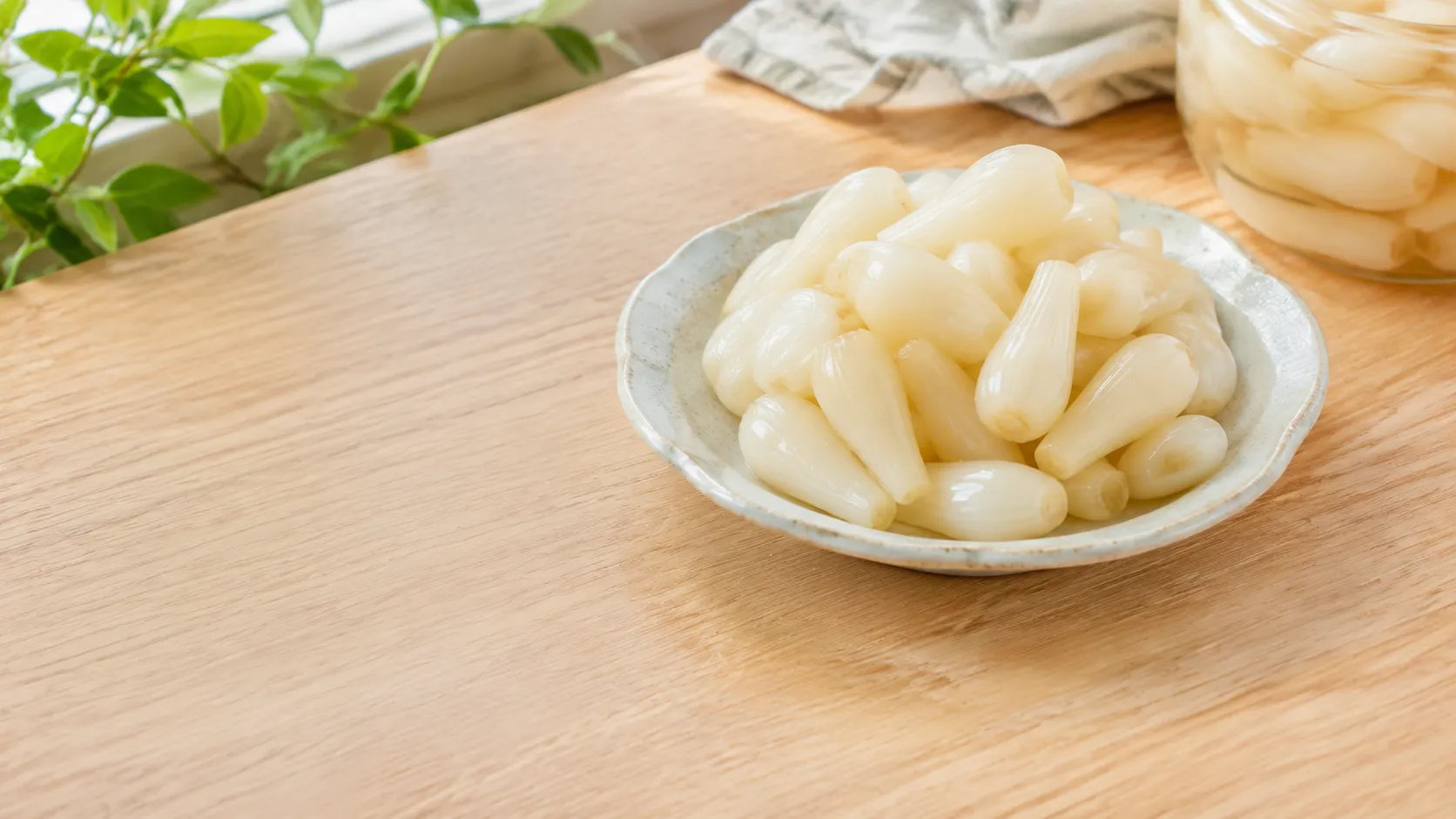
Rakkyo (砂丘らっきょう)
The crunch is so loud I actually stopped talking mid-sentence. Then I ate five more and understood why they sit next to curry in every restaurant in Japan.
September 2, 2026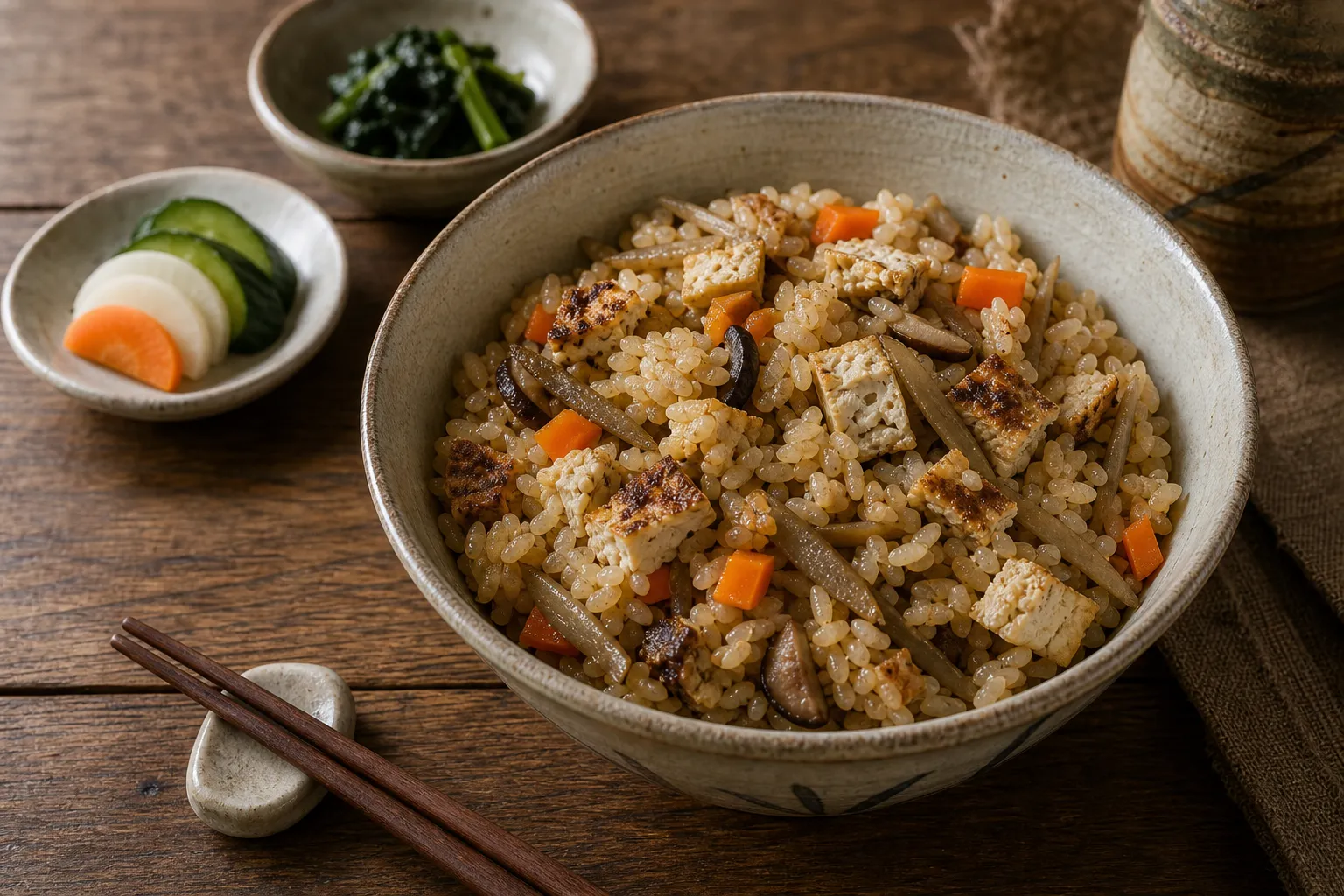
Local FoodTottori
Dondoroke-meshi (どんどろけ飯)
Rice named after thunder — because the tofu crackles like a storm when it hits the hot pan. Crumbled grilled tofu, carrot and burdock cooked right into the rice: humble Tottori country food with the best name in Japan.
July 12, 2026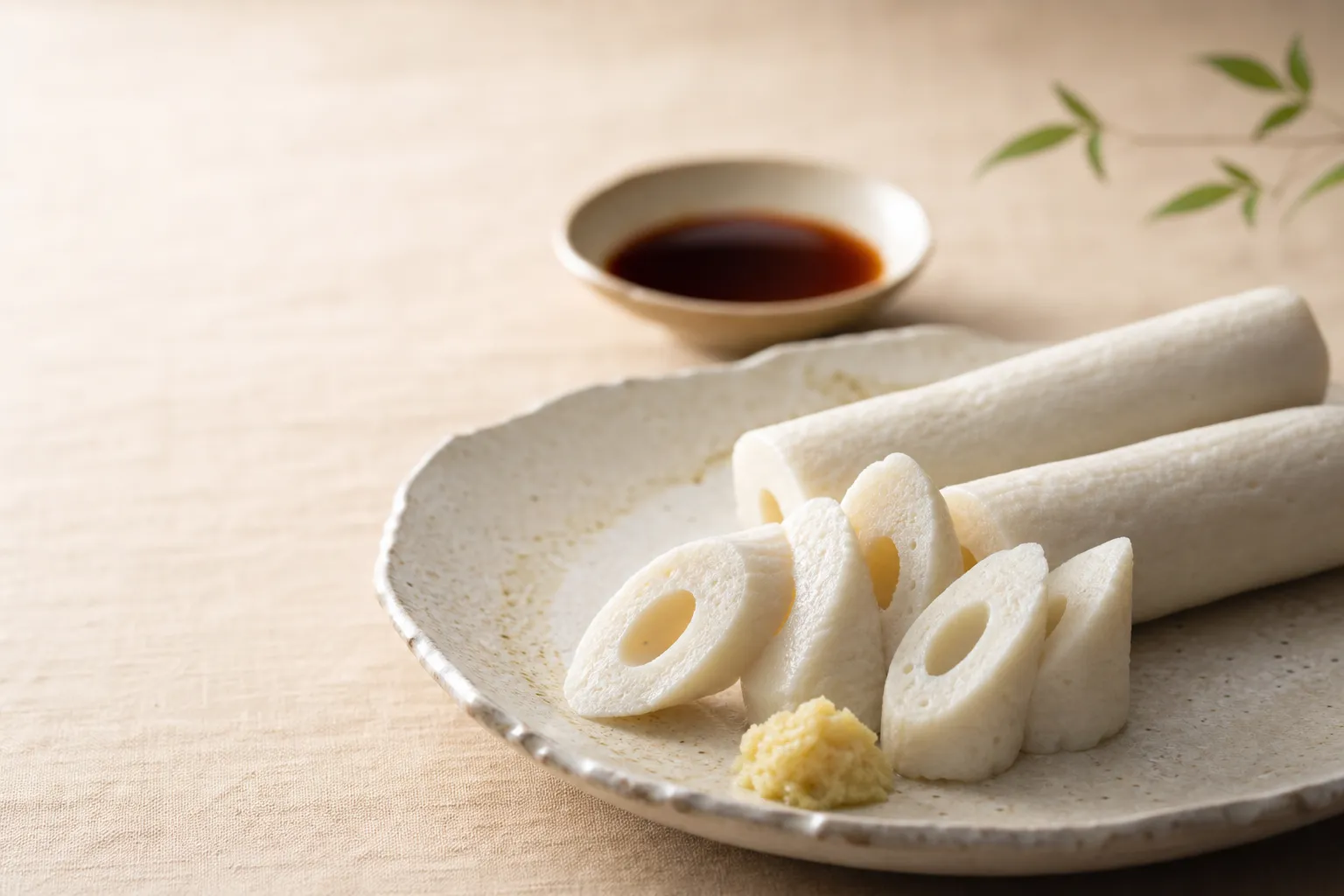
Local FoodTottori
Tofu Chikuwa (豆腐ちくわ)
Half tofu, half fish paste, and lighter than either one has any right to be — Tottori took a chewy snack tube and made it pillowy, and I'm still thinking about it.
July 5, 2026