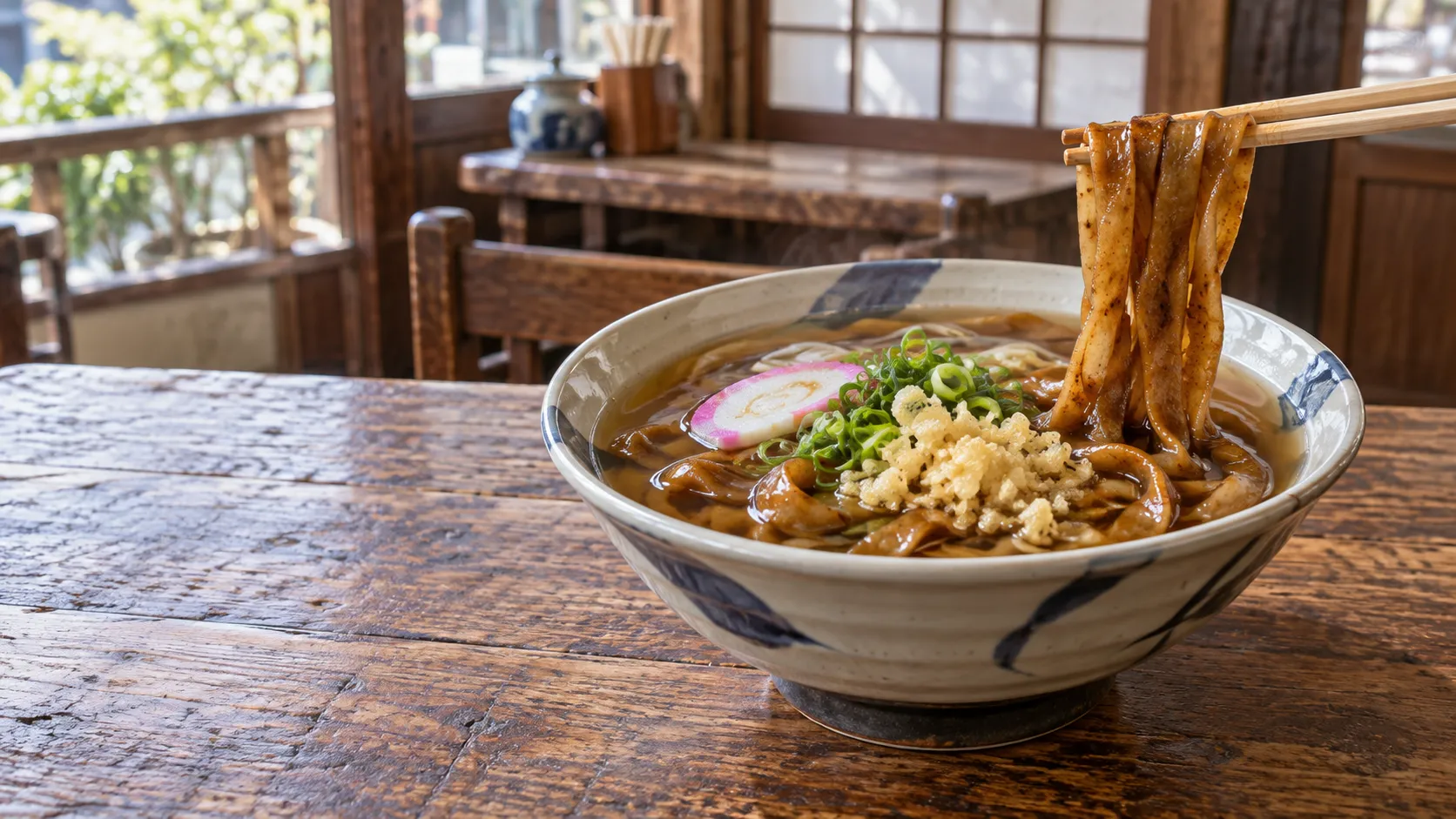
The bowl arrived and I genuinely thought something had gone wrong in the kitchen.
Share this dish


Somebody in Kuroishi looked at a plate of fried noodles and thought: what this needs is soup. They were wrong about that. They were also completely right.
Would you try this dish?
Rate how much you would like to try it.
🍜 Build your Aomori food trip around Kuroishi Tsuyu Yakisoba.Add to Food Planner →
 Add to Food Planner →
Yakisoba. In soup. Fried noodles — sauce-brown, unmistakably yakisoba — sitting in a clear hot broth with a piece of fish cake and some spring onion floating on top, like two different lunches had collided on the way out of the kitchen and nobody had stopped them.
I looked around. Everyone else was eating theirs without comment. So I picked up the chopsticks, lifted a tangle of noodles out of the broth, and discovered that Kuroishi had been right about this the entire time.
Because the sauce doesn't dissolve. It clings. Every noodle carries its own coating of sweet-savoury Worcestershire-ish yakisoba sauce, and as you pull it through the clean soba broth the two things meet in your mouth rather than in the bowl — fried noodle sweetness, then clear dashi saltiness, then the broth gradually turning browner and richer with every bite until the last mouthful is a completely different drink from the first.
Kuroishi tsuyu yakisoba is exactly what the name says: the town's flat, thick, chewy yakisoba, served in hot soba broth. It is a small northern town's answer to a question nobody else asked, and I have thought about it constantly since.
The town that already had a noodle, and then made another one
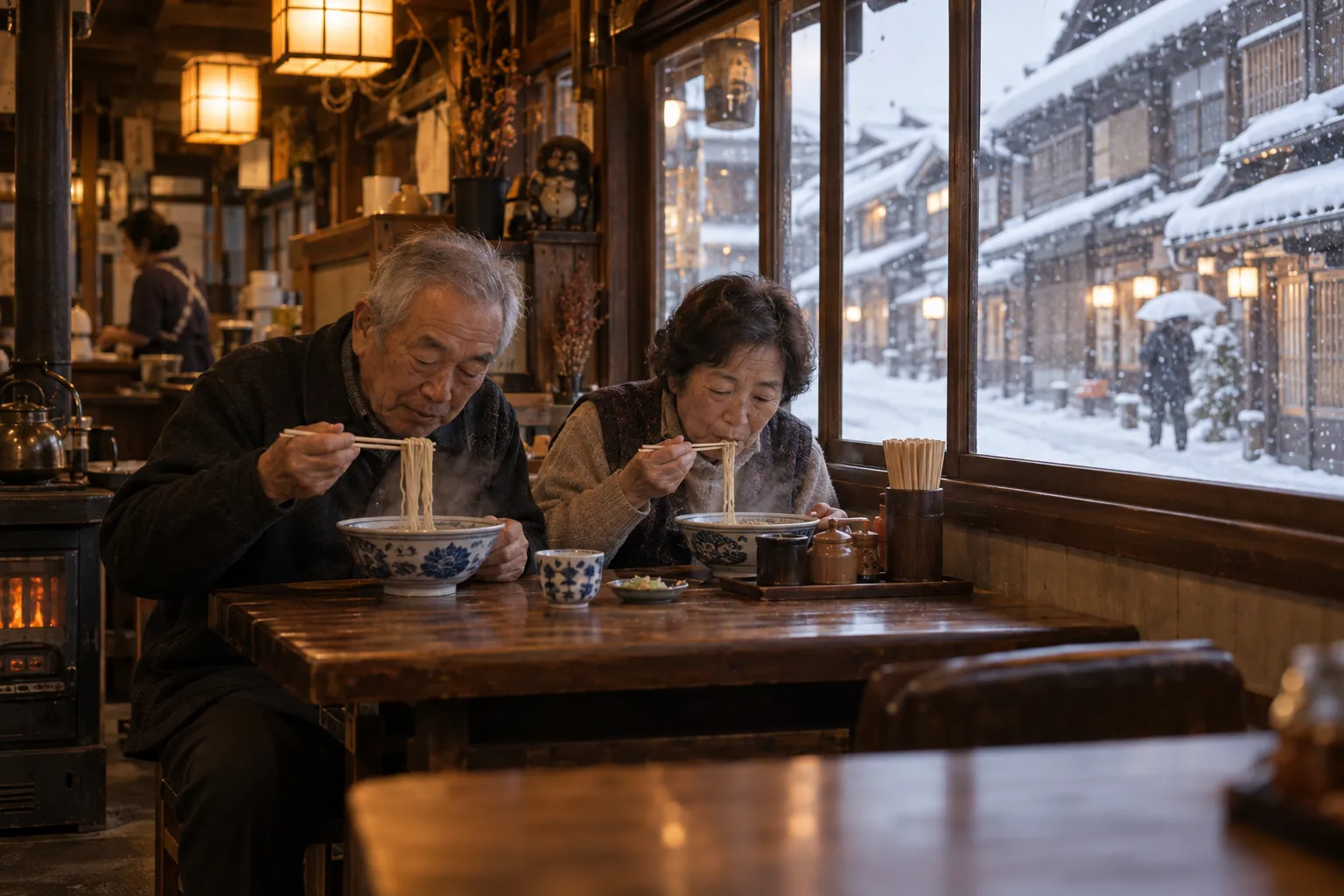
Kuroishi is a small city in Aomori with a preserved street of old merchant houses and a long, serious attachment to noodles. Its yakisoba came first — made with a distinctive flat, thick, notably chewy noodle that is nothing like the thin round ones most of Japan fries.
The soup version came later and came from below: the story told locally is that it started at a shop where children asked for their yakisoba with soup, and the shop obliged, and it stuck. Whatever the exact origin, it stayed a purely local habit for decades — the kind of thing a town eats without ever thinking of it as a dish.
Then, in the 2000s, Japan's local B-grade gourmet movement arrived and towns all over the country went looking through their own cupboards for something nobody else had. Kuroishi looked in its cupboard and found this. It got a name, a promotion campaign, a map of participating shops.
There's something I find quietly funny about that. For years it was just what you ate in Kuroishi. Then the rest of Japan turned up with a microphone.
Why the noodle makes it work
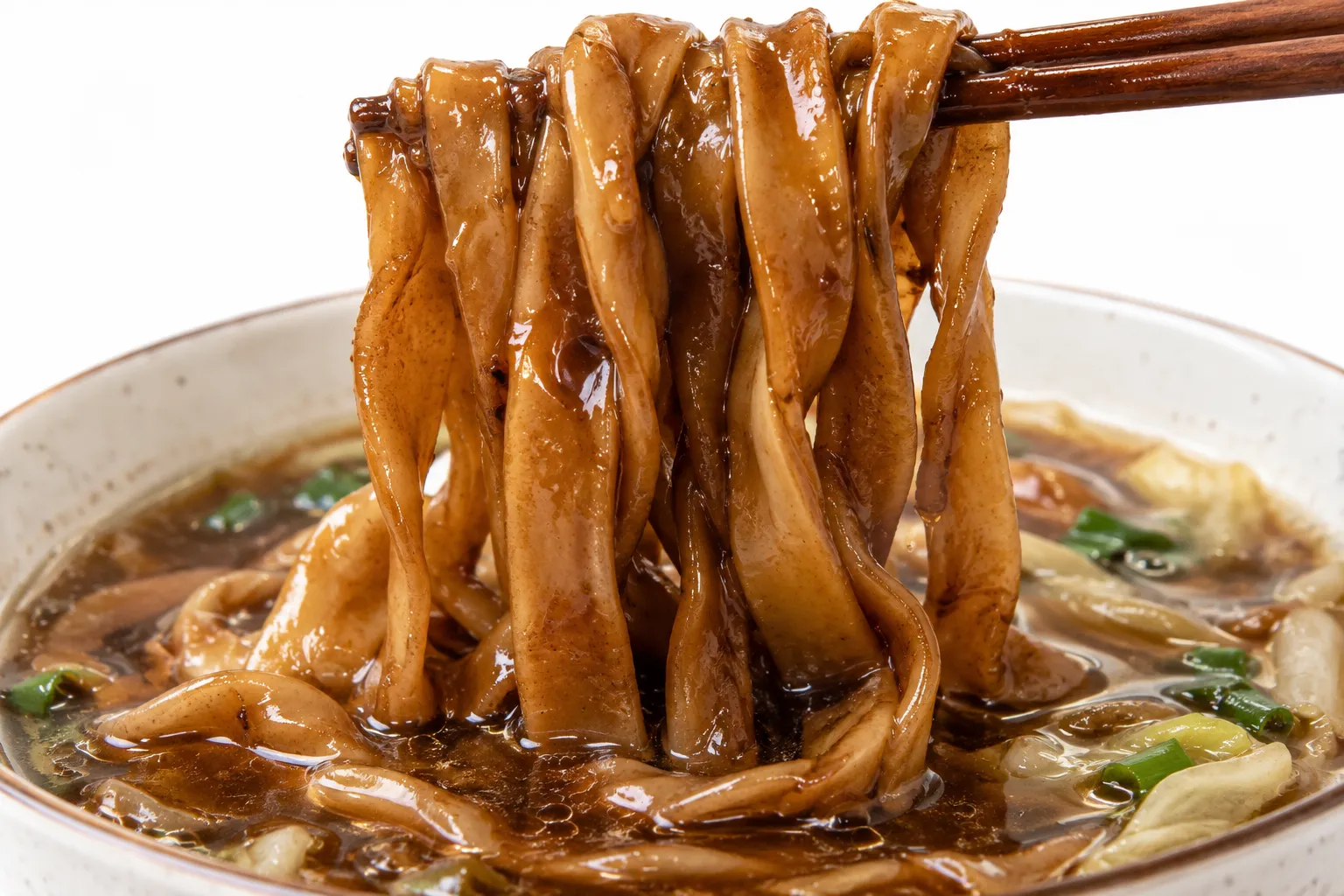
Take a normal yakisoba noodle — thin, round, soft — and put it in soup and you get mush in ninety seconds. The dish would be a curiosity and a bad one.
Kuroishi's noodle is built differently. It's flat, it's thick, it's dense, and it is chewy to a degree that surprises people the first time. Locals are proud of this and they should be. It's the whole reason the soup version exists as a real dish rather than a dare: these noodles can sit in hot broth and still fight back.
The broth underneath is a straightforward Japanese soba-style tsuyu — dashi, soy sauce, mirin — clean and light and salty. On its own it's the sort of thing you'd pour over plain soba on a hot day. Its job here is entirely contrast: it's the plain background that the sauce plays against.
And the sauce is where the strangeness lives. Yakisoba sauce is sweet, tangy, fruity-brown, a descendant of Worcestershire sauce that has gone its own way in Japan. It has no business in a dashi broth. Put them together and the first mouthful is honestly a bit confusing — two flavour systems that don't share a language, arriving at once.
By the third mouthful the confusion has resolved into something I can only describe as extremely comforting. Sweet and salty, fried and clean, heavy and light. It tastes like a hot lunch in a cold place, which is exactly what it is.
How it's put together
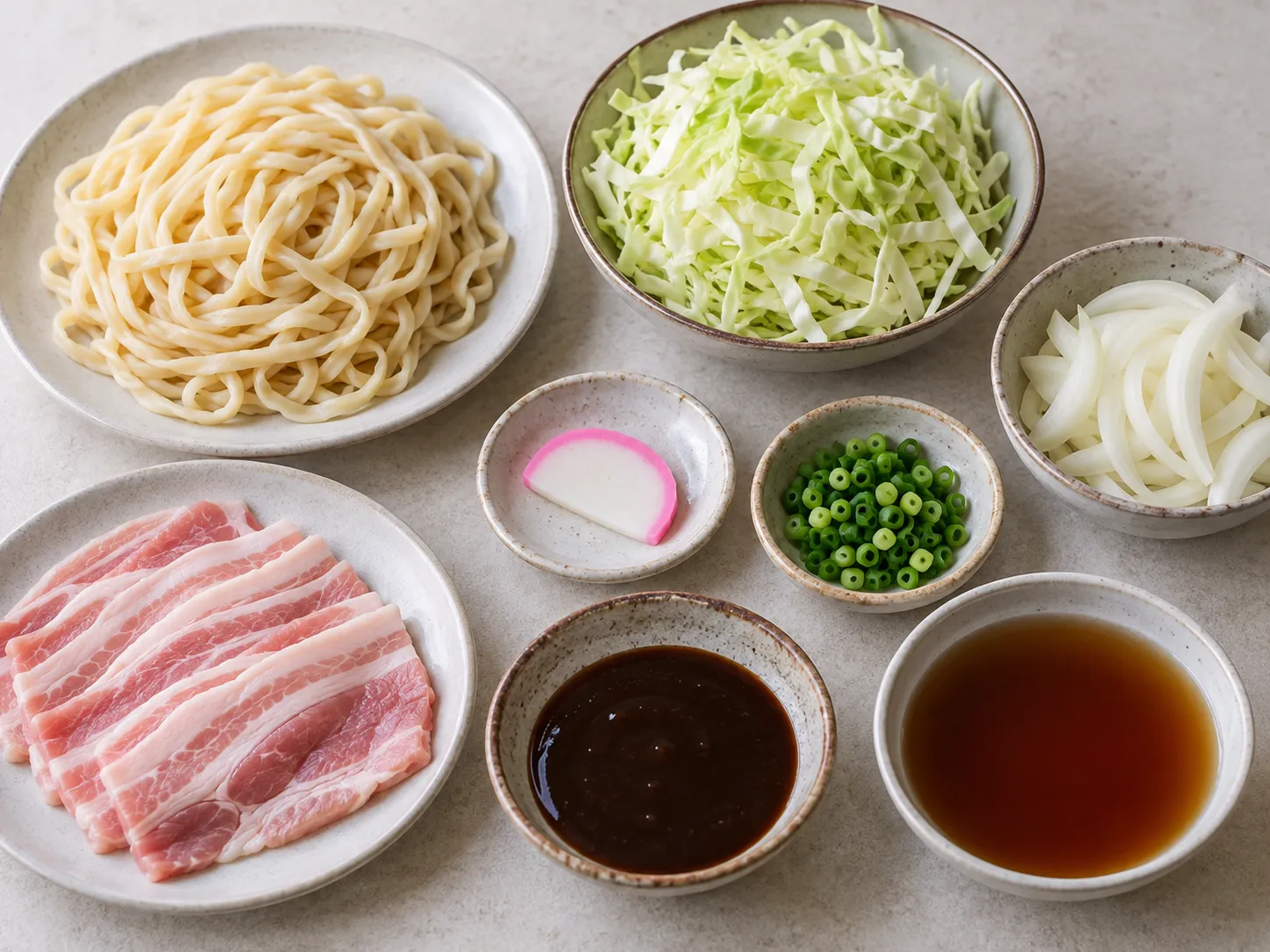
The order of operations is the whole trick, and shops do not skip steps:
- The noodles are fried first, properly — on a griddle with cabbage, onion and usually pork, exactly as if a plate of ordinary yakisoba were being made.
- Sauce goes on at the griddle stage, not in the bowl. This is essential. The sauce has to bake onto the noodles so it clings instead of dispersing.
- A soba-style broth is heated separately — dashi, soy, mirin — and kept clear.
- The fried noodles are transferred into a bowl and the hot broth is poured around them, not stirred through.
- Toppings go on — commonly fish cake, spring onion, sometimes tempura bits, sometimes an egg.
- It goes out immediately, because the noodles are good but they're not immortal.
Shops vary the toppings and the broth strength, and the participating restaurants around town each have their own version, which is the excuse you need to eat it twice.
Before you go — the stuff that actually matters
Your questions, answered honestly
"Does it actually taste good, or is it a novelty?" — It genuinely tastes good, and I say that as someone who sat down expecting a gimmick. The novelty gets you in the door; the sweet-salty contrast is what makes you order it again. It is not a refined dish. It's a deeply satisfying one.
"Will the noodles go soggy?" — Less than you'd think, which is the point of the local noodle. They soften gradually rather than collapsing. Eat at a normal pace and you'll be fine. Take a forty-minute phone call and you won't.
"Is it like ramen?" — No, and the comparison will mislead you. Ramen broth is built to be rich and seasoned to be drunk. This broth is a clean soba tsuyu and the flavour is coming from the sauce on the noodles. Go in expecting ramen and you'll find it thin; go in expecting soba and you'll find it strange; go in expecting neither and it makes sense.
"Do I drink the broth?" — Yes, and save some for the end. By then it's picked up the sauce and it's the best part of the bowl. There's a real argument that the last third is what the dish is actually for.
"Is it vegetarian?" — Usually not. Pork is standard in the fry, the broth is dashi-based, and dashi normally means bonito. Some shops will leave the meat out, but the broth underneath is the sticking point — ask directly.
"Can I get it outside Kuroishi?" — Occasionally elsewhere in Aomori, and instant versions exist as souvenirs. But the noodle is the dish, and the noodle is local, so the honest answer is that this is a reason to go to Kuroishi.
"Is it worth the detour?" — If you're already in Aomori, yes, comfortably. Kuroishi is a short trip from Hirosaki, and the old street with its preserved merchant houses is worth an hour on its own. If you're nowhere near northern Tohoku, be realistic — but put it on the list for when you are.
What the staff will ask you
| You'll hear | Romaji | Meaning | Just say |
|---|---|---|---|
| つゆやきそばでよろしいですか? | Tsuyu yakisoba de yoroshii desu ka? | "The soup one, is that right?" | Hai, sore de (yes, that one) |
| 大盛りにしますか? | Ōmori ni shimasu ka? | "Large portion?" | Futsū de (regular, please) |
| 玉子は入れますか? | Tamago wa iremasu ka? | "Egg in it?" | Onegaishimasu (yes, please) |
| 温かいのと冷たいのがあります | Atatakai no to tsumetai no ga arimasu | "We have hot and cold" | Atatakai no de (the hot one, please) |
| お飲み物はいかがですか? | O-nomimono wa ikaga desu ka? | "Anything to drink?" | O-hiya de ii desu (just water, thanks) |
To order, just say "Tsuyu yakisoba kudasai" (つゆやきそばください) — "Tsuyu yakisoba, please."
Where to eat it
- Kuroishi city centre, Aomori — the dish belongs to the town, and a number of shops around the centre serve their own version. The local tourist information will hand you a current map of participating restaurants, which is the most reliable way to find them.
- The Komise street area — Kuroishi's preserved arcade of old merchant houses, and a good place to be hungry near, with shops in walking distance.
- Hirosaki as a base — Kuroishi is an easy side trip from Hirosaki, which is where most travellers in this part of Aomori are actually staying.
- Souvenir shops and roadside stations in Aomori — instant and chilled versions to take home. A decent memory of the dish rather than a replacement for it.
Participating shops change over time and many are small family operations with irregular days off — pick up the current map locally or check before travelling out specially.
Soul Score
Local Roots4/5
First-Timer Friendly4/5
Adventure Level4/5
Comfort Level5/5
Travel Worthy4/5
These scores are one obsessed eater's gut feeling — not a verdict. A low number isn't a bad mark, just a different kind of adventure.
Know someone planning Japan?
← All Articles
Local Food · Kuroishi, Aomori
Still hungry?
Eat more from Aomori
Local FoodAomori
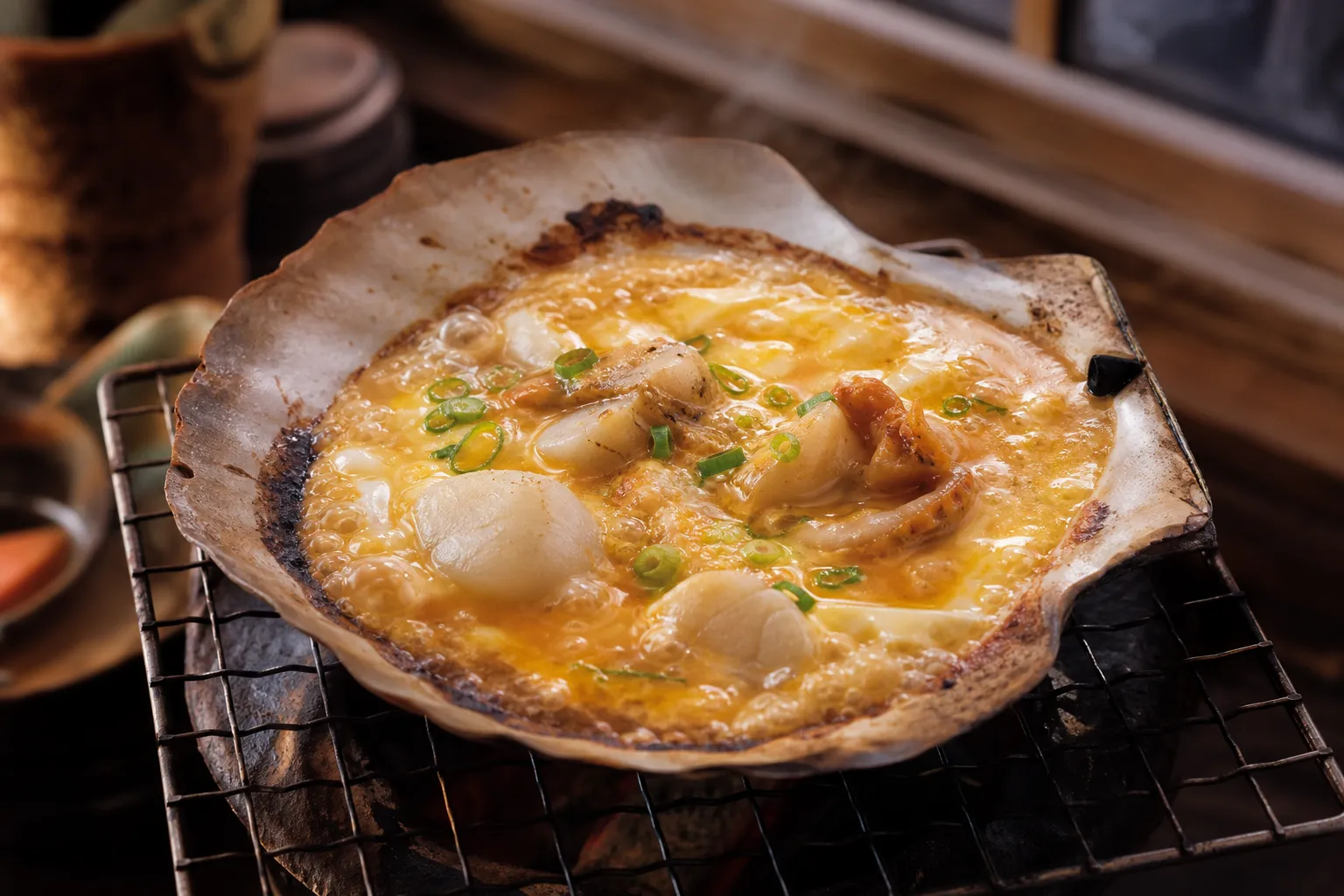
Kaiyaki Miso (貝焼き味噌)
A scallop shell used as its own tiny frying pan — miso, dashi and scallop bubbling away until a beaten egg drapes over it all in soft golden folds. Aomori grandmothers have been cooking dinner in a seashell for generations.
July 12, 2026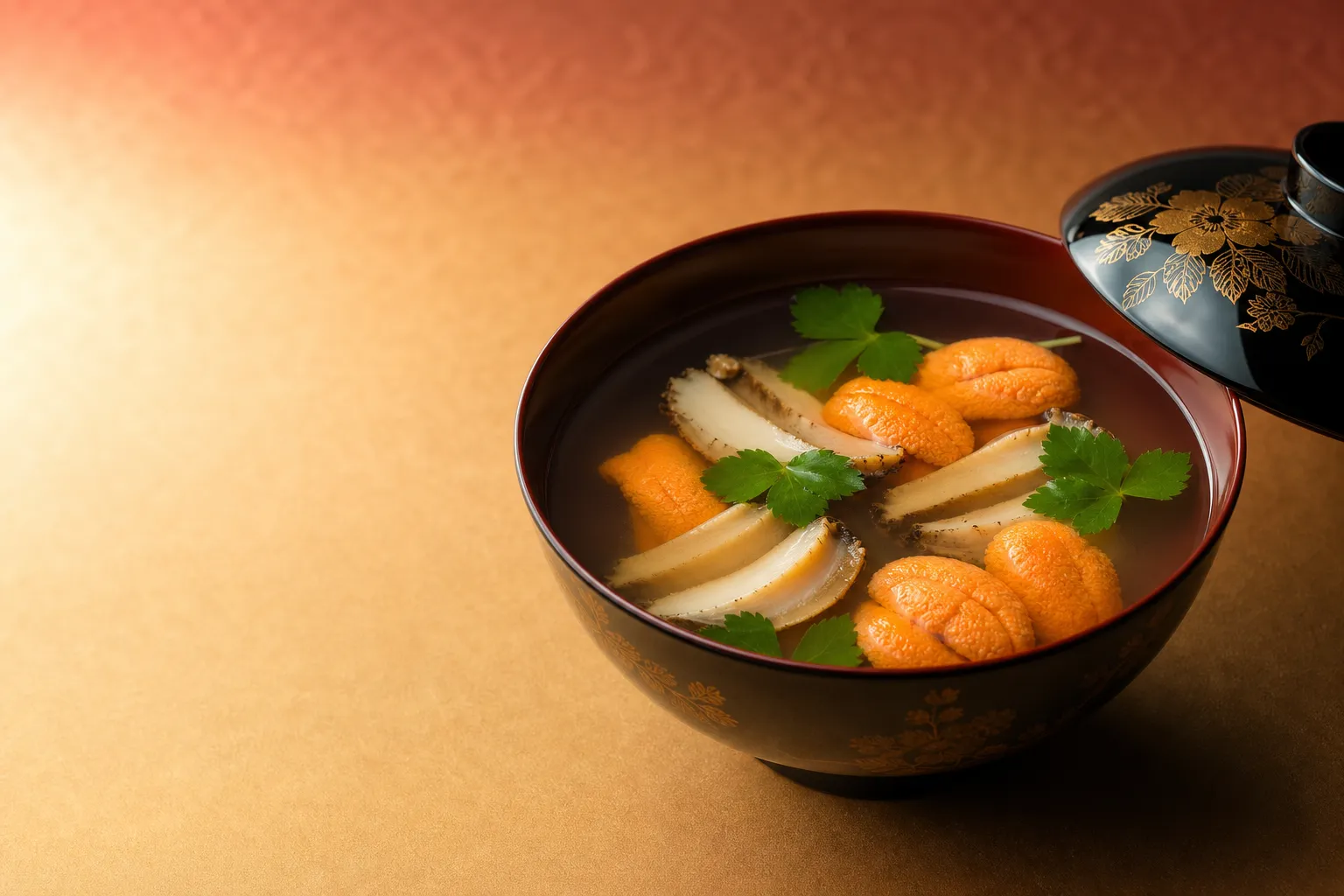
Local FoodHachinohe, Aomori
Ichigo-ni (いちご煮)
I ordered it expecting something fruity and got a bowl of the ocean at its most expensive instead — sea urchin and abalone floating in a broth so clear you could read through it.
July 5, 2026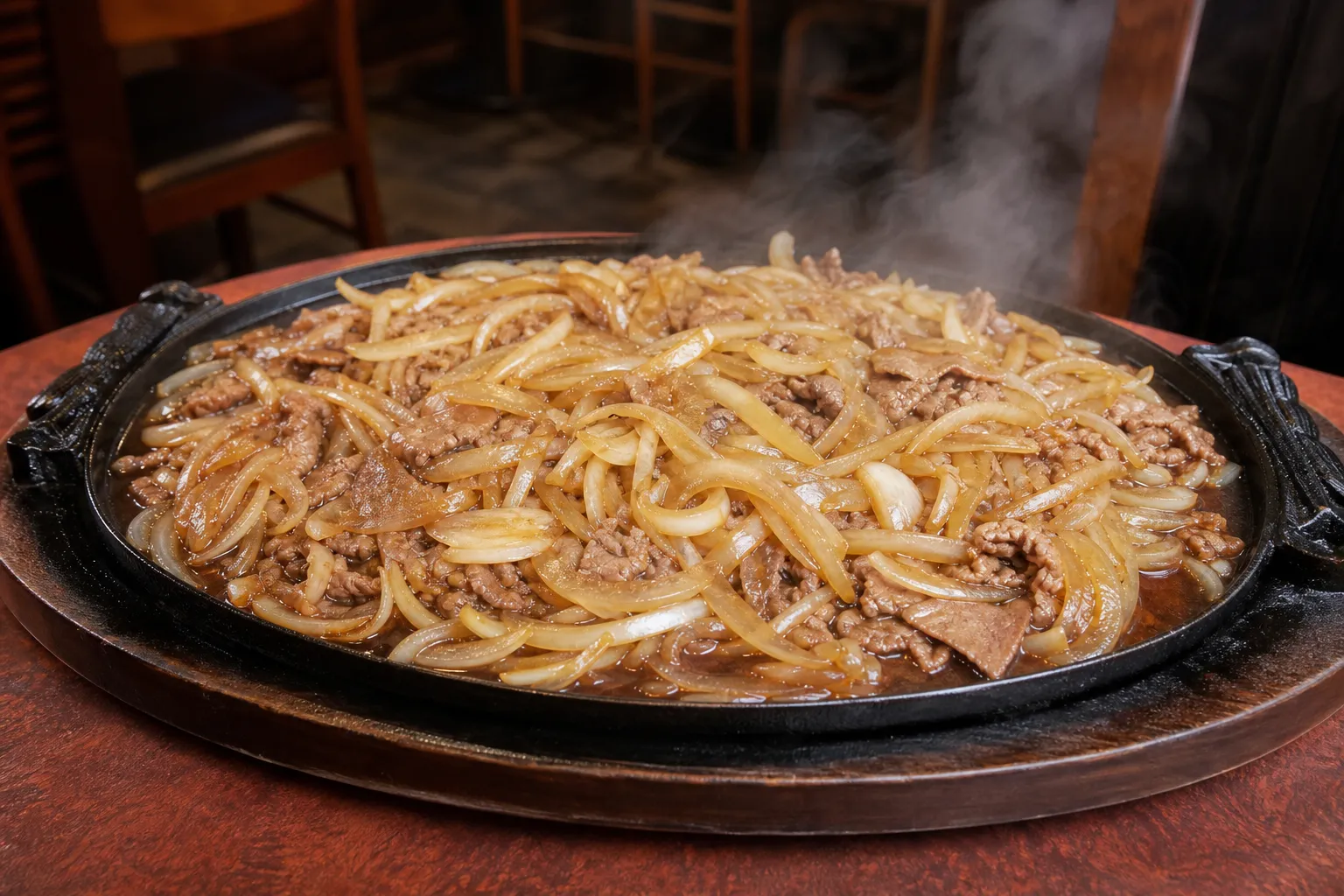
Local FoodTowada, Aomori
Towada Barayaki (十和田バラ焼き)
A hot plate arrives buried under onions, and you can't even see the beef yet — then it starts to sizzle down into a sweet-soy sauce and the whole table goes quiet. This is not yakiniku. This is Towada's own thing.
July 5, 2026