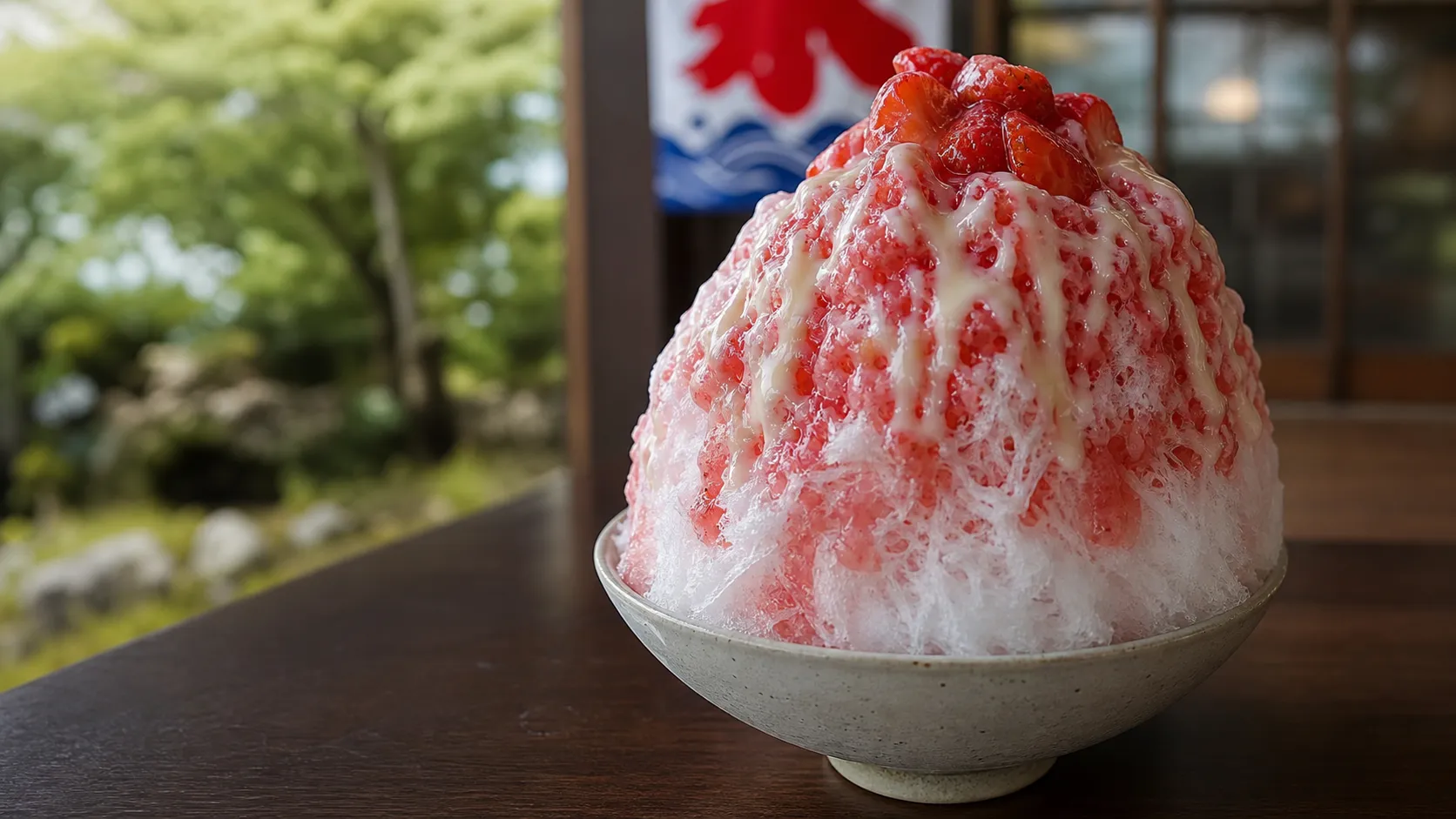
Aaaaaah — brain freeze!!
Share this dish


Mountains of fluffy shaved ice drenched in syrup — and at the high end, snow-soft ice with real fruit and condensed milk. Japan's summer survival dessert, far beyond a snow cone.
Okay. Okay. Worth it. So worth it. You went in too fast, you always go in too fast with kakigori, you knew this would happen and you did it anyway because the spoonful was right there and it was fluffy and cold and smelled like real strawberry and August and you are not sorry and you are immediately going back in.
This is Japan in summer. This is kakigori (かき氷).
At its simplest: a mountain of shaved ice soaked in fruit syrup, sold at every festival and neighborhood pool under the iconic red-and-blue 氷 ("ice") banner that means "cold salvation is here." But the modern kakigori scene has left "simple" far behind. Specialist shops now serve ice shaved so fine it falls apart on your tongue like fresh snow — fuwa-fuwa (fluffy), almost impossibly light — layered with house-made fruit purées, real condensed milk, anko bean paste, and syrup combinations that change with the season. One proper bite and you understand immediately why people queue around the block for this in August heat. And why the brain freeze, when it comes, feels almost earned.
A thousand-year-old luxury, now for everyone
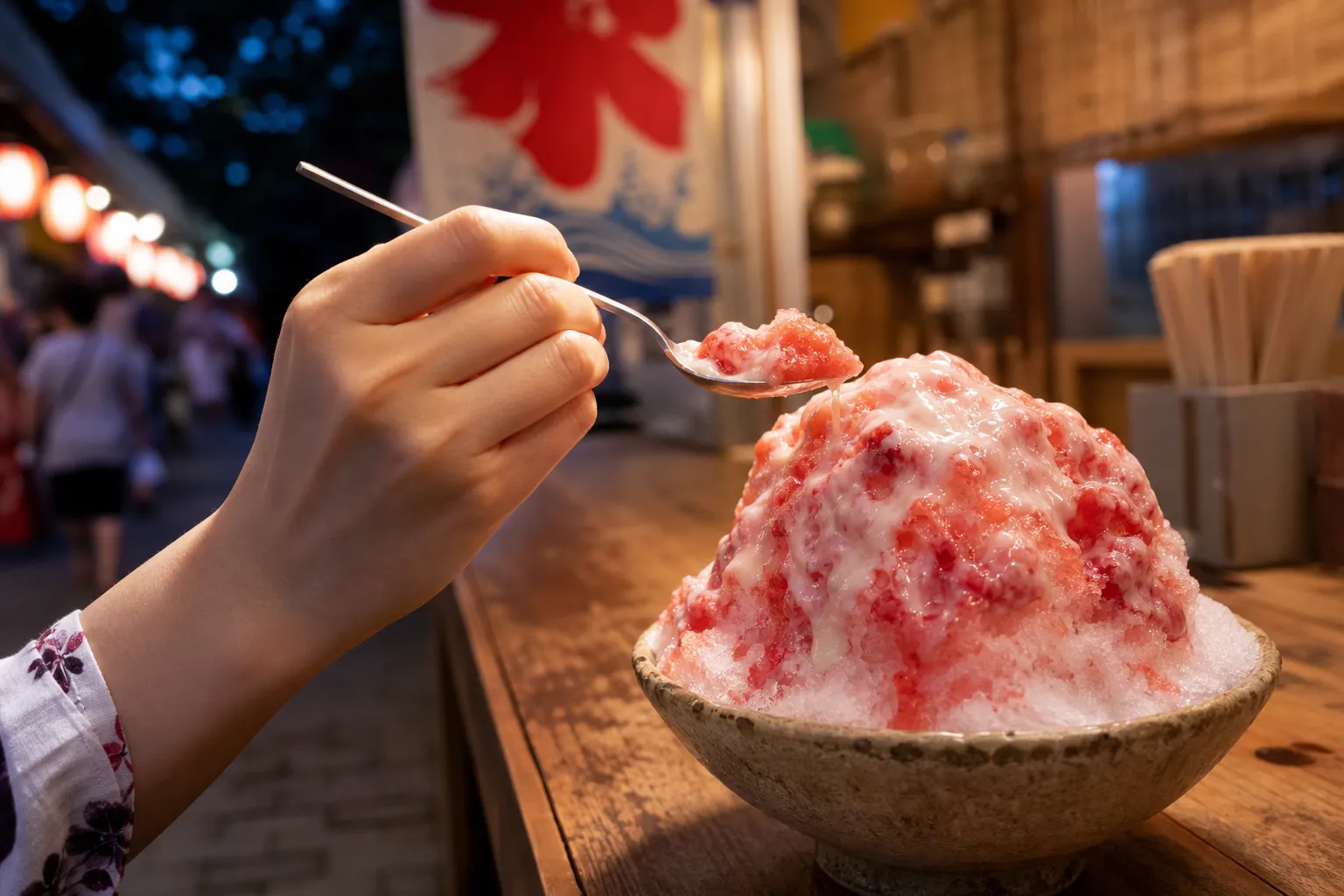
Shaved ice is ancient in Japan — it appears in The Pillow Book over a thousand years ago, when ice was a rare luxury reserved for nobility, shaved and topped with sweet vine syrup. Once ice became widely available, kakigori turned into the democratic summer treat it is today, sold under the universal red-and-blue 氷 ("ice") banner that signals "shaved ice here."
In recent years a gourmet kakigori boom has produced specialist cafés serving year-round, elaborate, fruit-forward creations that are worlds away from the festival cup.
Why the ice itself is everything
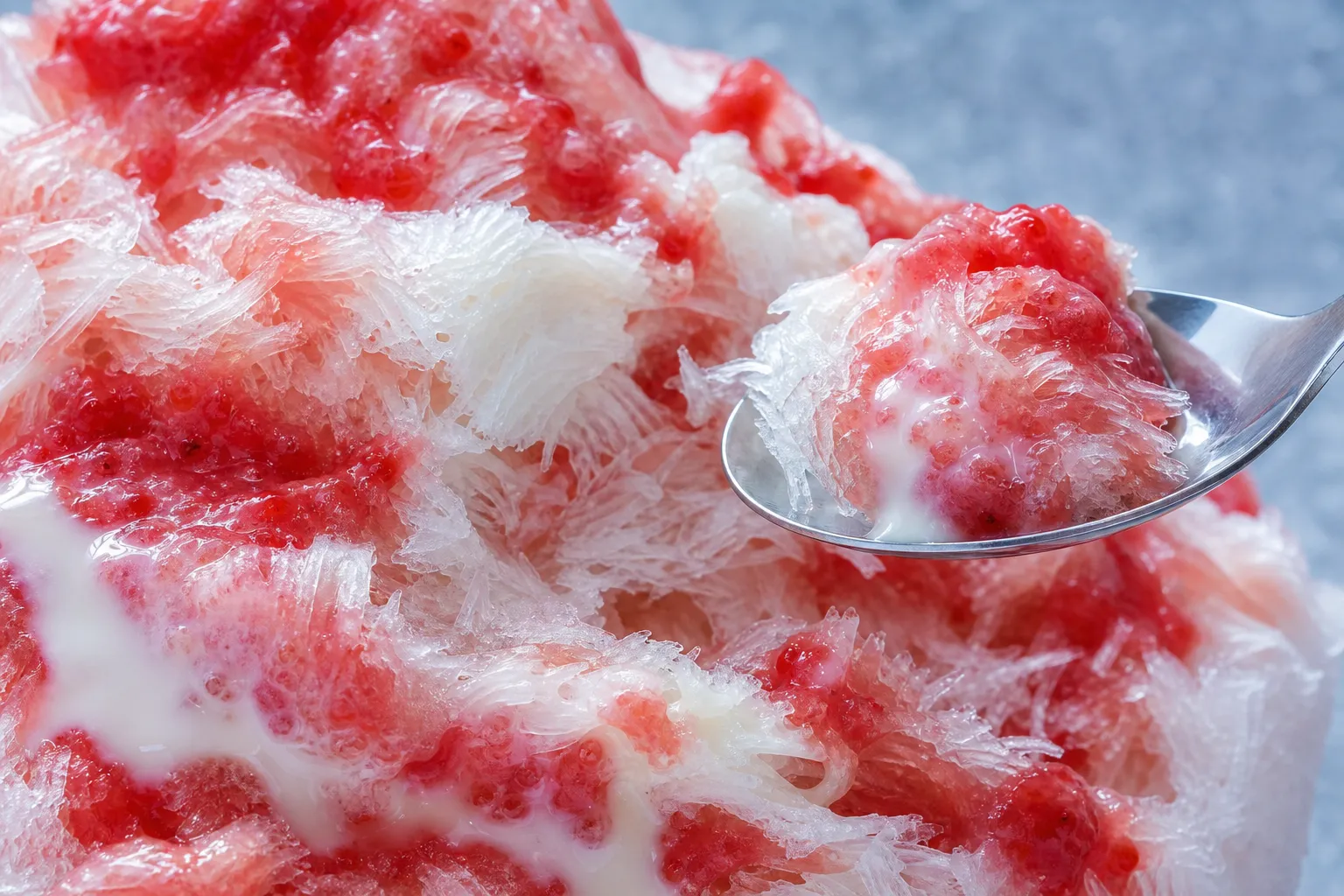
The difference between a meh kakigori and a transcendent one is the ice and the shave. Top shops use carefully made ice (sometimes pure block ice frozen slowly) and shave it ultra-thin so it's soft, fluffy, and melts instantly — no crunch, no brain-freeze, just a cloud that carries flavor.
Then the toppings: classic syrups (strawberry, melon, lemon, Blue Hawaii), condensed milk drizzle, ujikintoki (matcha syrup with red bean and mochi), or fresh seasonal fruit. The fluffier the ice and the more real the fruit, the higher the tier.
How it's made
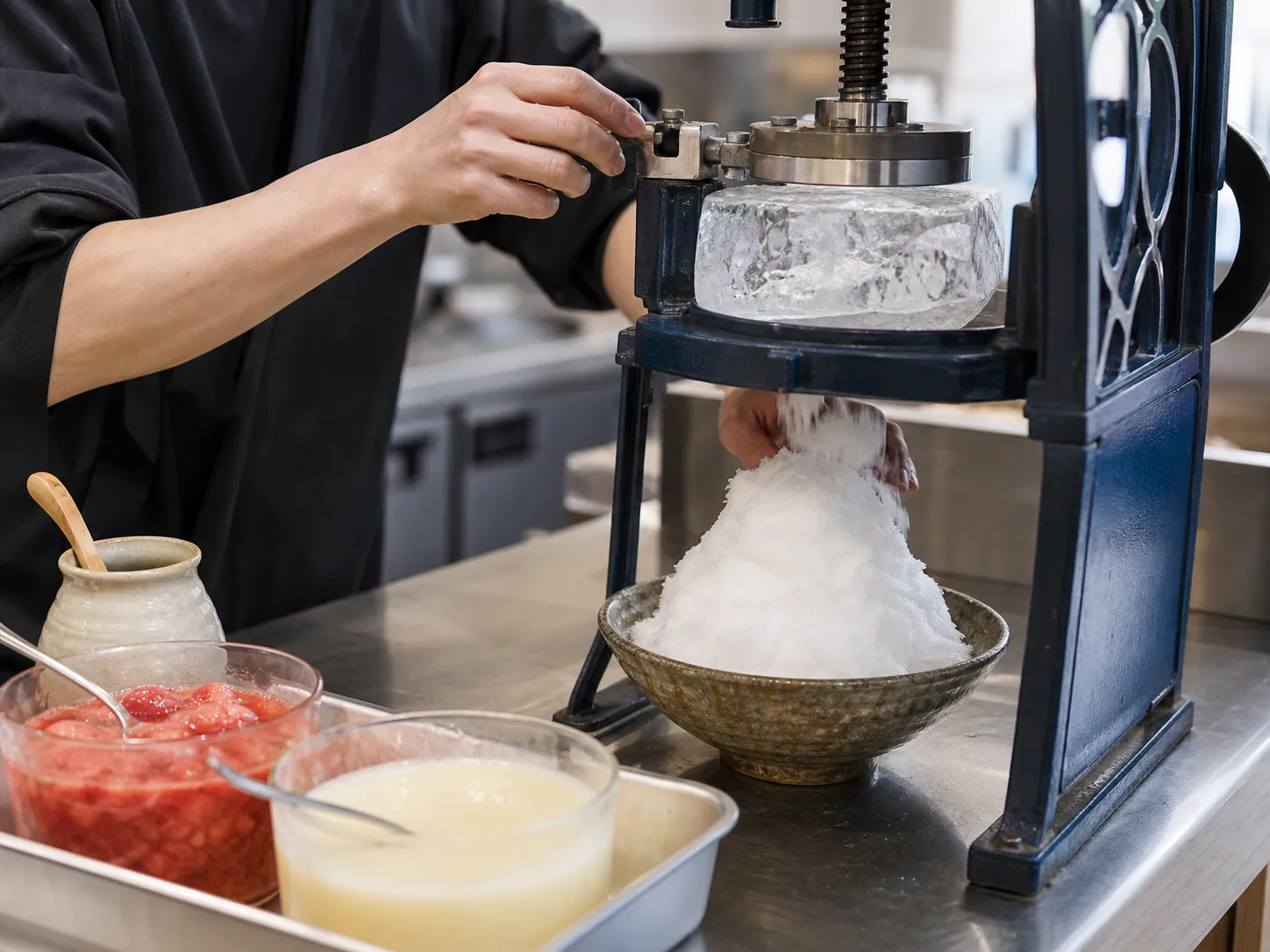
- Prepare a block of clear, slowly-frozen ice (premium) or use an ice-shaving machine
- Shave the ice ultra-thin into a tall, fluffy mound
- Pour or layer syrup throughout (not just on top, for even flavor)
- Add condensed milk, anko, mochi, or fresh fruit as desired
- Serve immediately with a spoon — eat fast before it melts
Before you go — beat the heat
Your questions, answered honestly
"Isn't it just a snow cone?" — No! Good kakigori is shaved snow-fine and fluffy, not crunchy ice pellets. The texture is the whole revelation — try a specialist shop, not just a festival cup, to get it.
"How do I avoid brain freeze?" — Eat slowly, and let the fluffy ice melt a moment on your tongue. Proper soft-shaved kakigori actually causes less brain freeze than hard ice.
"What flavor should I try?" — Ujikintoki (matcha + red bean + condensed milk) is the classic grown-up choice; strawberry or fresh-fruit with renyu (condensed milk) is a crowd-pleaser. Seasonal fresh-fruit specials are worth it.
"When is it available?" — Mainly summer at most shops (look for the 氷 banner), but gourmet kakigori cafés increasingly serve it year-round.
What the staff will ask you
| You'll hear | Romaji | Meaning | Just say |
|---|---|---|---|
| 味はどれにしますか? | Aji wa dore ni shimasu ka? | "Which flavor?" | Ichigo de (strawberry) / Ujikintoki de (matcha & bean) |
| 練乳はかけますか? | Ren'nyū wa kakemasu ka? | "Add condensed milk?" | Hai, onegaishimasu (yes please) |
| 店内でお召し上がりですか? | Tennai de omeshiagari desu ka? | "Eating in?" | Hai (yes) |
To order, just say "Ichigo no kakigōri kudasai" (いちごのかき氷ください) — "a strawberry shaved ice, please."
Where to eat it
- Specialist kakigori cafés (Tokyo, Kyoto, Nara has famous ones) — the fluffy, fruit-forward, queue-worthy tier.
- Festivals, pools, and shops with the 氷 banner — the classic cheap summer cup.
- Department-store & café summer menus — reliable seasonal options.
A summer essential — and at the top end, one of Japan's most surprising desserts.
Soul Score
Local Roots5/5
First-Timer Friendly5/5
Adventure Level3/5
Comfort Level4/5
Travel Worthy4/5
These scores are one obsessed eater's gut feeling — not a verdict. A low number isn't a bad mark, just a different kind of adventure.
Know someone planning Japan?
← All Articles
Sweets & Snacks · Nationwide
Still hungry?
You might also like
Sweets & SnacksSaga
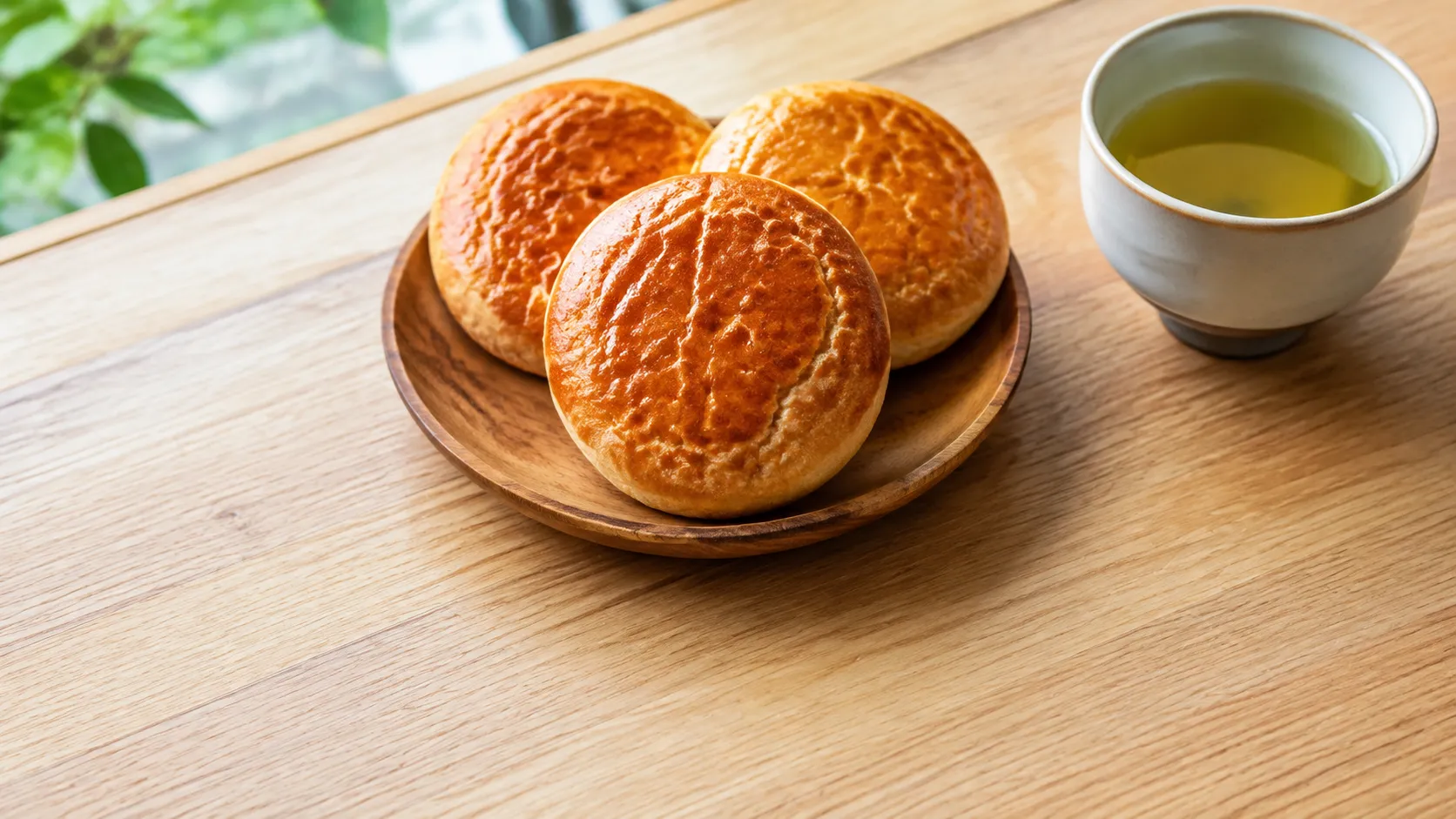
Maruboro (丸ぼうろ)
It looks like the most boring biscuit in Japan. Then you bite it and it's soft, and honey-warm, and about four hundred years of Portuguese sailors arrive all at once.
September 2, 2026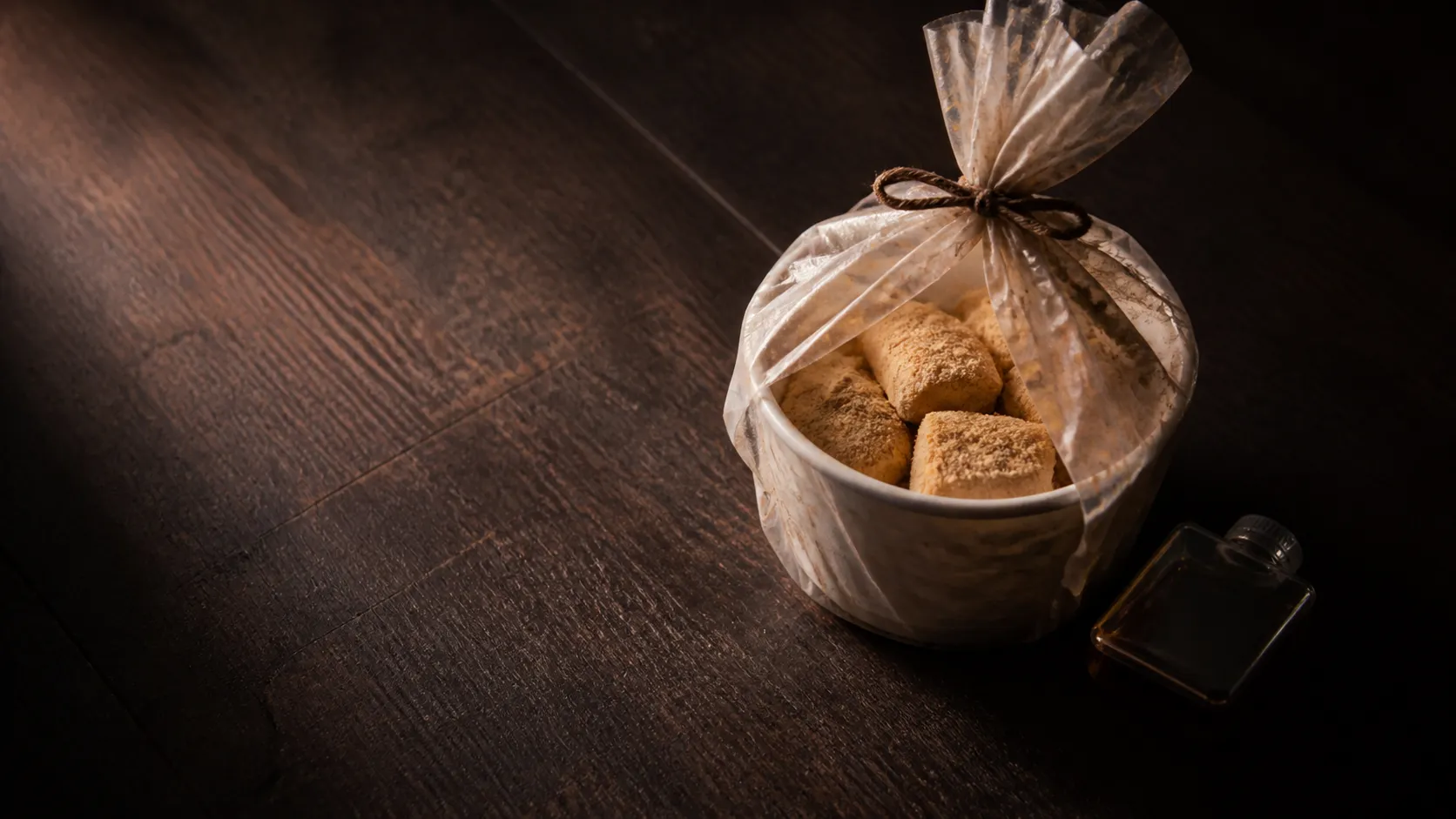
Sweets & SnacksYamanashi
Shingen Mochi (信玄餅)
There is a correct way to eat this and I did not know it, so I made a mess in front of several Yamanashi locals who were extremely kind about it and absolutely watching.
September 2, 2026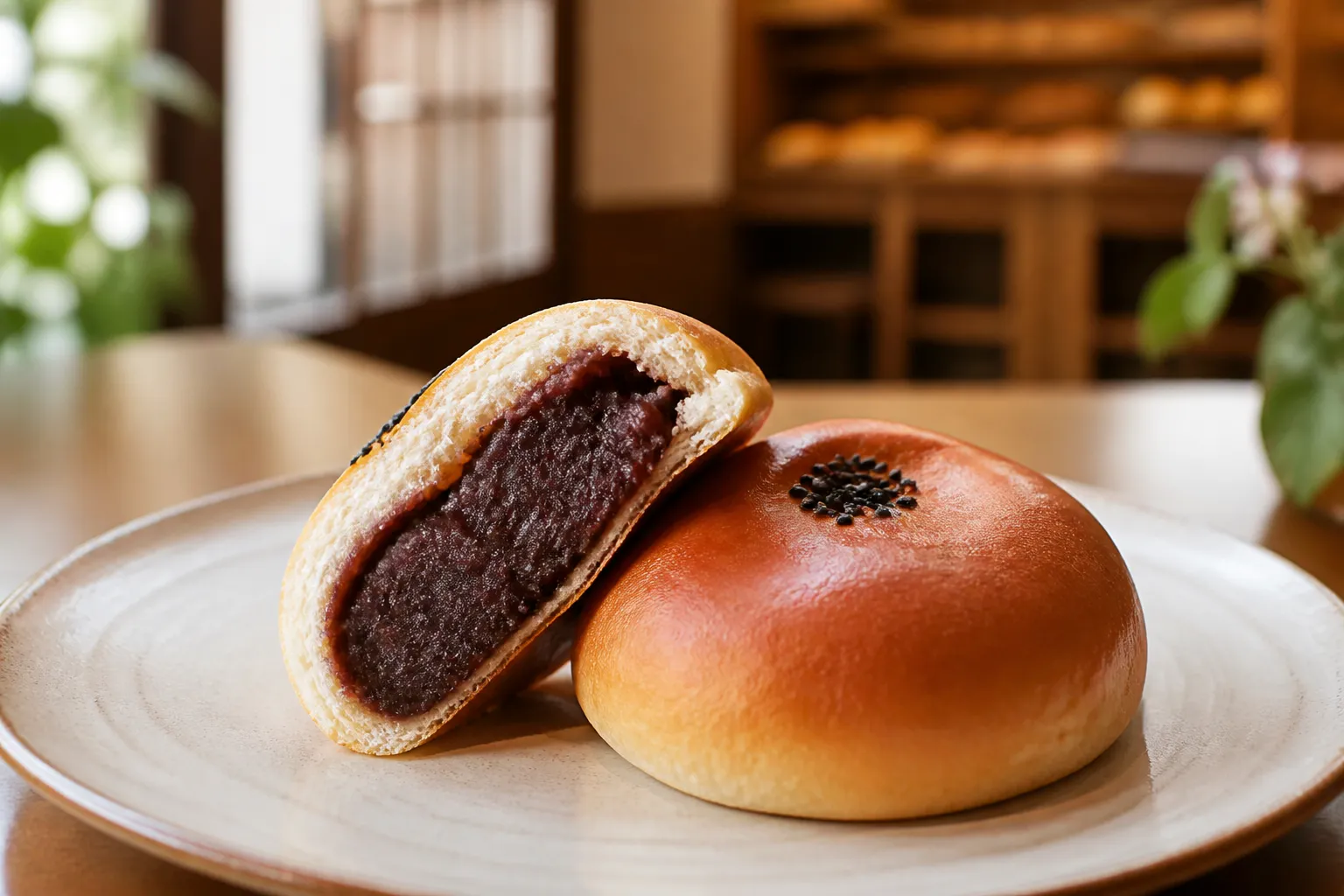
Sweets & SnacksTokyo
Anpan (あんパン)
A soft little bun, one bite in, and suddenly it's dense, dark, sweet red bean all the way through — the bread that talked 1870s Japan into eating Western-style bread at all.
July 27, 2026