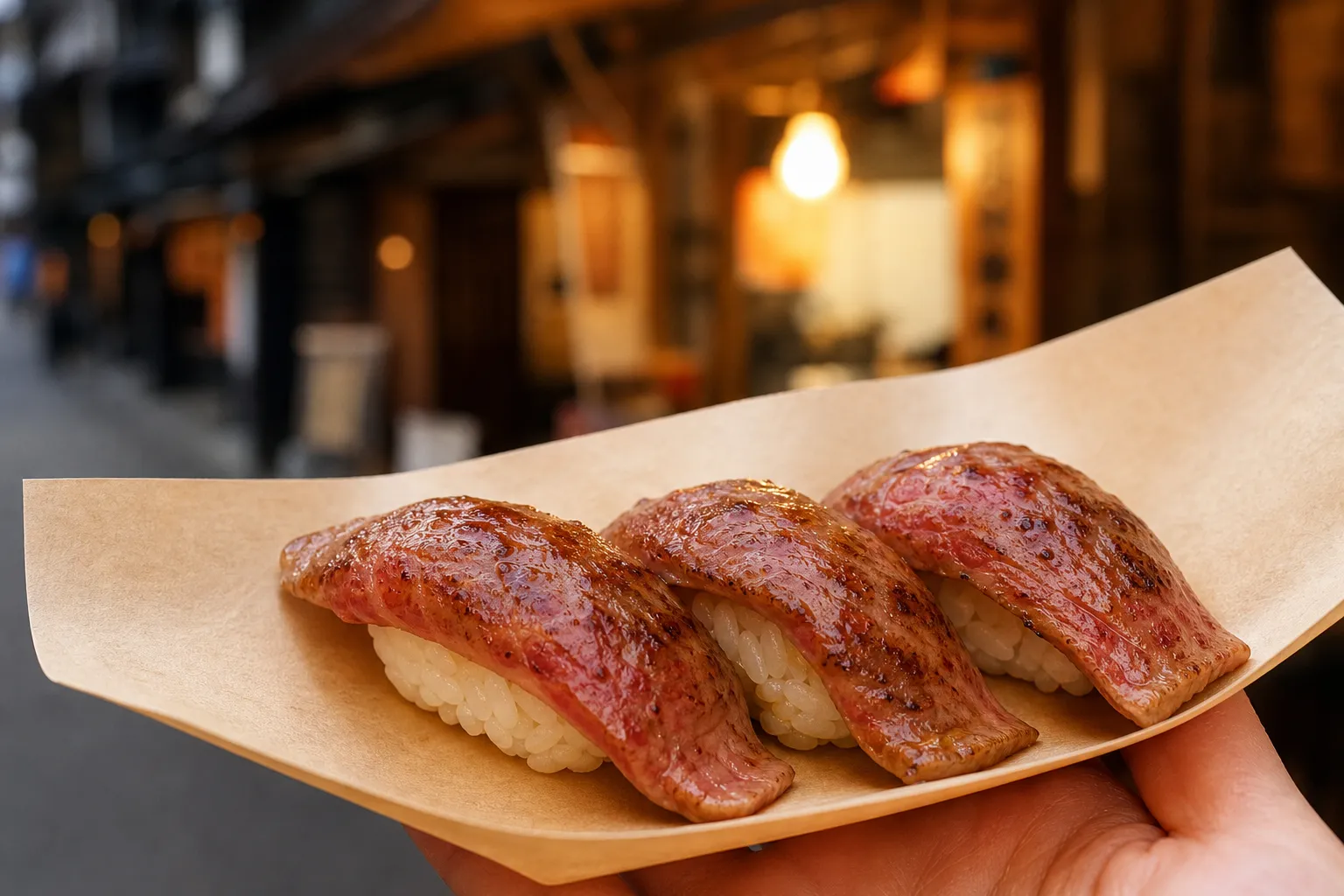
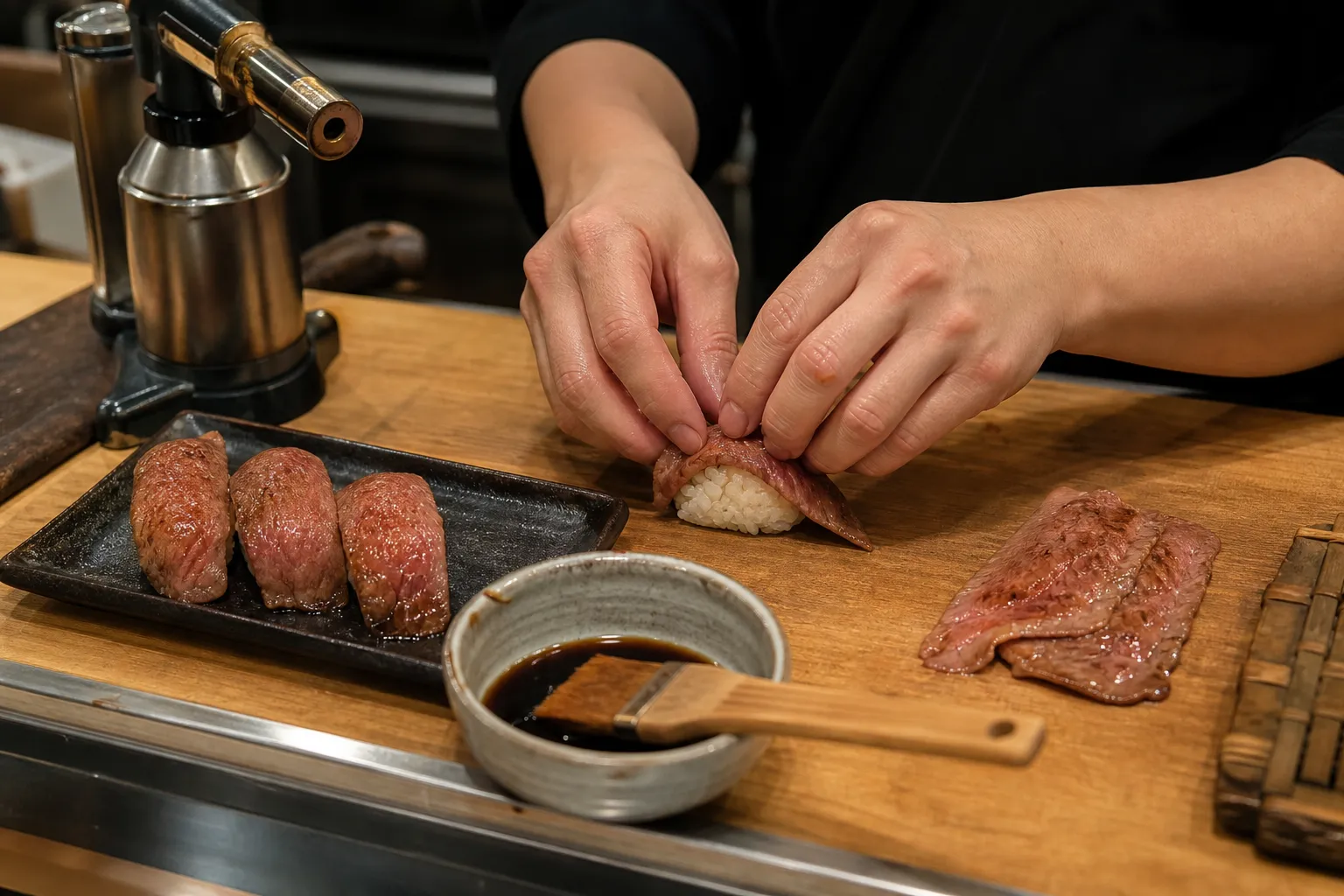
Someone handed me a curl of rice with a slice of seared, marbled beef draped over it, still warm from the torch, wrapped in a little paper boat, and I ate it in the middle of a wooden-lattice street in old Takayama before I'd even fully processed what had just happened. No table. No chopsticks. Just me, standing between centuries-old merchant houses, eating what might be the single best bite of beef I've had while also technically jaywalking.
Share this dish


A torch flares over a single bite of beef sushi on a wooden boat, someone hands it to you still warm, and you eat Japan's most-awarded wagyu standing in the middle of a street.
🍜 Planning a food trip to Gifu?Add this dish to my Food Trip →
 Add this dish to my Food Trip →
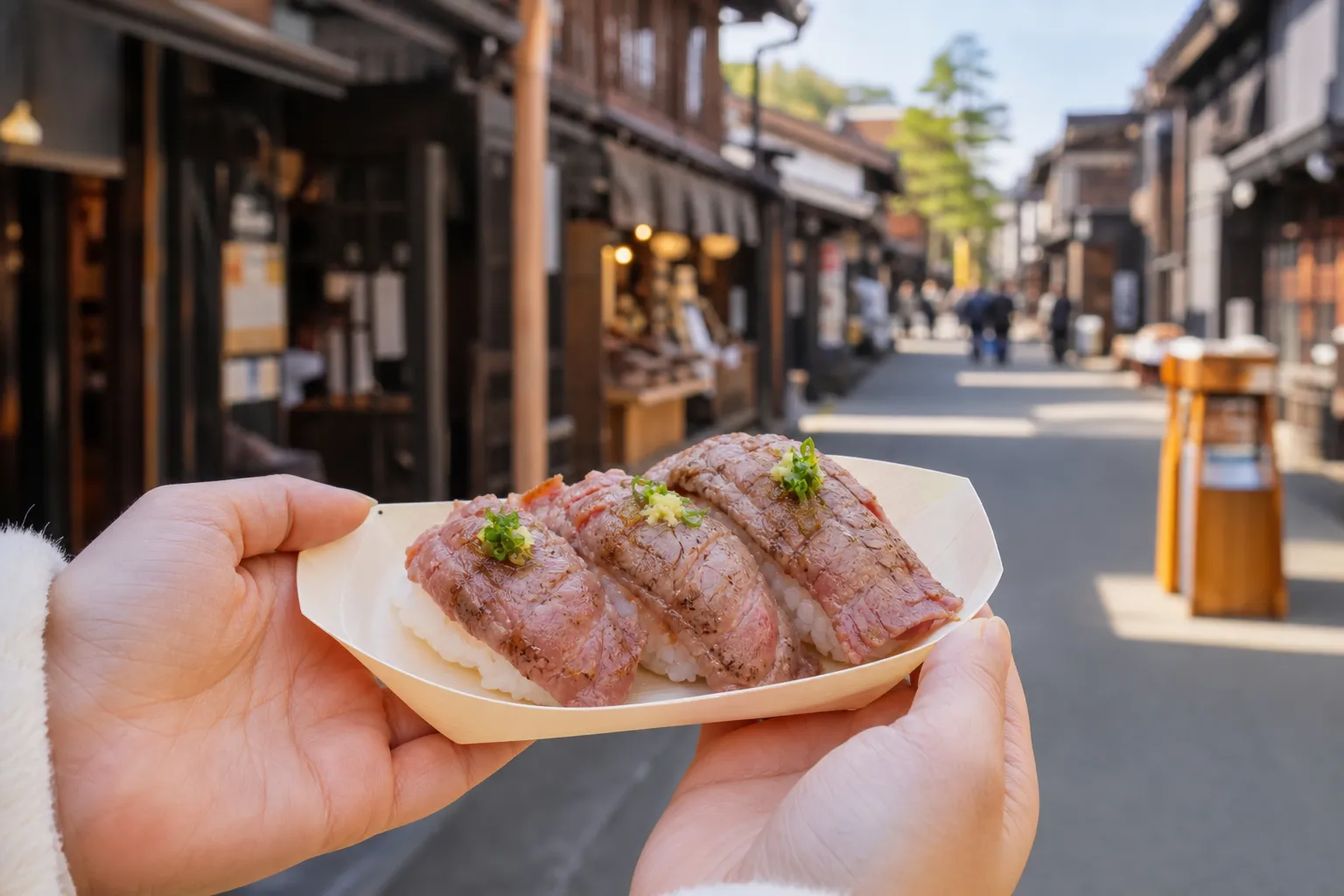
Here's what it is: Hida beef (飛騨牛, Hida-gyū) is a highly decorated wagyu brand from the mountainous Hida region of Gifu Prefecture, centered on the beautifully preserved old town of Takayama. It's raised to strict local standards and has repeatedly won top honors at Japan's national wagyu competitions, putting it firmly among the country's most respected beef brands despite being younger than legends like Kobe or Matsusaka. While it's absolutely worth ordering as a proper steak or sukiyaki, it's most famous with travelers as beef nigiri-zushi — a torch-seared slice of marbled Hida beef on a small ball of vinegared rice, sold from stalls right in the street.
A mountain beef that keeps winning gold
Hida beef doesn't have centuries of samurai-era legend behind it the way some famous wagyu brands do — its modern reputation was built through decades of careful breeding programs in Gifu's mountain region. And yet, at Japan's national Wagyu Olympics (the Zenkoku Wagyu Nōryoku Kyōshinkai, held once every five years), Hida beef has repeatedly taken home top prizes, which is the wagyu world's equivalent of a small mountain town suddenly winning the World Cup. I love that about it — it's proof that you don't need four hundred years of history to become one of the best in the country, just very good cattle and very stubborn dedication.
The Hida region itself, high in Gifu's mountains, gets brutally cold winters, and Takayama's old town — all dark wood facades, sake breweries, and narrow lanes — has been a trading hub for centuries. Standing there with beef nigiri in hand, snow-capped peaks visible past the rooftops, it's easy to see why this beef became a point of local pride worth building a whole street-food culture around.
Why the street-food version works so well
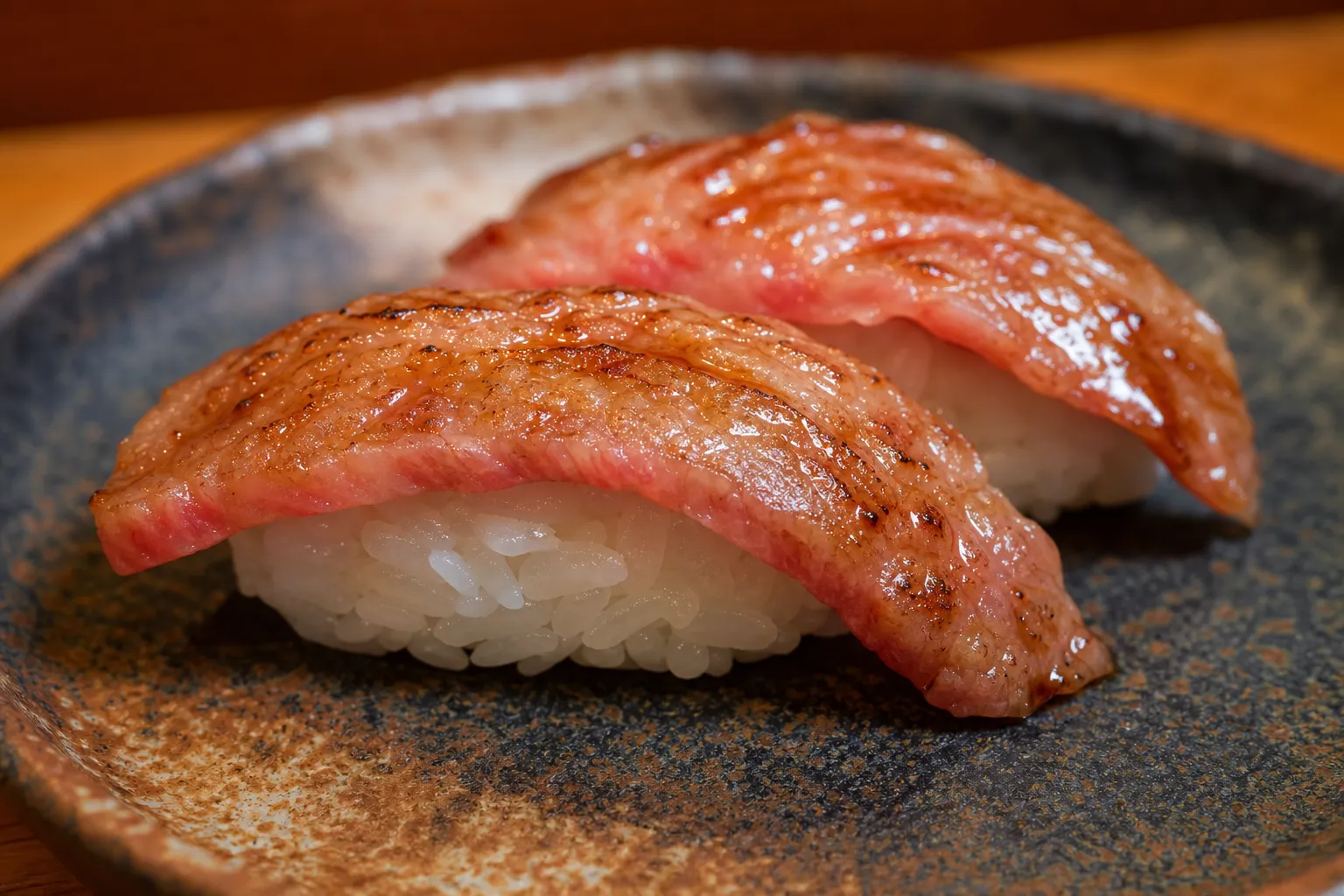
- A quick torch sear renders just the surface fat, leaving the inside soft and pink, so you get seared aroma and melting texture in one bite
- The marbling is generous, so even a single small slice delivers real richness — no need for a huge portion
- A light soy glaze is often all it needs, so the beef flavor stays front and center rather than getting buried in sauce
- Serving it nigiri-style turns premium wagyu into a genuine grab-and-go street food, unusual for beef this good
- Because each piece is bite-sized, it's an easy, low-commitment way for first-timers to try serious wagyu without booking a whole steak dinner
I have eaten three in a row standing in the same spot. I have no regrets and I would do it again tomorrow.
How it's made (and how it's served)
- Cattle are raised in the Hida region of Gifu to strict breed and origin standards before earning the Hida-gyū name.
- Graded on marbling and quality, with the best grades going to both premium restaurants and the famous street-food stalls.
- Sliced thin and, for the street version, briefly seared with a handheld torch to render the outer fat while keeping the center soft.
- Placed over a small ball of vinegared sushi rice, nigiri-style, sometimes finished with a light soy or ponzu glaze.
- Served immediately, wrapped in paper or set on a small wooden tray, meant to be eaten right away while it's still warm.
Before you go — a beef so good it doesn't need a table
Your questions, answered honestly
"Is the street nigiri as good as a real steak?" — It's a different experience rather than a lesser one — you get less total meat, but the torch-seared fat and warm rice combination is genuinely delicious and a great introduction. For the full experience, also try a proper Hida beef steak or sukiyaki at a sit-down restaurant if you have time.
"How many pieces should I get?" — Two or three pieces makes a satisfying snack; it's not really a meal replacement, so plan to eat something else alongside your Takayama old-town wandering.
"Is it safe to eat while walking?" — Yes, that's exactly how it's designed to be eaten — most stalls hand it to you ready to go, and eating while strolling through the old town is completely normal and expected.
"How does it compare to Kobe or Matsusaka beef?" — Hida beef is younger as a brand but has won major national wagyu competitions, so in blind tastings it holds its own — think of it as a newer legend rather than a lesser one.
What the staff will ask you
| You'll hear | Romaji | Meaning | Just say |
|---|---|---|---|
| いくつになさいますか? | Ikutsu ni nasaimasu ka? | "How many pieces?" | Futatsu onegaishimasu (two, please) |
| タレをかけますか? | Tare o kakemasu ka? | "Should I add the glaze/sauce?" | Hai, onegaishimasu (yes, please) |
| 焼き加減はいかがいたしましょうか? | Yaki-kagen wa ikaga itashimashō ka? | "How would you like it cooked?" (for steak) | Osusume de onegaishimasu (whatever you recommend) |
To order, just say "Hida-gyū o kudasai" (飛騨牛をください) — "Hida beef, please."
Where to eat it
- Takayama's old town (Sanmachi Suji), Gifu — the classic spot for beef nigiri and beef bun street stalls, walking distance from the morning markets.
- Takayama restaurants — specialist steakhouses and sukiyaki restaurants throughout the city serve full Hida beef courses.
- Gifu City and other towns in the region — also serve certified Hida beef; look for the brand certification on menus.
Street stalls can sell out of popular items by afternoon and opening hours vary by shop and season, so check current hours and go earlier in the day if you can.
Soul Score
Local Roots4/5
First-Timer Friendly5/5
Adventure Level3/5
Comfort Level4/5
Travel Worthy4/5
These scores are one obsessed eater's gut feeling — not a verdict. A low number isn't a bad mark, just a different kind of adventure.
Know someone planning Japan?
← All Articles
Local Food · Gifu
Still hungry?
Eat more from Gifu
Local FoodGifu
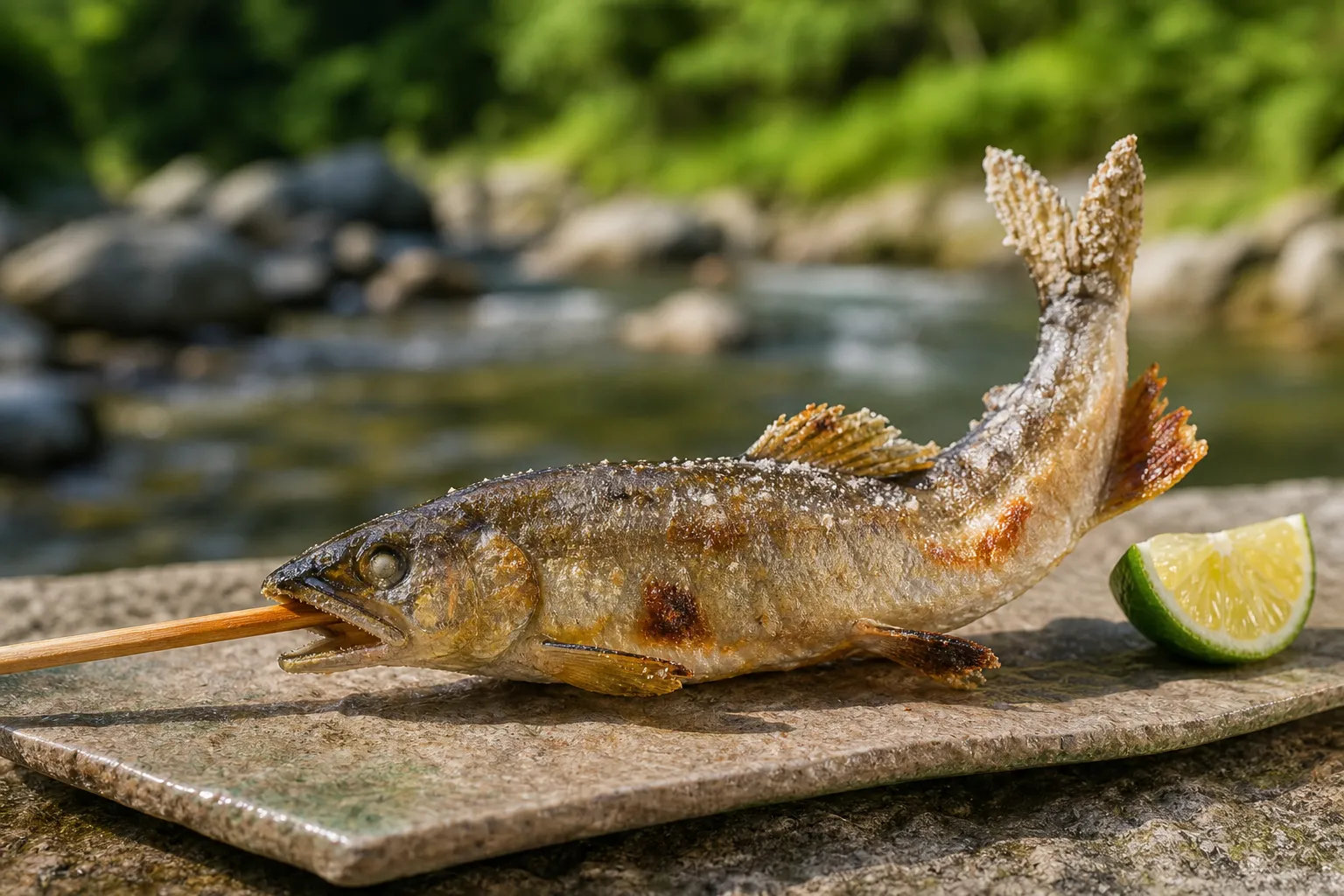
Ayu no Shioyaki (鮎の塩焼き)
A whole river fish, salted and grilled over coals until the skin blisters and the fins go crisp — and then you eat the entire thing, head to tail, chasing the clean green taste of the Nagara River.
July 12, 2026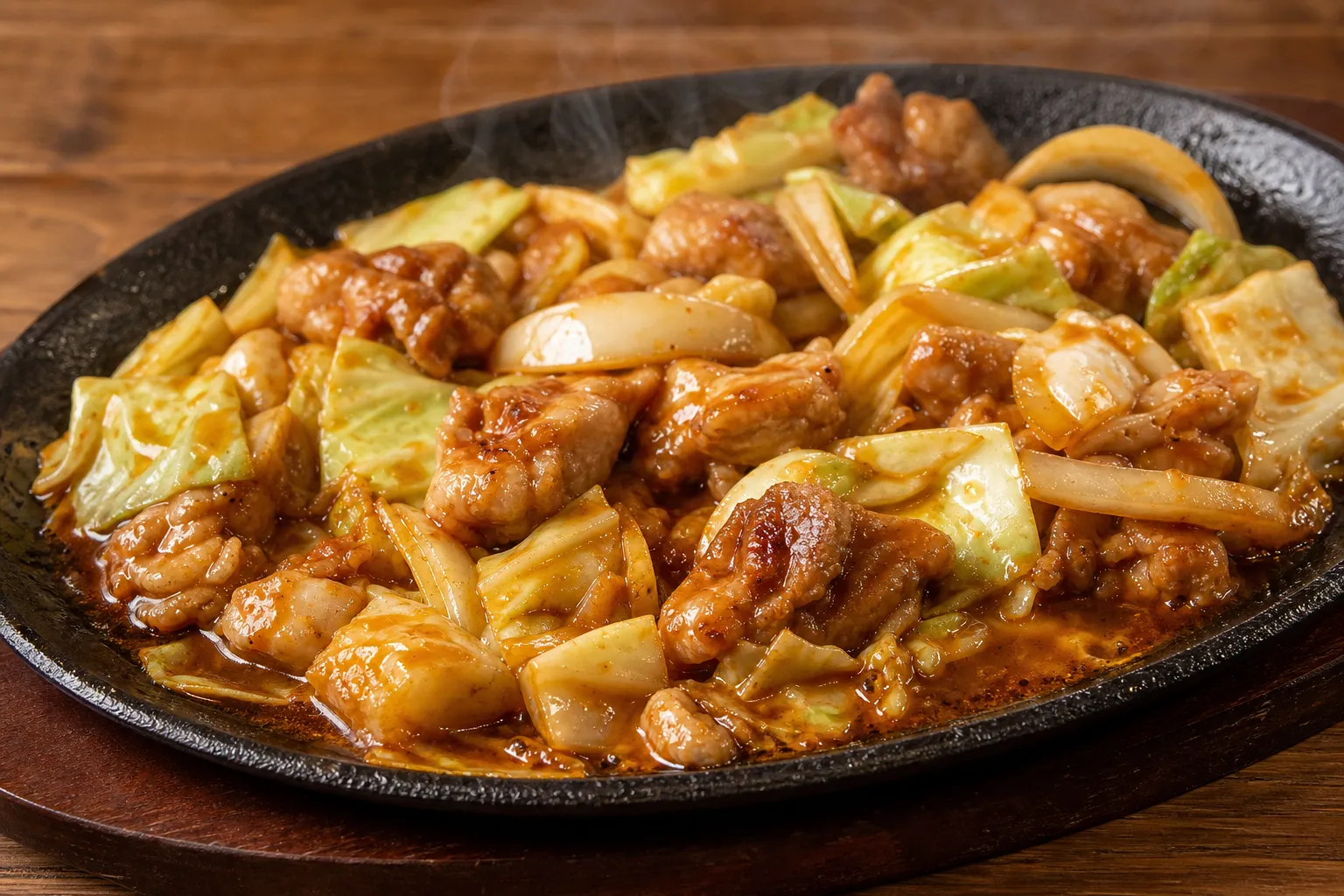
Local FoodOkumino, Gifu
Keichan (けいちゃん)
Chicken and cabbage hit a screaming-hot iron plate slathered in miso, and the whole table leans in — this is food you cook together, argue over, and fight for the last piece of.
July 5, 2026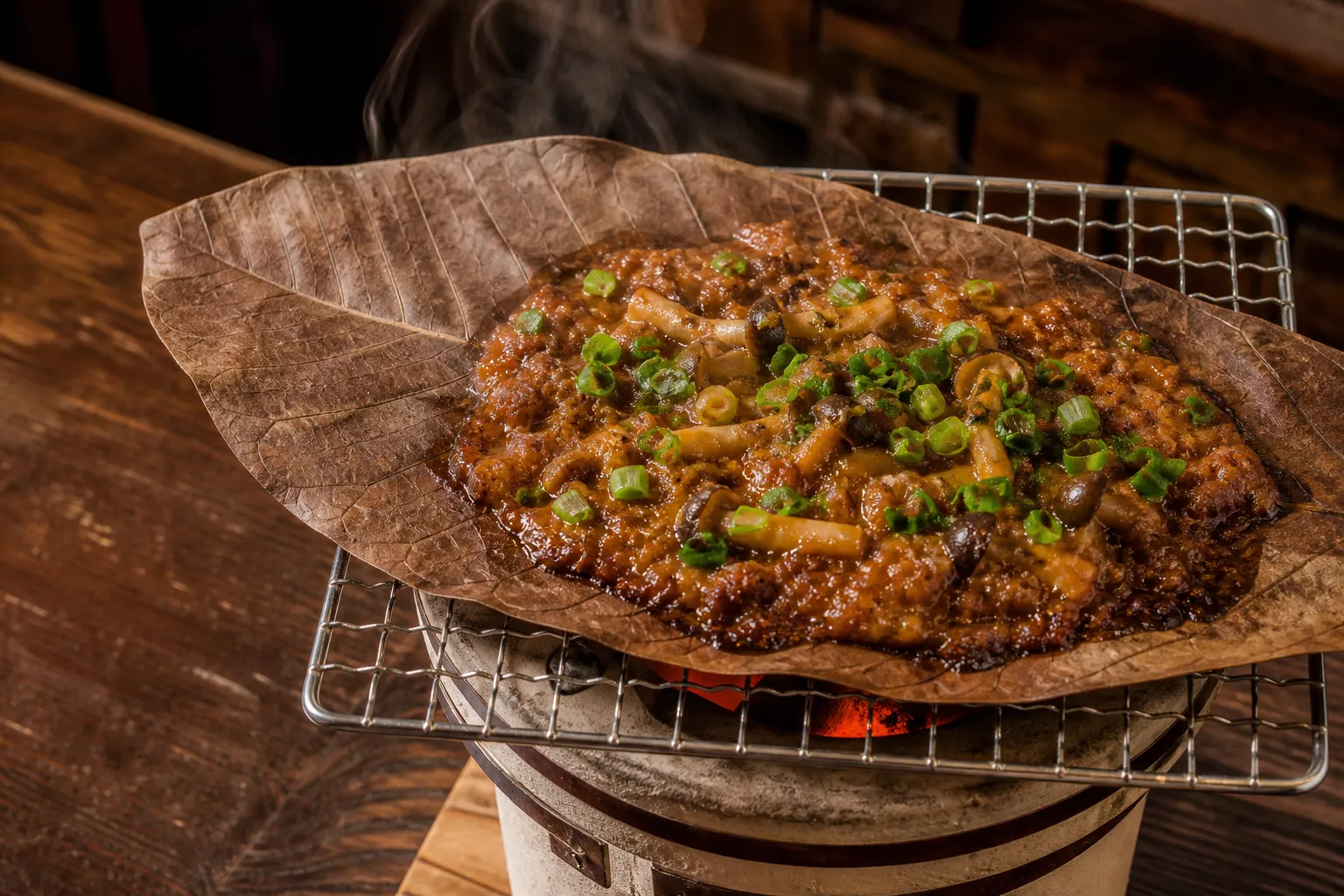
Local FoodTakayama, Gifu
Hoba Miso (朴葉味噌)
Sweet miso bubbling and caramelizing on a big dried magnolia leaf over a tabletop flame — Hida-Takayama's mountain breakfast turns one scoop of miso into the best reason to keep eating rice.
July 3, 2026