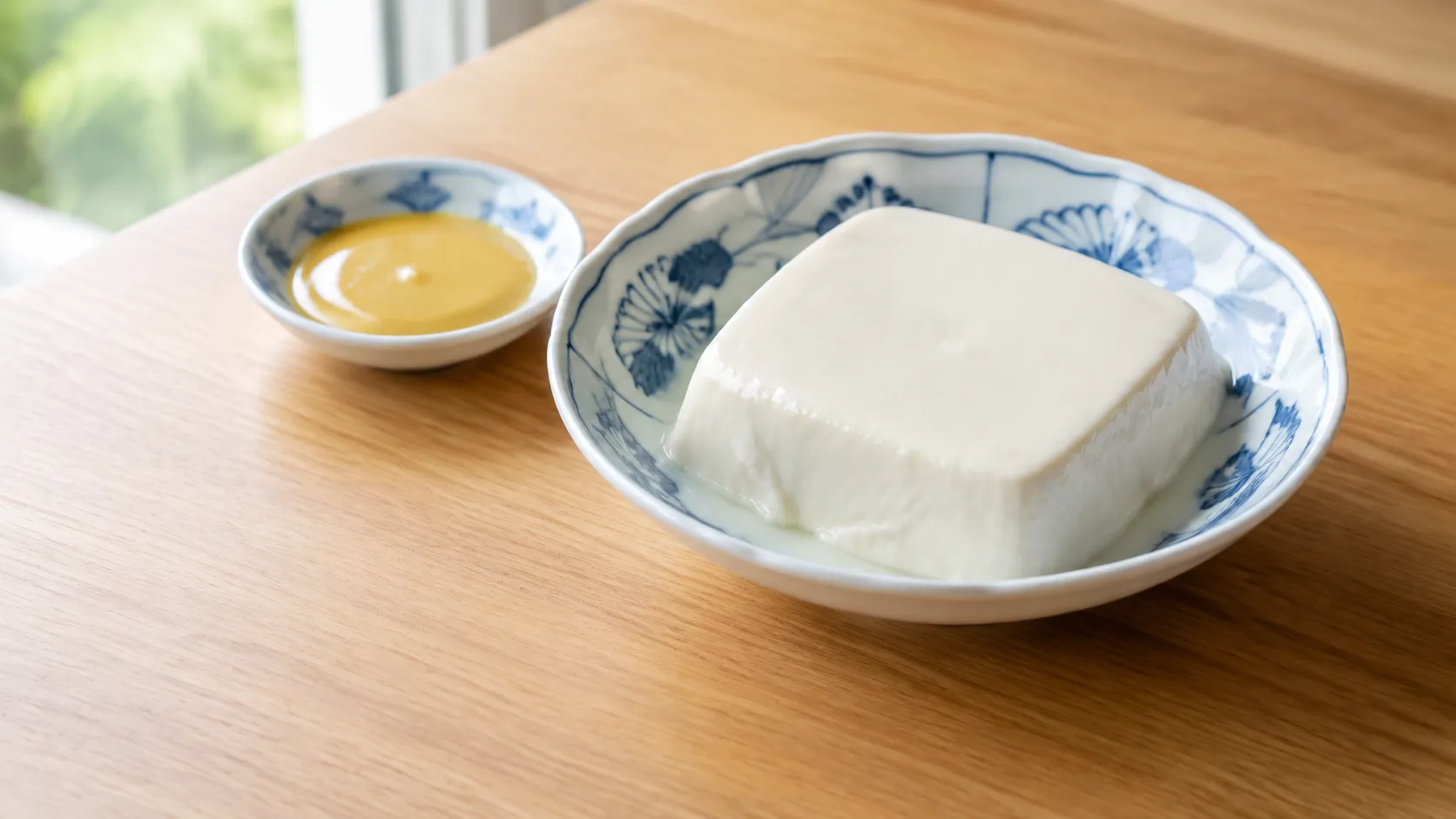
It sagged. Then it stretched. Then it very nearly went over the side of the bowl entirely, and I made a small panicked chopstick manoeuvre that I am not proud of, and the woman behind the counter started laughing at me without any attempt to hide it.
Share this dish


I tried to pick it up with chopsticks and it sagged, stretched, and very nearly escaped — which is when the shop owner started laughing at me from behind the counter.
🍜 Planning a food trip to Saga?Add this dish to my Food Trip →
 Add this dish to my Food Trip →
"Not like tofu," she said, and mimed a scooping motion. Scoop. Not pinch. Every instinct I had about how to pick up a white cube in a bowl was wrong, because this white cube has the structural integrity of a very determined pudding.
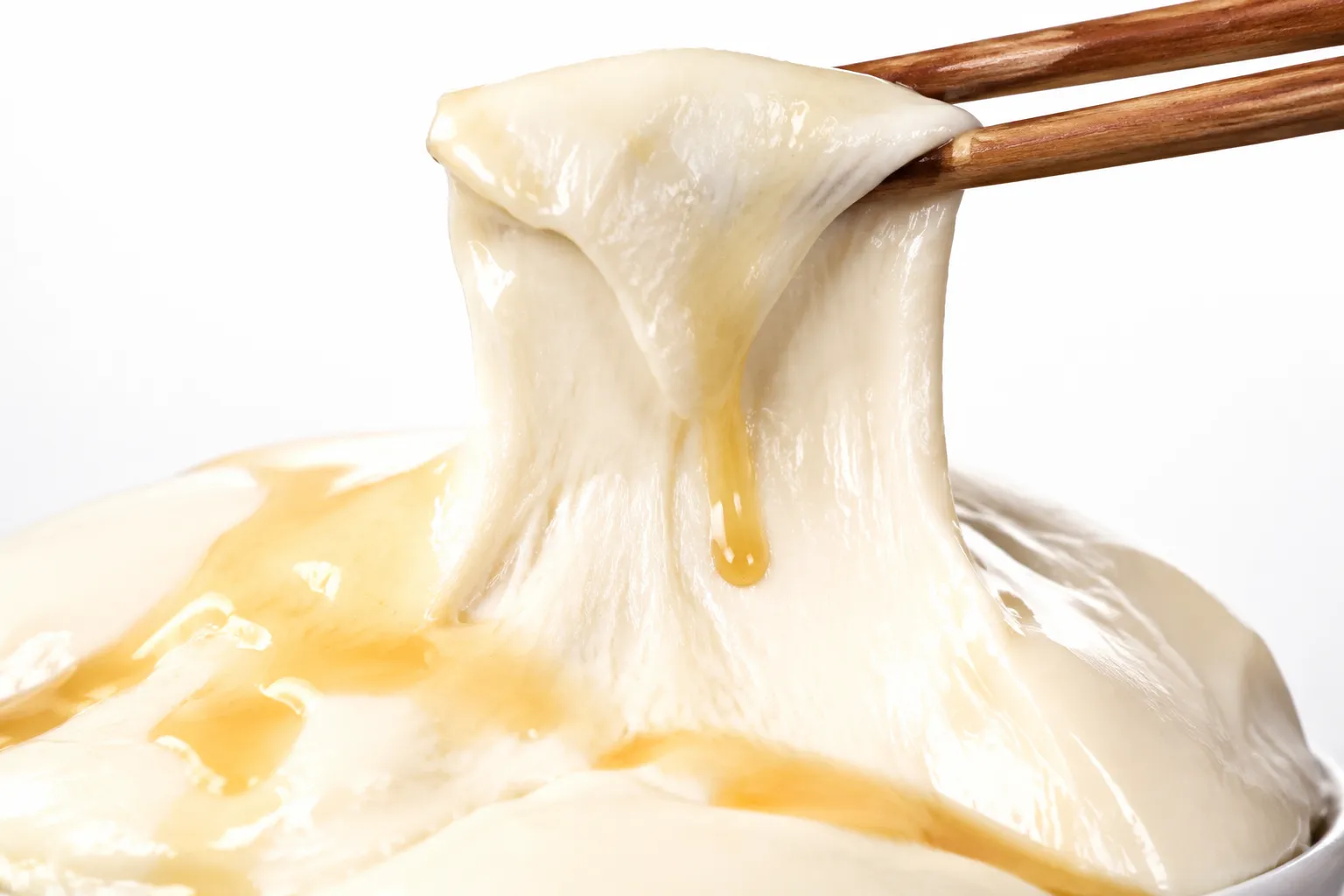
And then the taste, which was the second surprise: sweet. Not sugary — but soy-sweet, milky, rounder and fuller than tofu, with a slippery, sticky, almost custardy body that coated my mouth. Over the top, a pale yellow sweet vinegared miso that was doing exactly the job a sharp sauce should do against something that rich.
Godofu is Arita's own thing: soy milk thickened with starch rather than set with a coagulant, which technically disqualifies it from being tofu at all. It's soft, it's sticky, it wobbles alarmingly, and it comes from the town that makes Japan's most famous porcelain.
A soft food from a hard-fired town
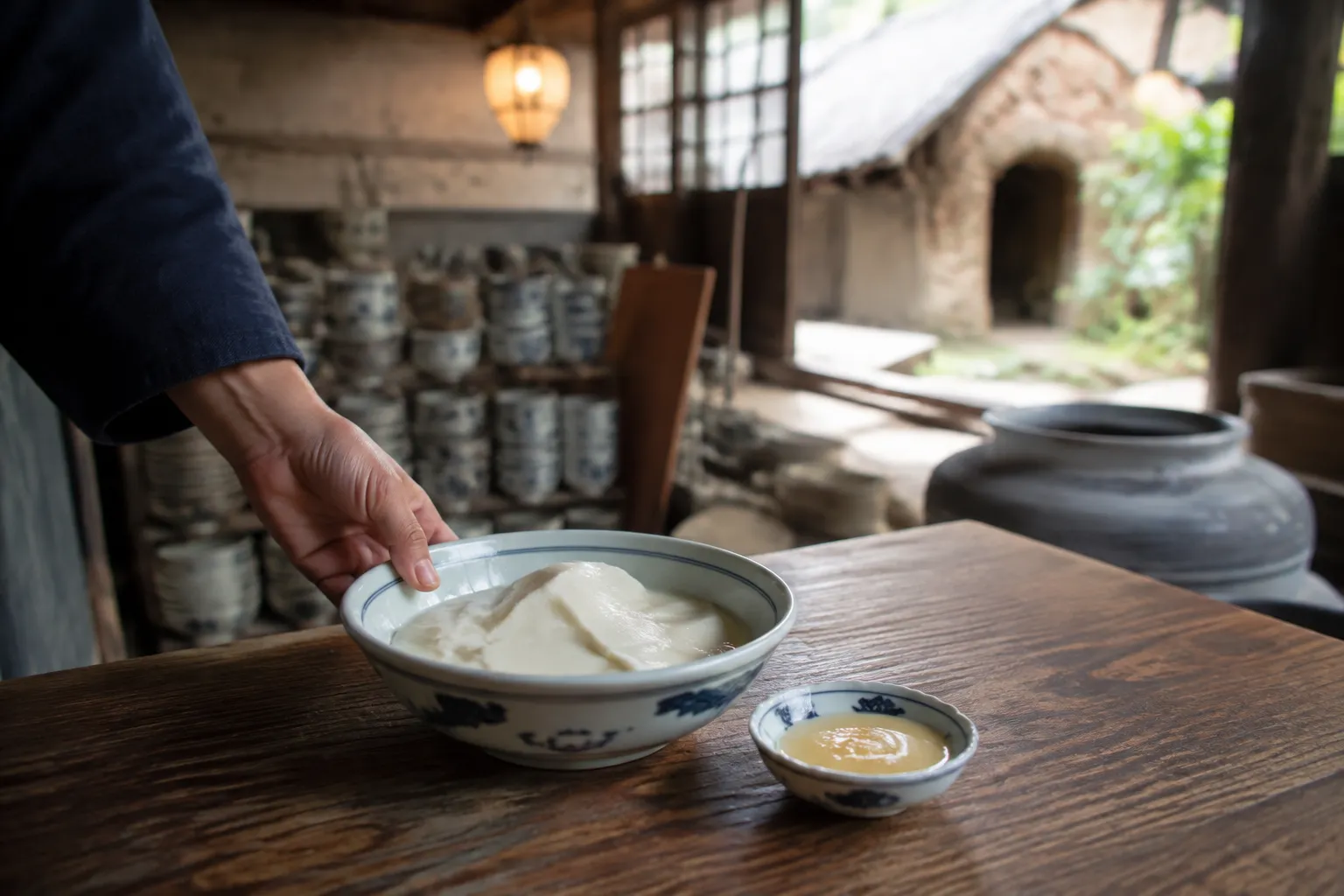
Arita is where Japanese porcelain began. In the early 1600s, kaolin clay was found in the hills here, and a town formed around firing it — four hundred years of kilns, and porcelain that shipped out through nearby ports to Europe, where it turned up on aristocratic tables under the name Imari.
Godofu grew up in that town. The usual explanation ties it to Buddhist temple cooking and to techniques that arrived with continental influence — a vegetarian food that could be made with what was on hand, no coagulant required, in a place with a lot of temples and a lot of workers who needed feeding. It's been a home and temple food here for a very long time, and it never really left the district.
What I keep circling back to is the pairing. This is a town whose entire identity is hard — fired clay, white porcelain, precision, permanence, objects made to survive centuries. And its local food is a soft, wobbling, barely-holding-together white thing, served on that porcelain, that you have to eat gently or lose.
I don't think that's meaningful. I just think it's wonderful. And eating godofu out of a genuine Arita bowl in Arita is one of those small alignments that makes a place feel like it fits together.
Why starch instead of a coagulant changes everything
Regular tofu is made by adding nigari — a mineral coagulant — to soy milk, which makes the proteins clump into curds that are then pressed. It's a curdling process, and it produces something that holds an edge, breaks cleanly, and weeps water.
Godofu skips that entirely. Soy milk is thickened with starch — kudzu or sweet potato starch, depending on the maker — and cooked until it sets on cooling. Nothing curdles. Nothing is pressed. There's no water to squeeze out, so nothing is lost.
The result is a food that is denser and richer than tofu while somehow also being far more fragile. It holds a cut square shape until you touch it, at which point it gives completely. It's slightly sticky. It's glossy. It has a faint elastic pull, from the starch, that tofu never has.
And it tastes more of soy than tofu does, because none of the flavour has been pressed out with the whey. Milky, gently sweet, clean.
The standard partner is sumiso — miso whipped with vinegar and a little sugar into a pale, tangy sauce — and it's the right call. Something this rich and this mild needs acid pushing back at it. Some places serve it instead with wasabi and soy, or ginger and soy, which is sharper and also good. In summer it's eaten cold as a light dish; some households eat it as something close to a dessert.
How it comes together
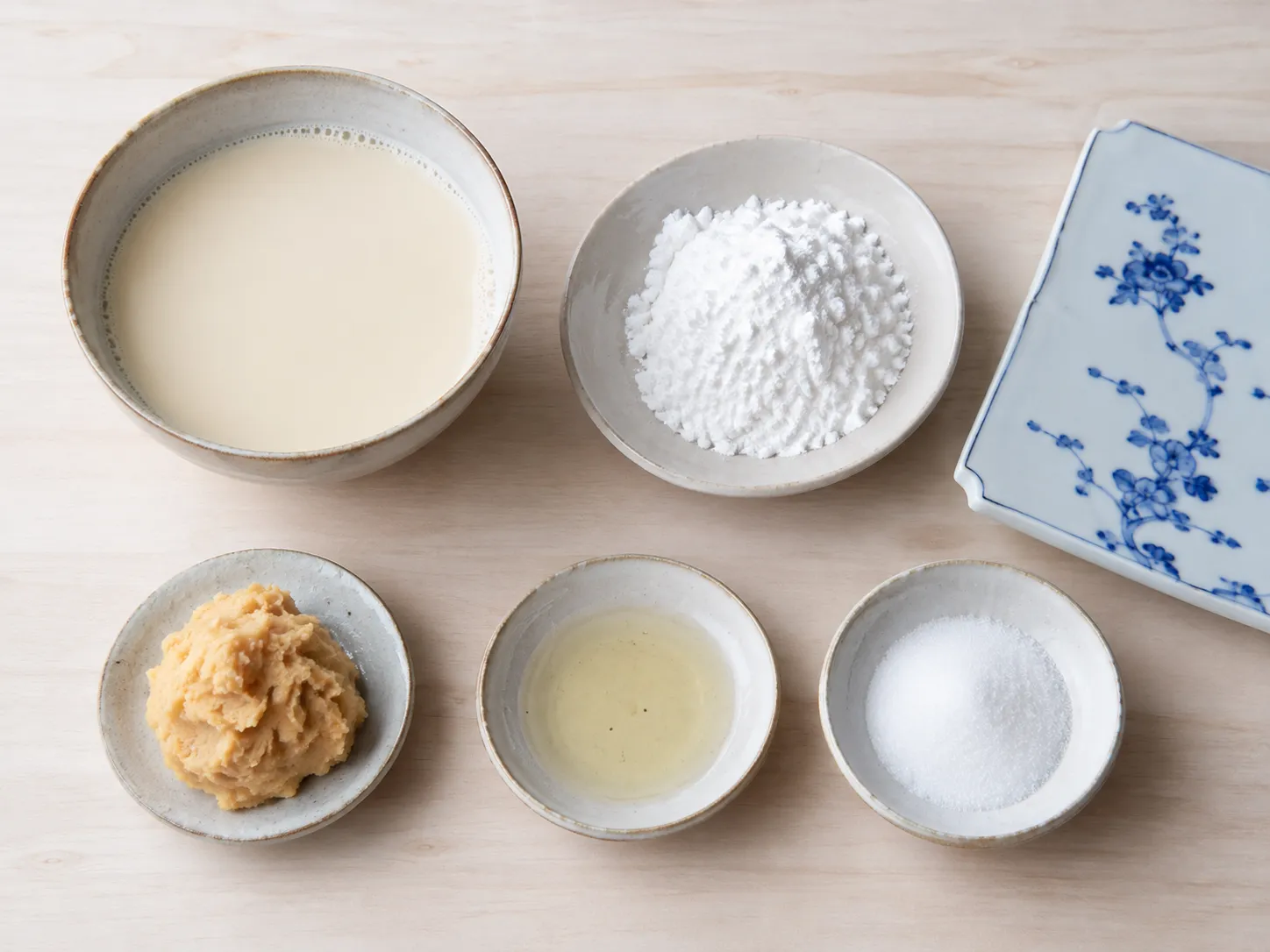
- Soak and grind soybeans, then strain to produce a thick soy milk — thicker than you'd use for ordinary tofu
- Dissolve kudzu or sweet potato starch into a little cold soy milk, then combine
- Heat while stirring constantly as the mixture thickens and turns glossy, pulling away from the pan
- Pour into a mould and cool until set — it firms as it cools, not as it cooks
- Cut into squares and serve with sweet vinegared miso, or with wasabi or ginger and soy
Step 3 will be familiar if you've ever made a starch-thickened sauce, and it has the same failure modes: stop stirring and you get lumps and a scorched base. Get it right and the mixture becomes heavy and glassy in a way that tells you it's done more clearly than any timer.
There's no pressing, no waiting for curds, no whey to discard. It's a same-day food, which is exactly why it's a home food.
Before you go — the stuff that actually matters
Your questions, answered honestly
"Is it actually tofu?" — Not by any technical definition, no. Real tofu is coagulated and pressed; this is thickened with starch. It's called tofu because it's white, wobbly, soy-based, and eaten in the same slot in a meal. Japan is comfortable with this. So am I.
"How is it different from goma-dofu?" — Goma-dofu, the famous temple version from places like Koyasan, uses ground sesame with kudzu and has no soy at all. Godofu uses soy milk with starch and no sesame. Same trick, different base — and godofu is markedly softer and stickier.
"Is it vegan?" — The block itself, yes. The sauce is the variable: sweet vinegared miso is usually fine, but some versions of it and some soy dips include dashi made with bonito. Ask.
"How do I pick it up without disaster?" — Scoop from underneath rather than pinching from the sides, and take smaller pieces than you think you need. Or use the spoon if one is offered. The shop owner who laughed at me was right and I have accepted it.
"Sweet or savoury?" — Savoury, mainly — but it sits close enough to sweet that a version with kuromitsu syrup or kinako as a dessert exists and is completely reasonable. If a shop offers both, get both. They're small.
"Does it keep?" — Not long. It's a fresh, same-day food and it's best eaten within a day or two refrigerated. It doesn't freeze well — the starch structure breaks and it turns watery. Buy it to eat there, not to carry.
"What else should I do in Arita?" — Look at porcelain. The town is walkable, the kiln district and its shops are the real attraction, and the huge ceramic fair held over Golden Week in late April and early May draws enormous crowds. Eat godofu out of something you're about to buy.
What the staff will ask you
| You'll hear | Romaji | Meaning | Just say |
|---|---|---|---|
| 酢味噌とわさび醤油、どちらにしますか? | Sumiso to wasabi-jōyu, dochira ni shimasu ka? | "Sweet vinegared miso or wasabi soy?" | Sumiso de (sumiso, please) |
| 崩れやすいので気をつけて | Kuzureyasui node ki o tsukete | "It falls apart easily, be careful" | Hai, ki o tsukemasu (I'll be careful) |
| 日持ちしませんがよろしいですか? | Himochi shimasen ga yoroshii desu ka? | "It doesn't keep — is that alright?" | Hai, kyō tabemasu (yes, I'll eat it today) |
| 何丁にしますか? | Nan-chō ni shimasu ka? | "How many blocks?" | Ichi-chō kudasai (one, please) |
| 器は有田焼です | Utsuwa wa Arita-yaki desu | "The bowl is Arita porcelain" | Kirei desu ne (it's beautiful) |
To order, just say "Godofu kudasai" (ごどうふください) — "Godofu, please."
Where to eat it
- Arita town's kiln district and its restaurants — the home of the dish, often served on local porcelain, and easy to combine with a day looking at ceramics.
- Tofu shops and local food shops around Arita and Imari — where you can buy a block fresh from the maker, which is the best version there is.
- Roadside stations and set-meal restaurants across western Saga — the practical option, where it turns up as one dish in a larger local spread.
This is a fresh, small-batch, locally made food — shops sell out, some make it only on certain days, and the Arita ceramic fair period transforms the town completely. Check ahead if you're travelling for it.
Soul Score
Local Roots5/5
First-Timer Friendly4/5
Adventure Level4/5
Comfort Level5/5
Travel Worthy4/5
These scores are one obsessed eater's gut feeling — not a verdict. A low number isn't a bad mark, just a different kind of adventure.
Know someone planning Japan?
← All Articles
Local Food · Arita, Saga
Still hungry?
Eat more from Saga
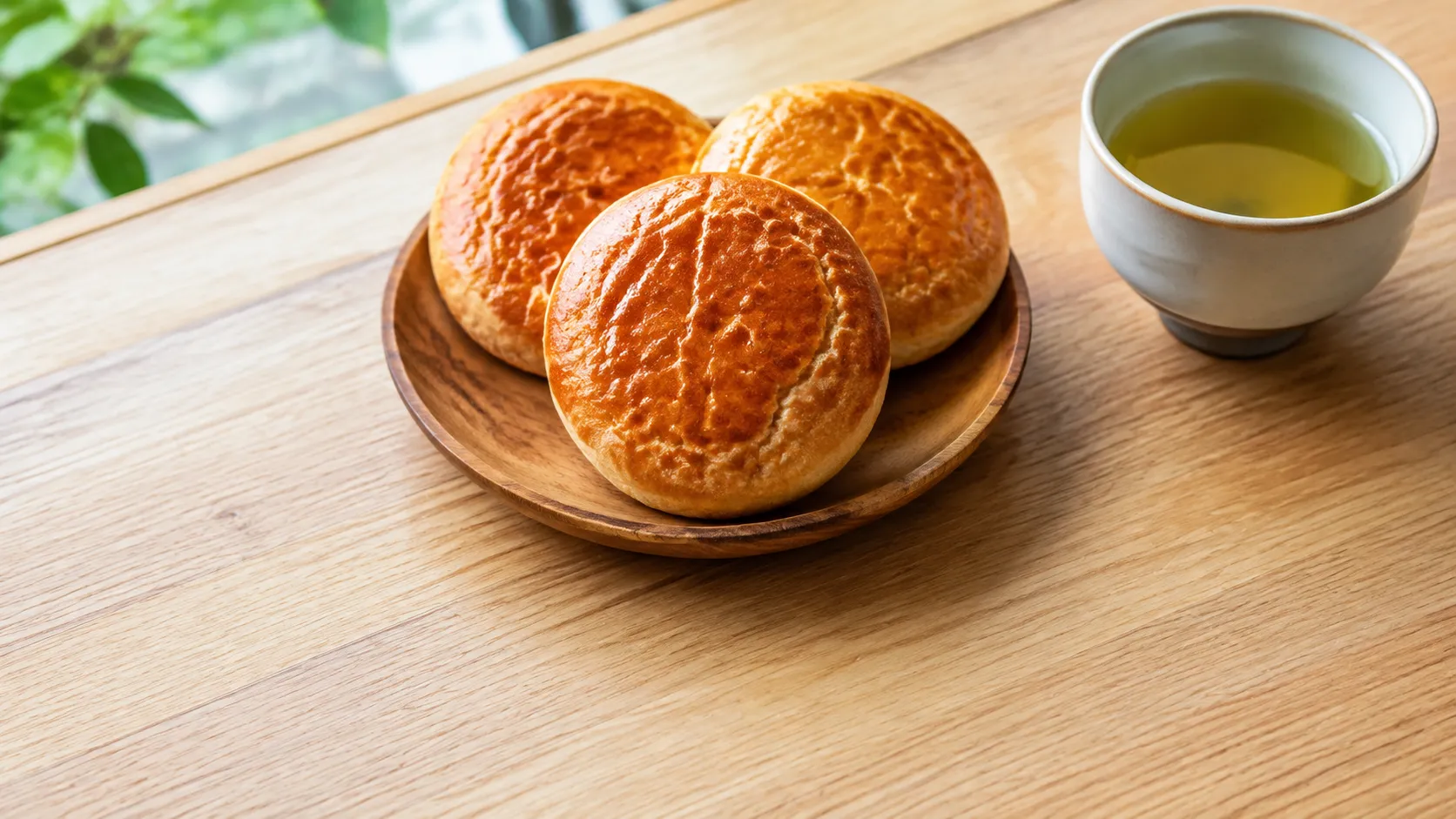
Sweets & SnacksSaga
Maruboro (丸ぼうろ)
It looks like the most boring biscuit in Japan. Then you bite it and it's soft, and honey-warm, and about four hundred years of Portuguese sailors arrive all at once.
September 2, 2026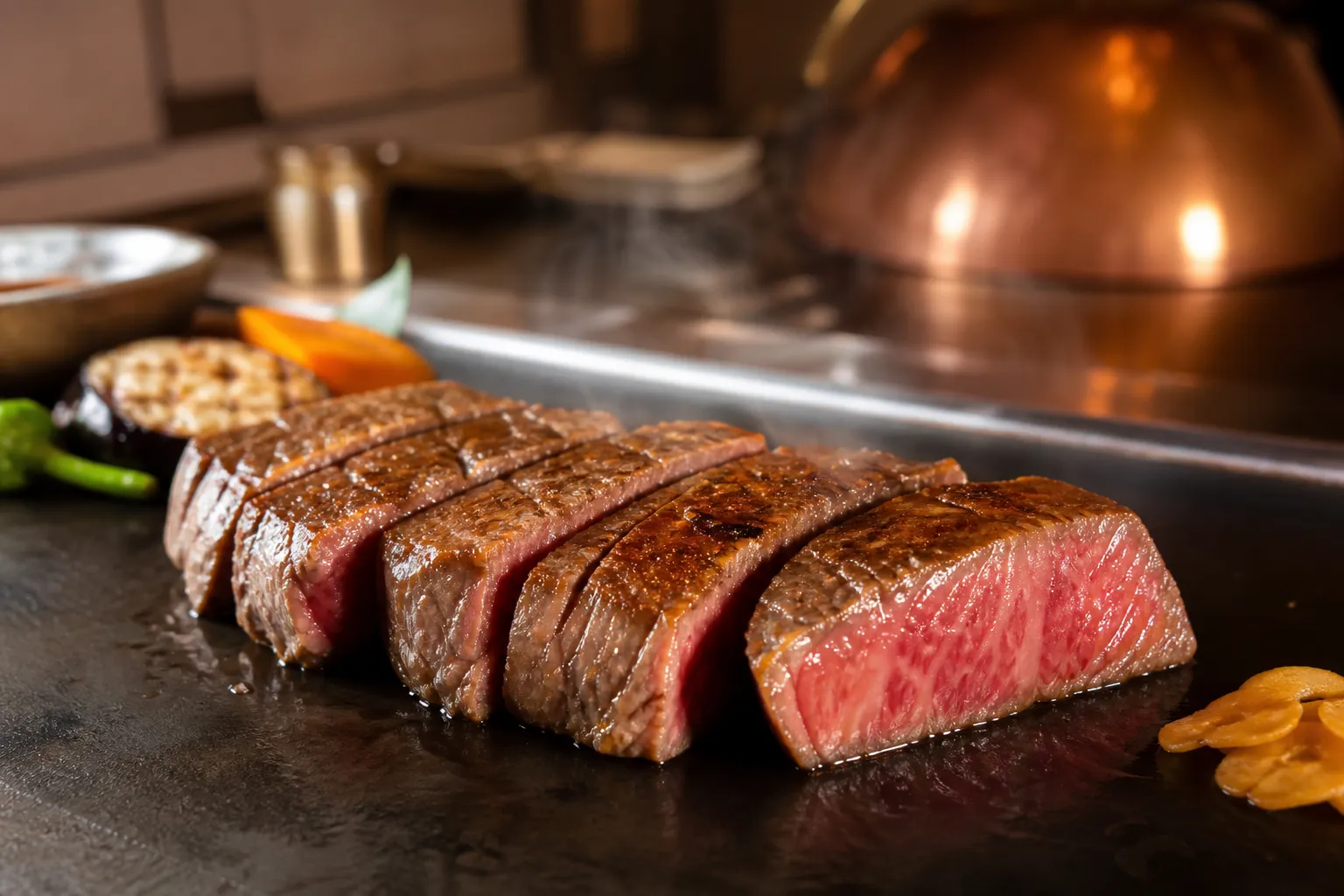
Local FoodSaga
Saga Beef (佐賀牛)
Marbled Kyushu wagyu seared on a screaming-hot iron plate until the fat crackles and the crust goes brown — Saga's strictly-graded beef, and the best steak reason to stop in Japan's quietest prefecture.
July 12, 2026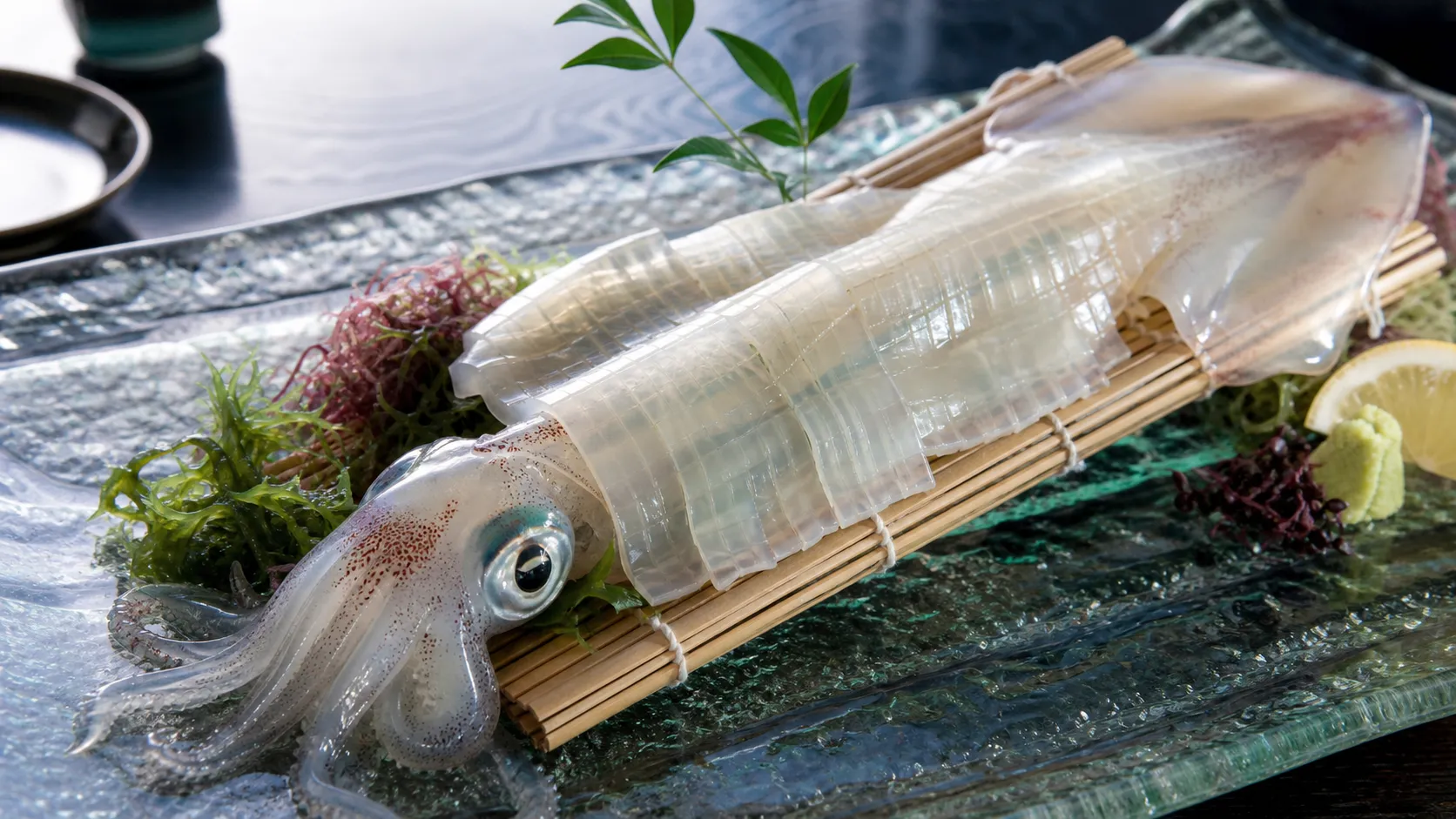
Local FoodYobuko, Saga
Yobuko Squid, Ika Ikizukuri (呼子のイカ活造り)
Squid so fresh the body is still glassy-clear and the legs are still moving when it reaches your table — sweeter and cleaner than any squid you thought you knew, at the little port that made it famous.
July 12, 2026