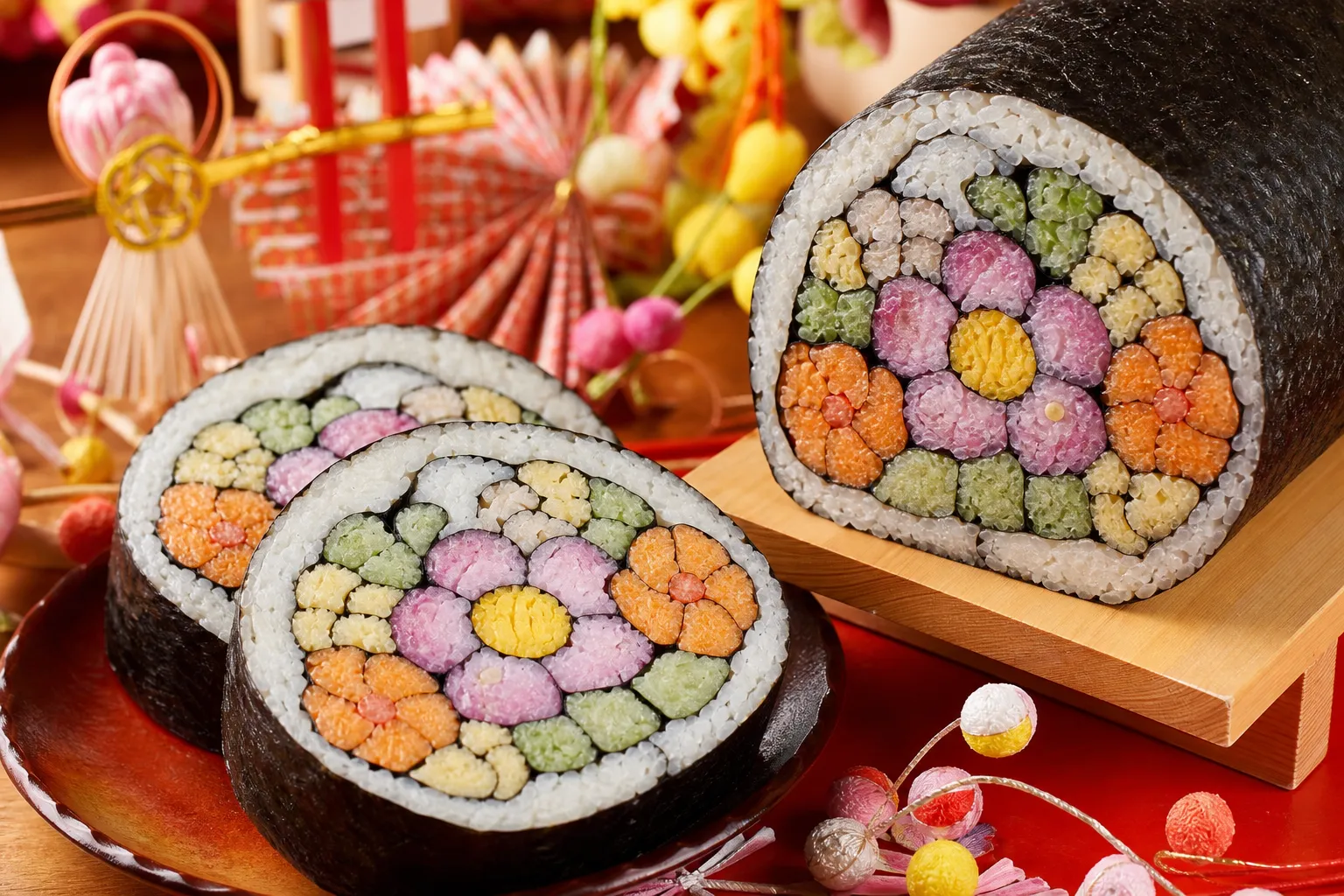
Someone lifts a knife, slices through a roll as thick as your wrist, and lays the piece down facing you — and there, staring back from the cut rice, is a pink flower with a yellow center and green leaves, drawn entirely in food. I actually laughed out loud the first time. It's a picture. In the sushi. And then you eat the picture, and it's just... good sushi, lightly sweet and vinegared, and your brain can't decide whether to be impressed or hungry. Both. The answer is both.
Share this dish


Someone slices a fat sushi roll in front of you and a full-color flower blooms out of the cut face — this is edible pixel art from the rice paddies of Chiba, and it is absurd and glorious.
🍜 Planning a food trip to Chiba?Add this dish to my Food Trip →
 Add this dish to my Food Trip →
Here's what it is: futomaki matsuri-zushi (太巻き祭り寿司) is a giant decorative sushi roll from Chiba engineered so that its cross-section is a picture — a camellia, a plum blossom, a butterfly, sometimes a cartoon face — built from rice tinted different colors (pink from denbu, yellow from egg, green from herbs or nori) and precisely arranged fillings rolled in stages. That's the whole point: it is not a plain fat futomaki, not an ehomaki you eat silently facing a lucky direction, and definitely not a hand roll. It's craft sushi that hides a painting inside, and the reveal is the whole show.
Festival food from the Boso rice country
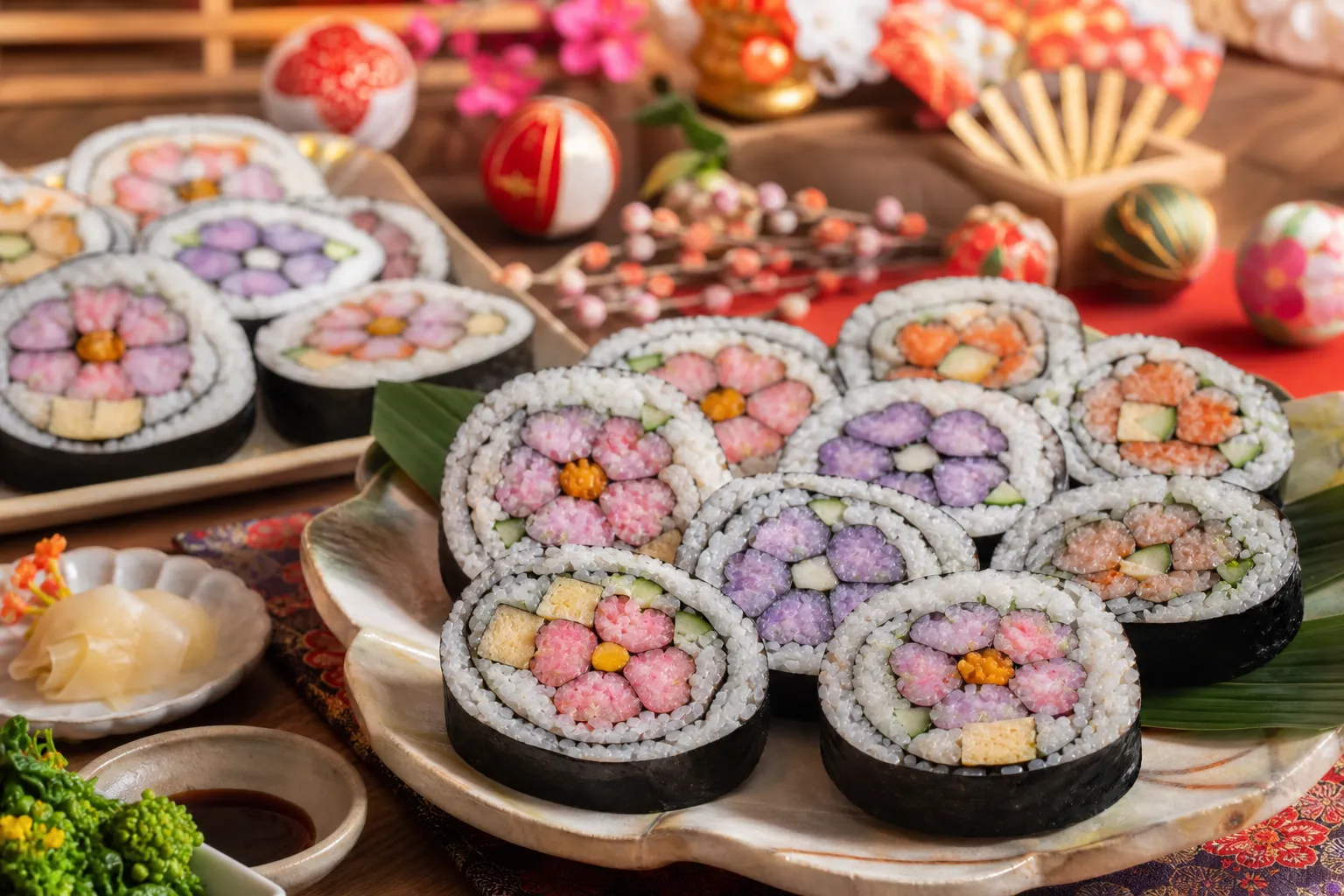
This is farmhouse celebration food, born in the Boso Peninsula where Chiba's rice paddies meet the sea. When there was a festival, a wedding, a New Year, a big gathering — someone in the family, usually the grandmother, would sit down and build one of these, because a roll with a flower inside says "this is a special day" louder than any plain sushi ever could. It's農村 hospitality made visible: you feed your guests, and you also make them gasp.
I find that genuinely moving. Somebody's great-grandmother worked out how to draw with rice and fish, purely to make the people she loved smile at a table — and that knowledge got passed down, hand to hand, as matsuri-zushi, "festival sushi." Chiba has leaned into it hard: there are local associations, teachers, and competitions keeping the technique alive, and the designs have only gotten wilder. Traditional plum blossoms, sure, but also pandas, hearts, and characters. It's folk art you're allowed to eat.
What makes the eating experience different
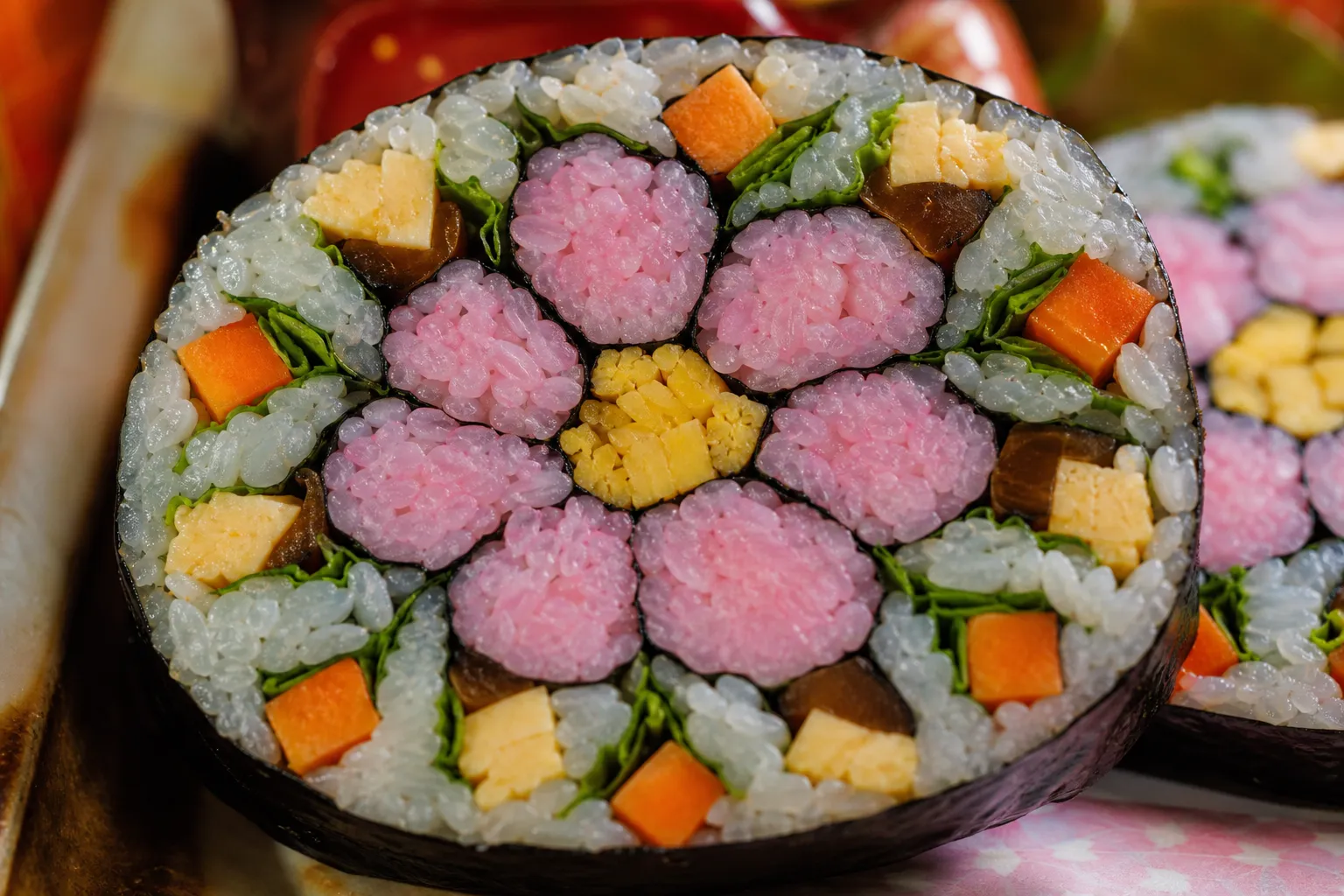
- The reveal is the dish. Whole, it's just a fat log. Sliced, it's a bouquet. Nothing else at the table has a punchline like this.
- Color you can taste. The pink is sweet fish flake (denbu), the yellow is egg, the green is herb or nori — the palette isn't dye for show, it's flavor, so the picture is made of actual ingredients.
- Mild and gently sweet. The rice is soft, lightly sweet-vinegared celebration rice; the fillings are savory and calm. It's easy-to-love flavor wrapped around a hard-to-believe look.
- It's a gift, not a snack. A cut roll is generous, shareable, photogenic — this is food designed to be brought to people and passed around.
- Every maker's flower is different. One grandmother's camellia isn't another's; the design tells you who made it.
How it's made
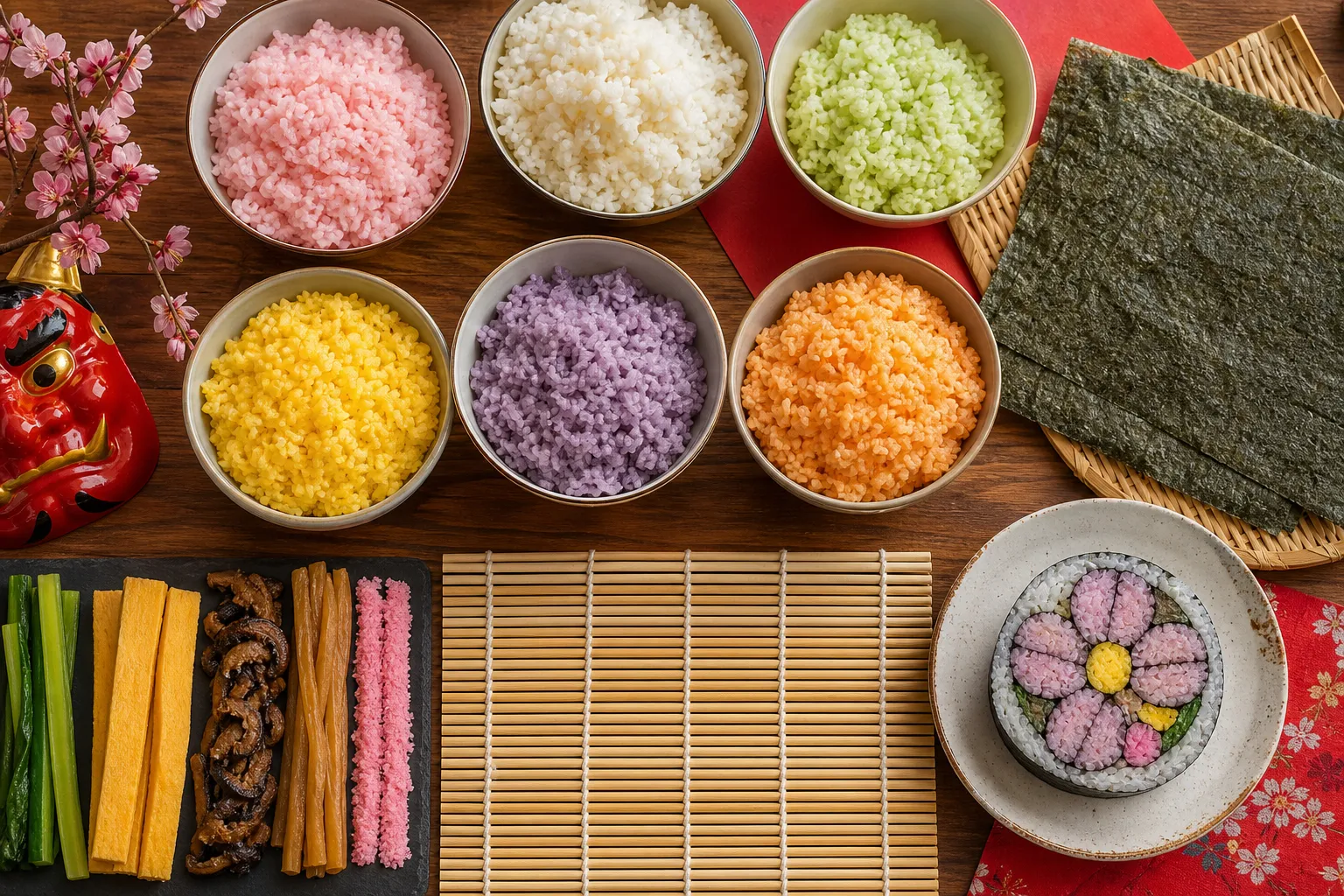
- Tint the rice. Batches of vinegared sushi rice are colored separately — pink with denbu, yellow with egg or kanpyō, green with herbs or aonori — plus plain white.
- Build the small parts. Petals, centers and leaves are pre-rolled as thin sub-rolls or shaped columns, each wrapped in nori — the "pixels" of the final picture.
- Assemble on a big sheet. On a large nori sheet spread with rice, the maker arranges the pre-made parts in exactly the right positions so the design will appear when cut.
- Roll it all together. Everything is rolled up into one thick log with a bamboo mat, pressing firmly so nothing shifts.
- Slice and gasp. A sharp, wiped-between-cuts knife slices the log crosswise — and the flower (or face, or butterfly) appears on every single piece.
The craft is all in the planning: the maker is thinking in cross-section the entire time, placing colors blind and trusting that the cut will prove them right. Get it wrong and it's a smear; get it right and it's a bloom.
Before you go — chase the reveal in Chiba
Your questions, answered honestly
"How is this different from a normal futomaki or an ehomaki?" — A plain futomaki is a fat roll with a row of fillings; an ehomaki is the uncut lucky roll you eat whole at Setsubun. Matsuri-zushi is engineered so the cut face is a picture — tinted rice, pre-built petals, the works. Same family, entirely different ambition.
"Is it sweet or savory?" — Gently both. The rice is soft and lightly sweet-vinegared, the fillings (egg, denbu, gourd, herbs) are mild and savory. Nothing raw or fishy-strong is required, which is part of why it's crowd-pleasing celebration food.
"Can I actually find it as a traveler, or is it a home-only thing?" — Both exist. Home versions are the soul of it, but you can buy it: look at Chiba roadside stations (michi-no-eki), farm markets, department-store food halls around celebrations, and festival stalls. Availability is seasonal and maker-dependent, so it's a hunt.
"Do I eat the whole picture at once?" — Each slice is one picture, so yes — one piece, one flower, one bite (or two). It's meant to be shared, so grab a few slices and admire before you demolish them.
What the staff will ask you
| You'll hear | Romaji | Meaning | Just say |
|---|---|---|---|
| 何切れにしますか? | Nan-kire ni shimasu ka? | "How many slices?" | Yon-kire kudasai (four, please) |
| どの柄にしますか? | Dono gara ni shimasu ka? | "Which design?" | Osusume de (your recommendation) |
| お持ち帰りですか? | O-mochikaeri desu ka? | "Is this to take away?" | Hai, mochikaeri de (yes, to go) |
To order, just say "Futomaki matsuri-zushi o kudasai" (太巻き祭り寿司をください) — "Festival sushi roll, please."
Where to eat it
- Chiba roadside stations (michi-no-eki) and farm markets on the Boso Peninsula — local makers often sell cut rolls here, and it's the most reliable way for a traveler to find the real thing.
- Department-store food halls (depachika) in Chiba around celebrations — seasonal and New Year counters sometimes carry decorative matsuri-zushi.
- Local festivals and food events in Chiba — the dish's home turf; festival stalls and demonstrations are where you'll see it sliced live.
Matsuri-zushi is craft/celebration sushi, not standard convenience-store fare — availability is seasonal and varies by maker, so check ahead and grab it when you spot it.
Soul Score
Local Roots5/5
First-Timer Friendly4/5
Adventure Level4/5
Comfort Level4/5
Travel Worthy4/5
These scores are one obsessed eater's gut feeling — not a verdict. A low number isn't a bad mark, just a different kind of adventure.
Know someone planning Japan?
← All Articles
Local Food · Chiba
Still hungry?
Eat more from Chiba
Local FoodBoso Peninsula, Chiba
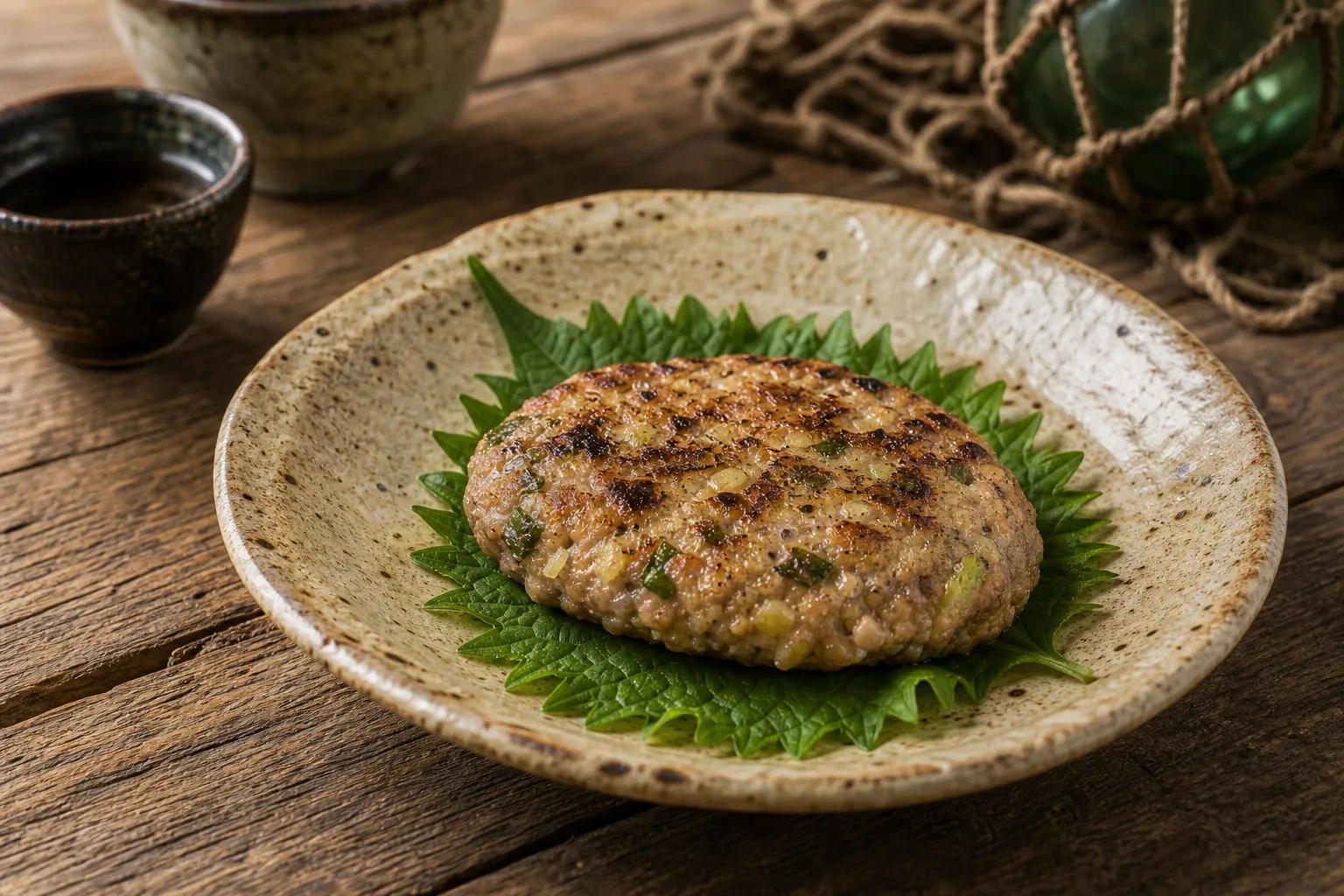
Sanga-yaki (さんが焼き)
Fresh fish, pounded on a board with miso and ginger until it turns to paste, patted into a little patty on a shiso leaf, and seared until the edges go brown and the whole boat smells like dinner.
July 12, 2026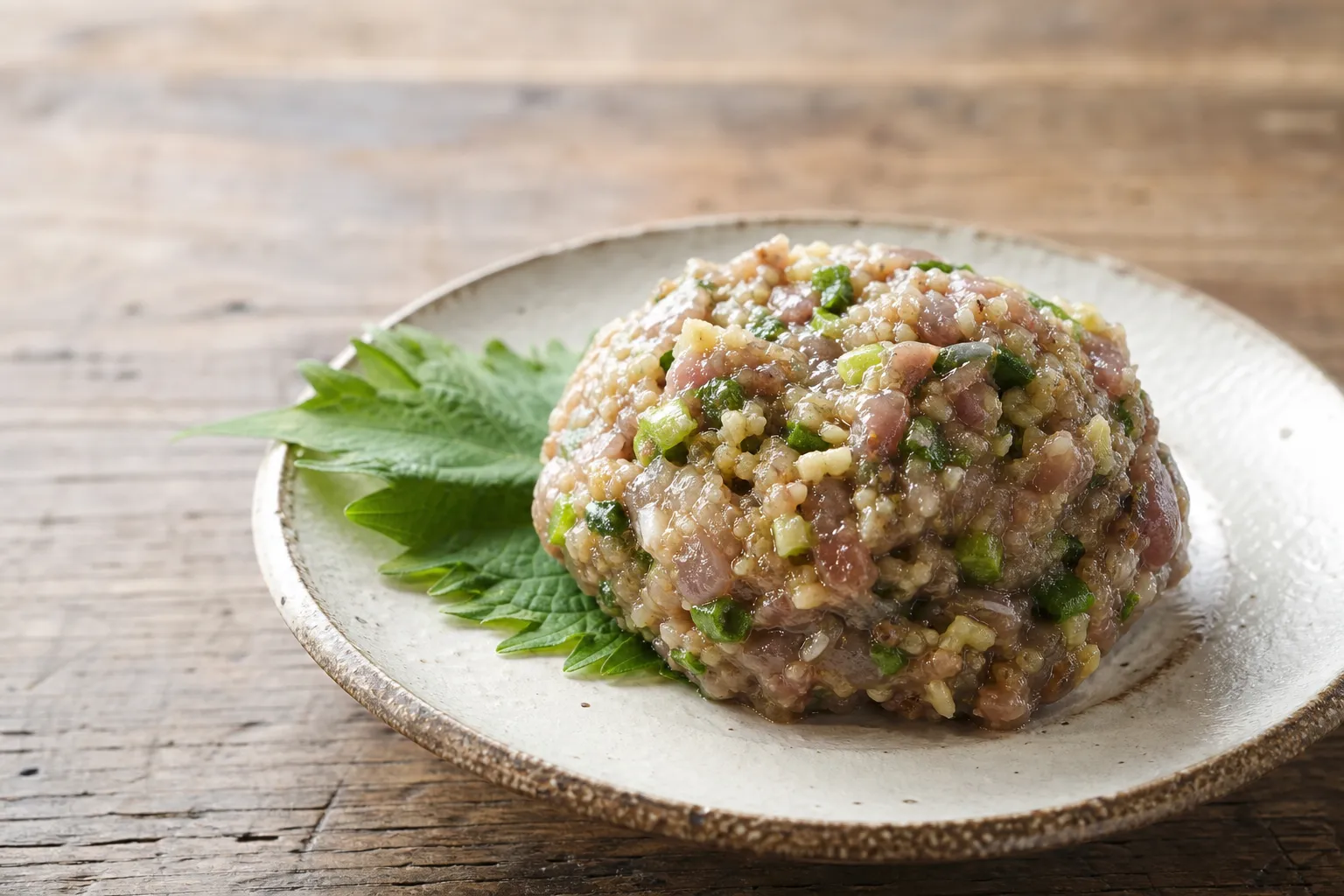
Local FoodChiba
Namero (なめろう)
Fishermen chopped their catch with a blob of miso until it turned into a sticky, savory paste — and refused to wait for a kitchen to do it properly.
July 5, 2026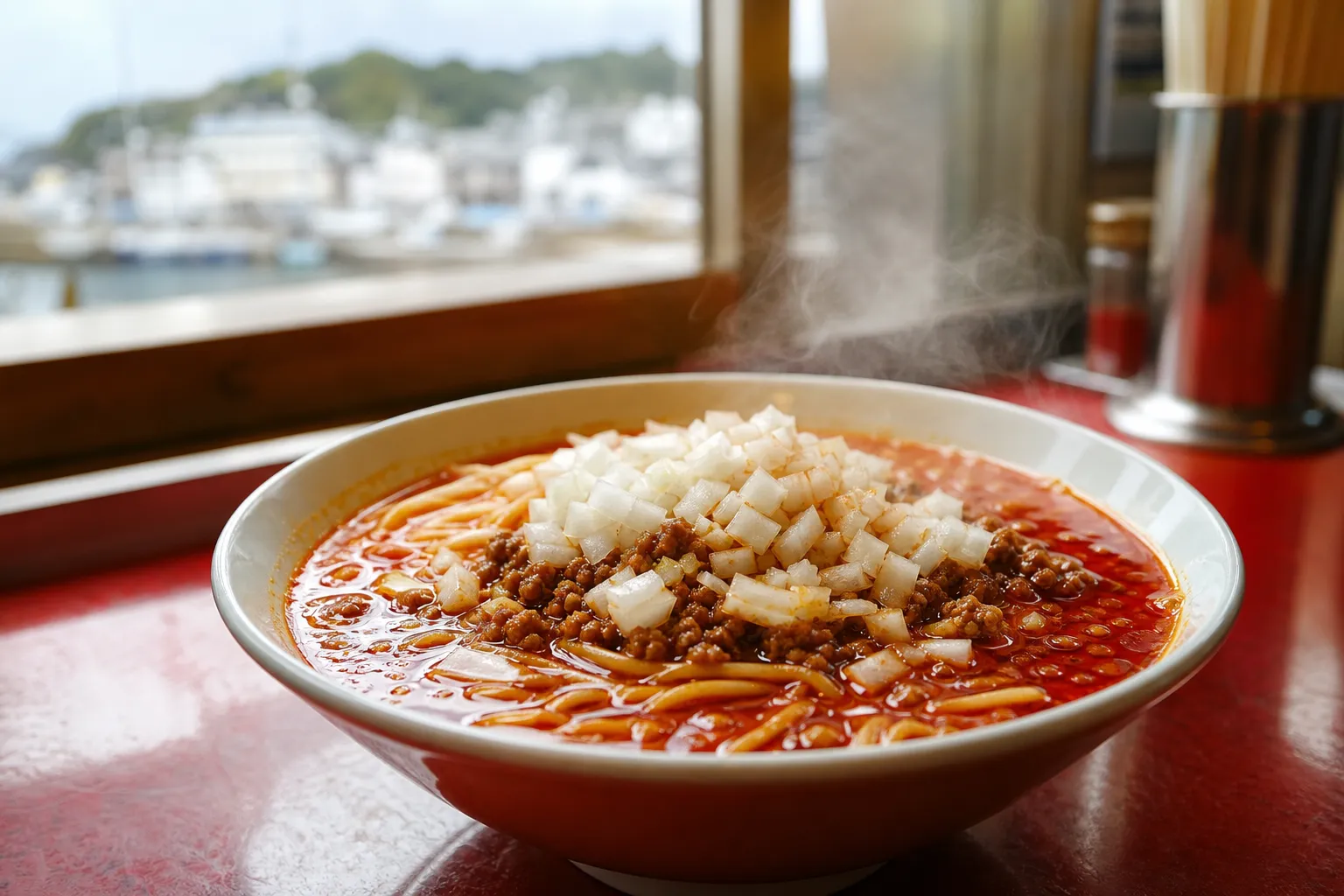
Local FoodKatsuura, Chiba
Katsuura Tantanmen (勝浦タンタンメン)
Not the creamy sesame tantanmen you know. This is a bowl of fire-red chili oil, minced pork and raw onion, invented by fishermen to thaw out after a freezing morning at sea. It bites back.
June 28, 2026