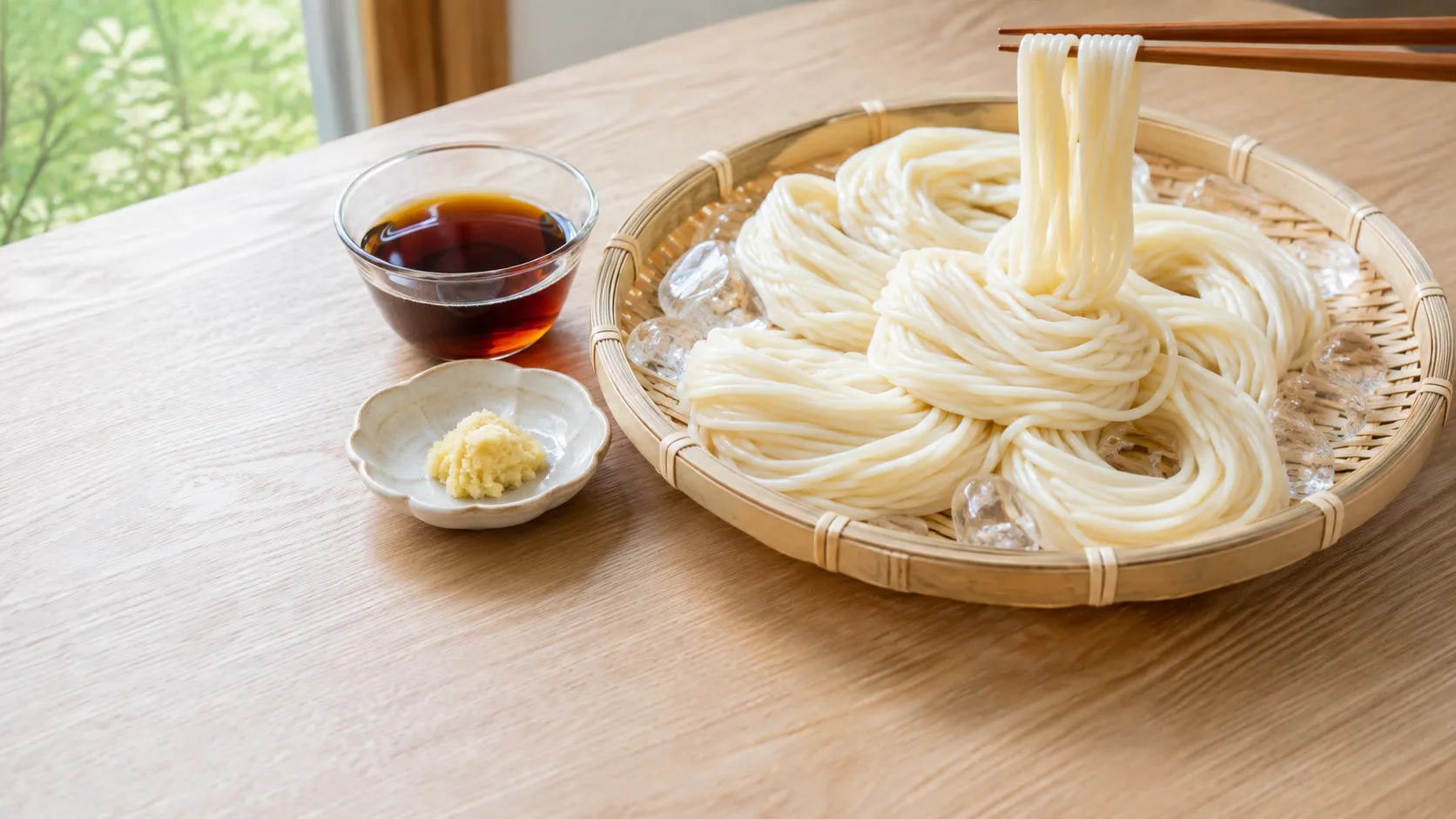
I lifted a bundle out of the ice water and something was wrong with it.
Share this dish


🍜 Planning a food trip to Tokushima?Add this dish to my Food Trip →
 Add this dish to my Food Trip →
Somen is delicate. That's the entire deal with somen — hair-thin, almost weightless, over so fast you barely register the texture. It's the noodle you eat in August when it's too hot to want food, and the pleasure is in how little it asks of you.
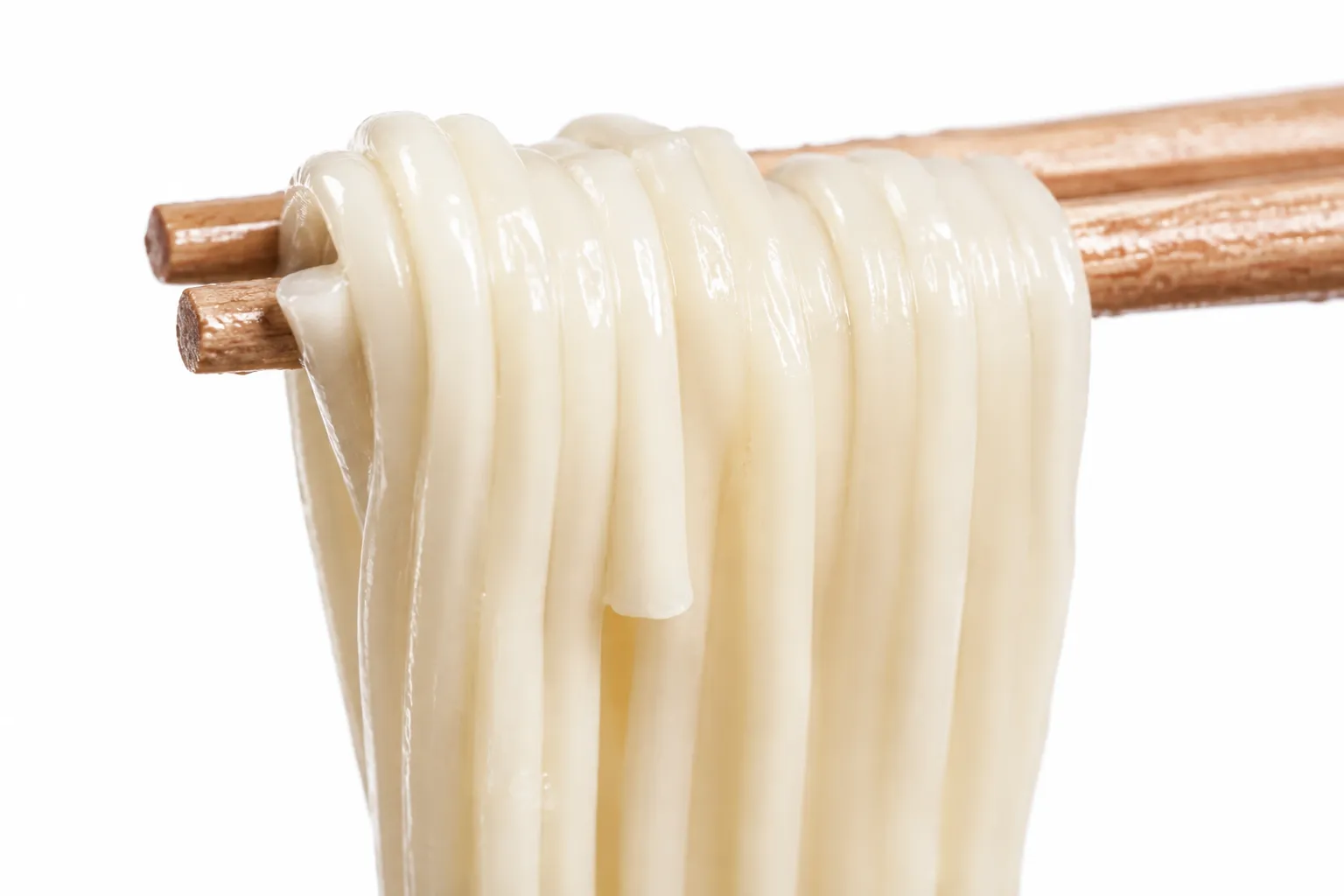
This was not that. These strands had heft. They hung off the chopsticks with a slight droop instead of floating, and when I bit down there was resistance — an actual chew, springy and firm, that lasted long enough to notice and enjoy. I sat there working my way through a bowl of what I'd been told was somen and quietly deciding that everyone else's somen had been slightly disappointing this whole time and I hadn't had the vocabulary to say so.
Handa somen is made in a river valley in western Tokushima and is deliberately, defiantly thicker than somen is supposed to be. There is a national standard for how thick a noodle can be and still use the name. Handa's is on the wrong side of it. They call it somen anyway, they have done for two hundred years, and honestly, good.
Noodles that came up a river
The Yoshino River runs the width of Shikoku, and before roads mattered it was the highway. Boats moved goods and people up and down it, and the town of Handa sat on that route.
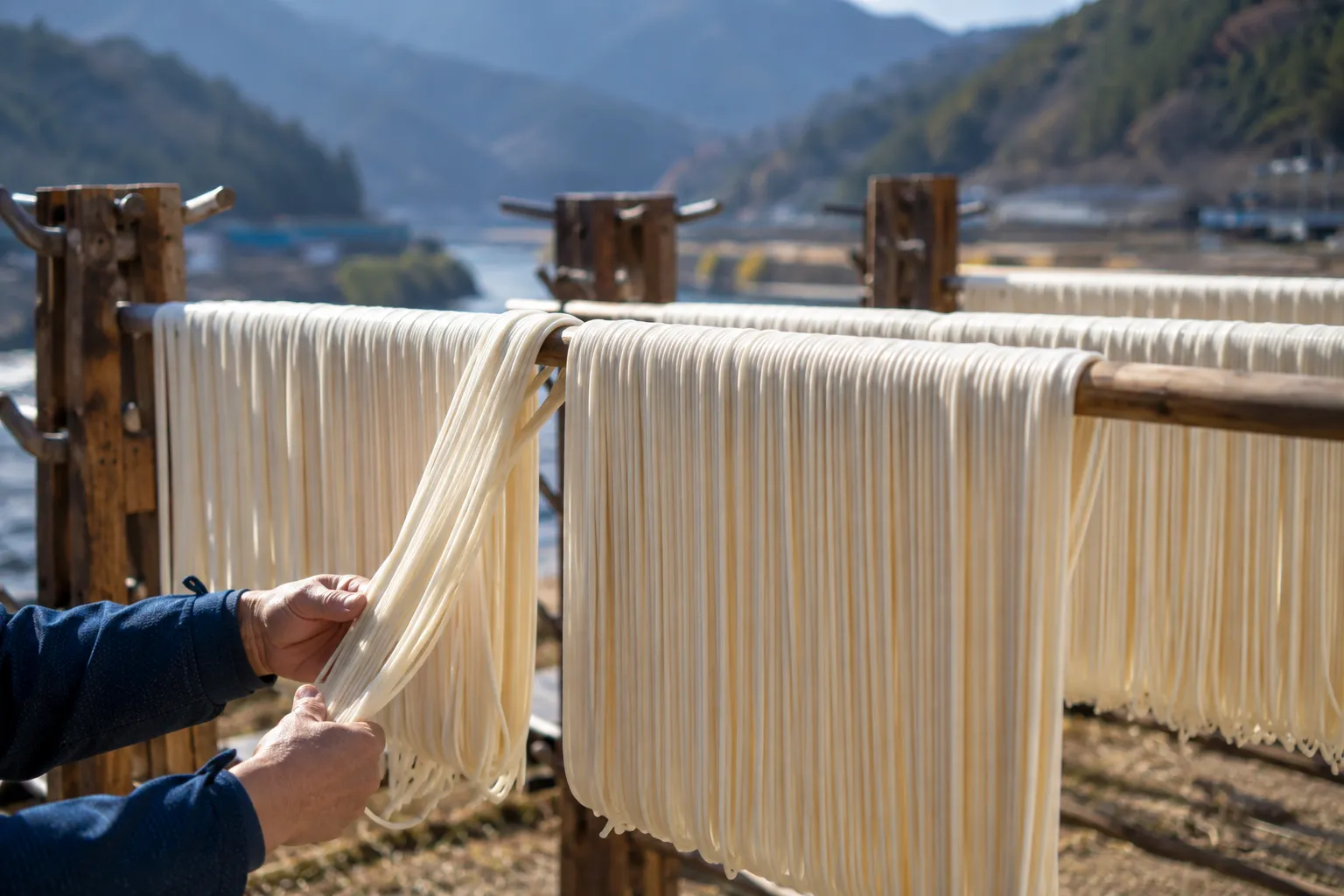
The story goes that boatmen from this valley, travelling on business as far as the Miwa area of Nara — the place generally credited as the birthplace of Japanese somen — brought the noodle-making technique home with them a couple of centuries ago. Handa had what the craft needs: wheat, clean water off the mountains, and cold dry winter winds coming down the valley for drying.
Then they changed it. Whether that was a deliberate decision or a local habit that hardened over generations, nobody can quite tell you, but Handa's noodles came out thicker than Miwa's and stayed that way.
Which puts them in a strange bureaucratic position. Japan's standards define somen, hiyamugi and udon by diameter, in millimetres, and by that measure a fair amount of what Handa produces sits in hiyamugi territory. It's sold as somen regardless, under a long-standing traditional-name allowance, and locals will tell you the standard is the thing that's wrong.
I find that quietly delightful. A whole valley, two hundred years deep in a craft, being informed by a national specification that its noodle is technically a different noodle — and continuing exactly as before.
Why thicker turns out to be better
Here's what thickness buys you: time.
A hair-thin noodle is gone the moment it hits your mouth. There's no chew to speak of, no window in which to notice anything. Handa's extra fraction of a millimetre gives the strand enough body to push back for a second or two — a smooth, round, springy resistance with a clean snap at the end — and suddenly the noodle is an ingredient instead of a vehicle.
That firmness comes from the making, not just the size. These are hand-stretched over and over, which aligns the gluten along the strand and gives it that directional, elastic chew. Sesame oil is worked in during stretching to keep the strands from fusing, and it leaves a faint richness behind.
Practically, it also means the noodles hold up. Ordinary somen goes soft and sad if it sits in its water for two minutes. Handa somen tolerates a slow eater, which sounds like a small thing until you're eating outdoors in summer and it isn't.
The classic serving is cold, on ice, with a cold dipping tsuyu, grated ginger and green onion. But the thickness also makes it genuinely good hot, as nyumen — noodles in a warm broth — which is a winter dish here and which thin somen frankly cannot pull off without collapsing.
How it comes together
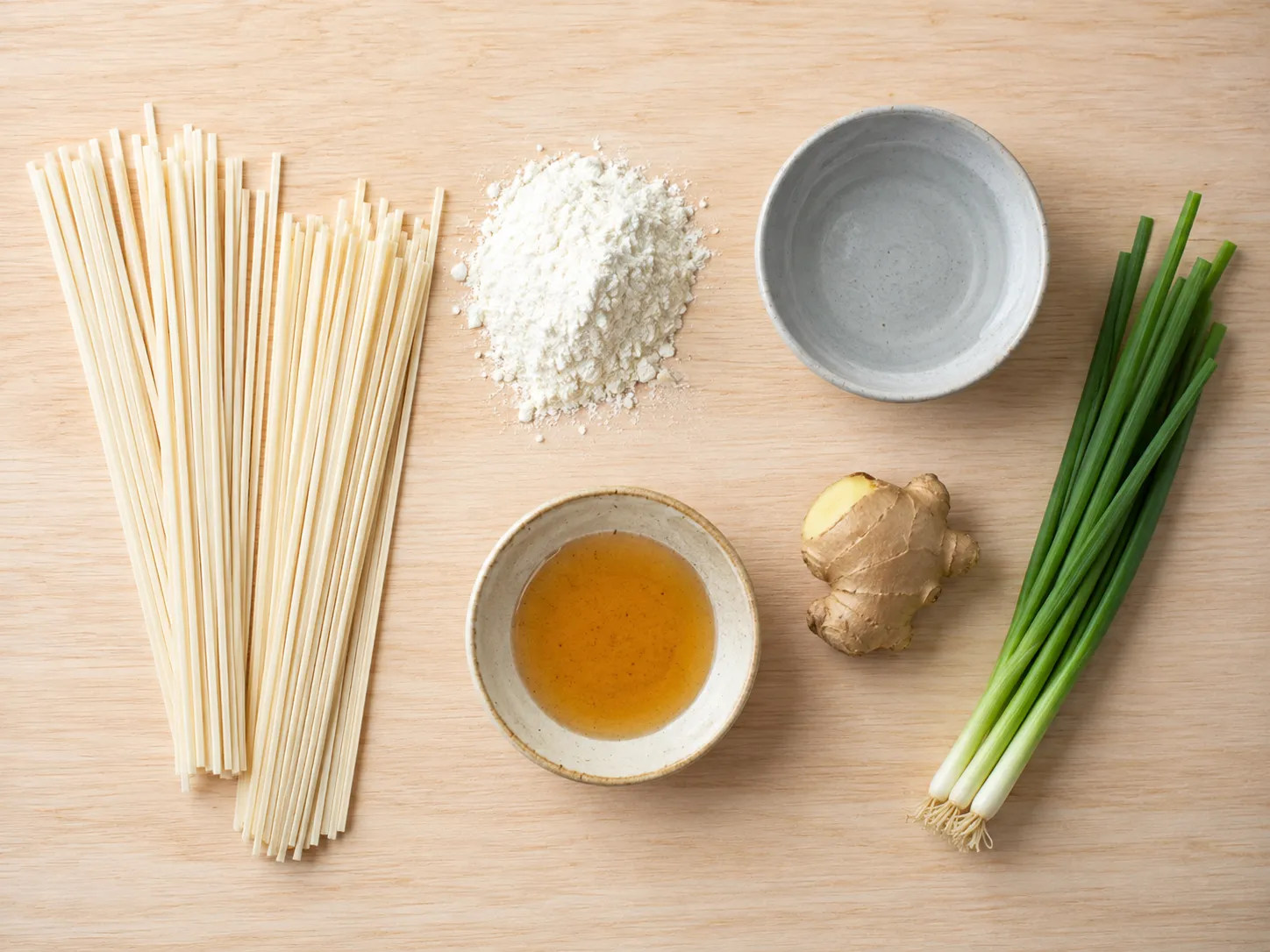
- Knead wheat flour with salted water into a firm dough, adjusting the salt to the day's temperature and humidity
- Rest, then cut the dough into a long rope and coil it, oiling with sesame oil as you go
- Stretch, rest, stretch again — repeated over hours, each pass thinning the strand while the resting lets the gluten relax
- Hang the strands on tall wooden racks in the cold winter valley wind and draw them apart with long rods to their final thickness
- Dry, cut to length, and bundle
Step 3 is why this is winter work. Handa's noodle-making season runs through the cold months, because temperature and humidity control the resting and drying, and a warm damp day ruins a batch. The whole process happens over one day and takes most of it — and the maker's judgement about when to stretch and when to wait is the difference between a good bundle and a broken one.
Before you go — the stuff that actually matters
Your questions, answered honestly
"How much thicker is it, really?" — Enough to see and much more than enough to feel. Put a strand next to ordinary somen and the difference is obvious; put them in your mouth and it's a different food. Still clearly thinner than udon, though — this isn't a chunky noodle, it's a substantial thin one.
"Cold or hot?" — Cold with dipping tsuyu is the default and the best introduction. Hot nyumen is genuinely good here in a way it usually isn't with somen, so if it's winter, take it.
"What do I put in the tsuyu?" — Grated ginger and chopped green onion, both usually served alongside. Add a little at a time — the tsuyu is concentrated and the noodle picks up more than you'd think. Some places offer grated daikon or shiso too.
"Do I slurp?" — Yes. Out loud. Cold noodles in Japan are meant to be pulled in with air, it cools them further and carries the aroma, and doing it quietly marks you as more of an outsider than doing it badly does.
"Is it just a summer food?" — The cold version is a summer staple, but Handa itself makes noodles in winter and eats them hot then. The area is a year-round proposition, unlike most somen.
"Can I take it home?" — This is the ideal edible souvenir: dried, bundled, light, stable for months, and it packs flat. Boxed gift sets are sold at roadside stations and station shops all over Tokushima.
"Is it worth going to Tsurugi for?" — The valley is beautiful, deep in the Yoshino River country with the Iya Valley's famous vine bridges and steep gorges not far away. Go for that region, and eat the noodles where they're made. As a standalone destination, no — as part of a western Tokushima trip, absolutely.
What the staff will ask you
| You'll hear | Romaji | Meaning | Just say |
|---|---|---|---|
| 冷たいのと温かいの、どちらにしますか? | Tsumetai no to atatakai no, dochira ni shimasu ka? | "Cold or hot?" | Tsumetai de (cold, please) |
| 薬味はお付けしますか? | Yakumi wa o-tsuke shimasu ka? | "Would you like the condiments?" | Onegaishimasu (yes, please) |
| 大盛りできますよ | Ōmori dekimasu yo | "We can do a large portion" | Ōmori de (large, please) |
| おみやげ用もございます | Omiyage-yō mo gozaimasu | "We have gift boxes too" | Mite mo ii desu ka? (may I look?) |
| ゆで時間が短いのでお待ちください | Yude jikan ga mijikai node omachi kudasai | "It cooks fast, one moment" | Hai (yes) |
To order, just say "Handa somen kudasai" (半田そうめんください) — "Handa somen, please."
Where to eat it
- The Handa area of Tsurugi town, along the Yoshino River — where it's made. Noodle makers, shops selling direct, and restaurants serving it a few minutes from the drying racks.
- Roadside stations (michi no eki) along the Yoshino River valley — the reliable option for both eating it and buying boxed bundles to take home.
- Restaurants in Tokushima city — plenty serve it, especially in summer, and it's the easy version if you're not heading west into the mountains.
Noodle-making itself is a winter activity and workshop visits are limited and often need arranging ahead — check before turning up expecting to watch, and note that rural bus services in the valley are sparse.
Soul Score
Local Roots5/5
First-Timer Friendly5/5
Adventure Level3/5
Comfort Level5/5
Travel Worthy4/5
These scores are one obsessed eater's gut feeling — not a verdict. A low number isn't a bad mark, just a different kind of adventure.
Know someone planning Japan?
← All Articles
Local Food · Tsurugi, Tokushima
Still hungry?
Eat more from Tokushima
Local FoodTokushima
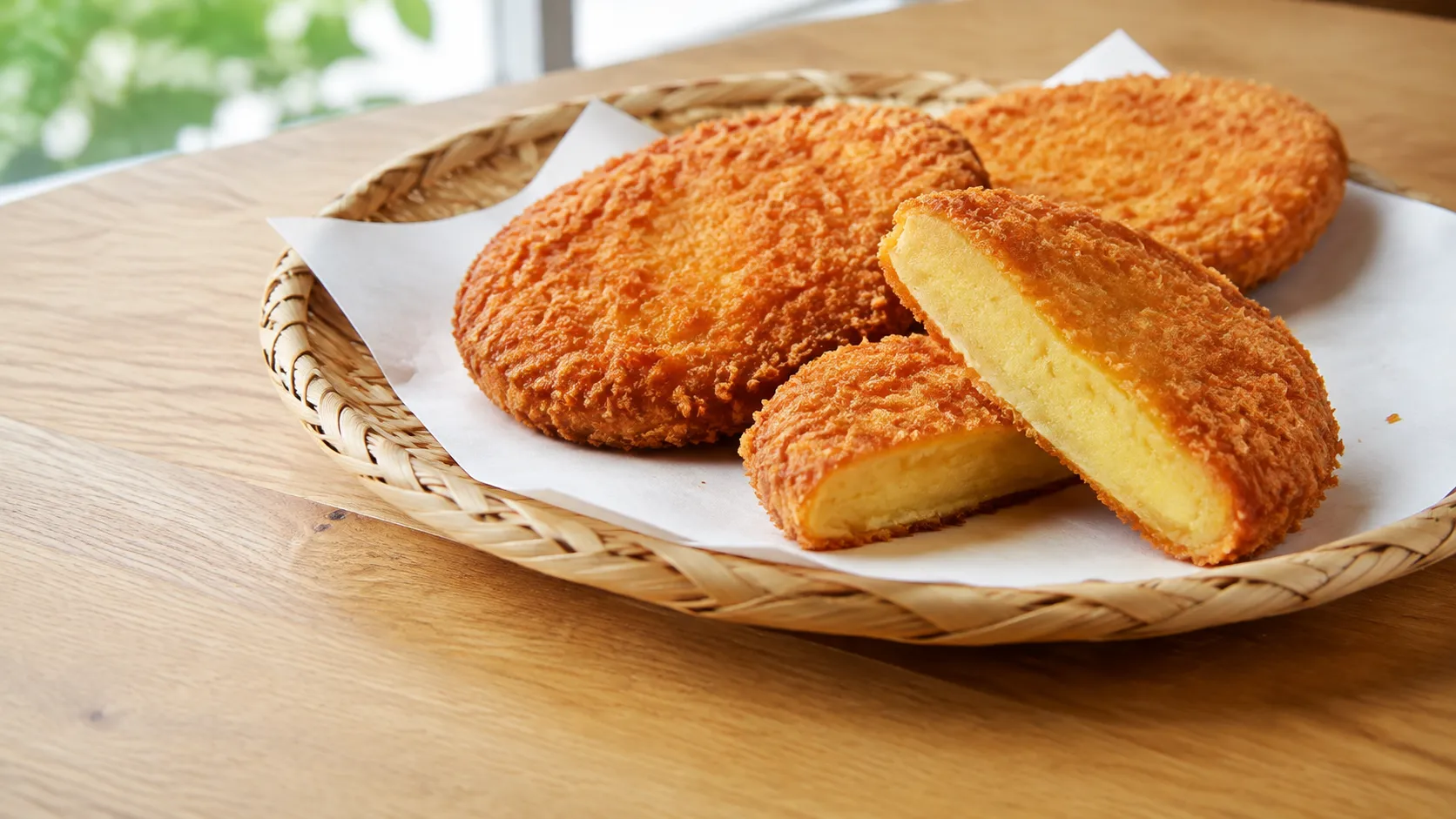
Fish Katsu (フィッシュカツ)
In Tokushima, saying "katsu" does not get you a pork cutlet. It gets you this — and the moment I understood that, a whole prefecture rearranged itself in my head.
September 2, 2026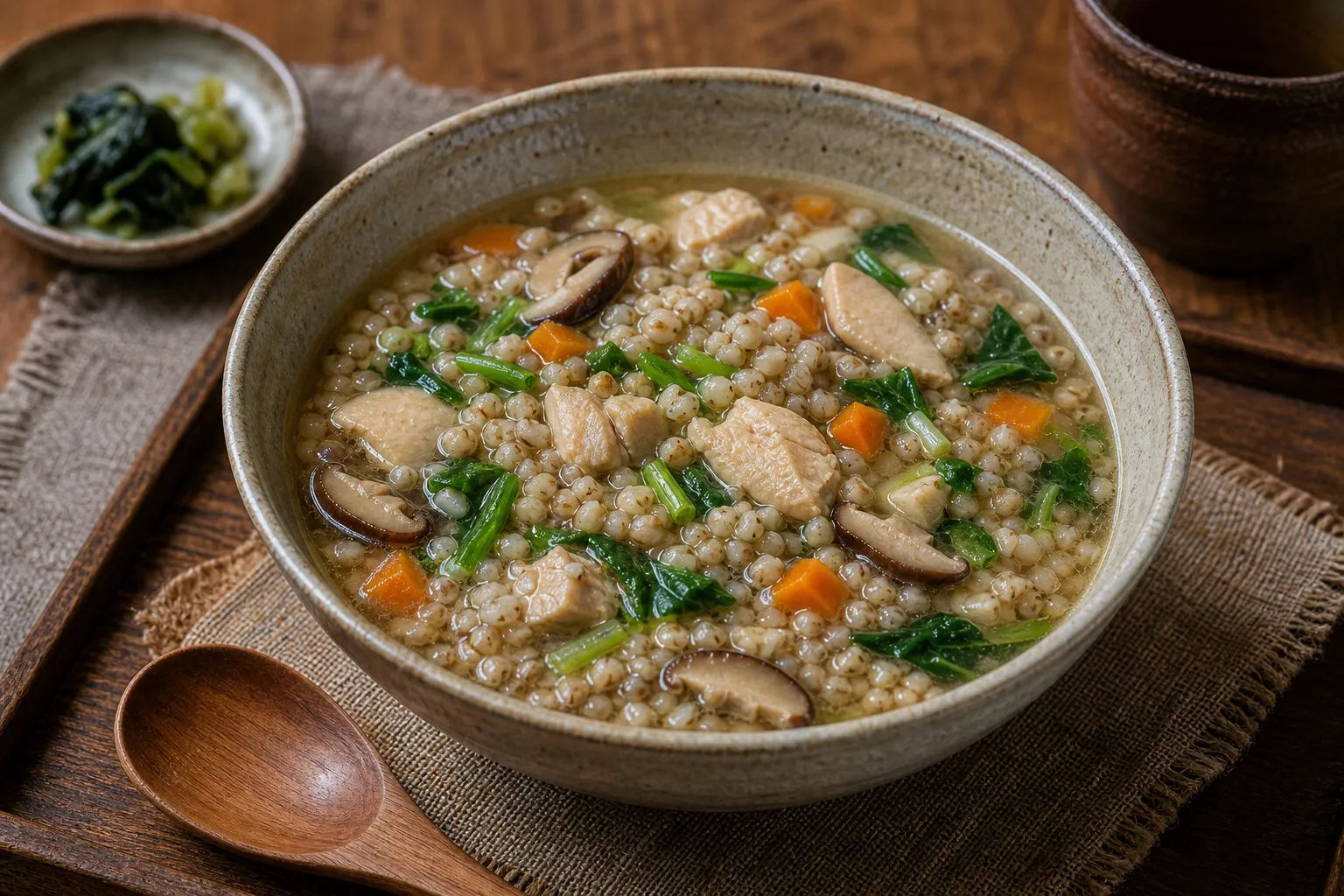
Local FoodTokushima
Sobagome Zosui (そば米雑炊)
Not soba noodles — whole buckwheat grains, plump and nutty, simmered into a warm chicken-and-vegetable soup deep in the Iya Valley. Refugee food that became one of Japan's most quietly comforting bowls.
July 12, 2026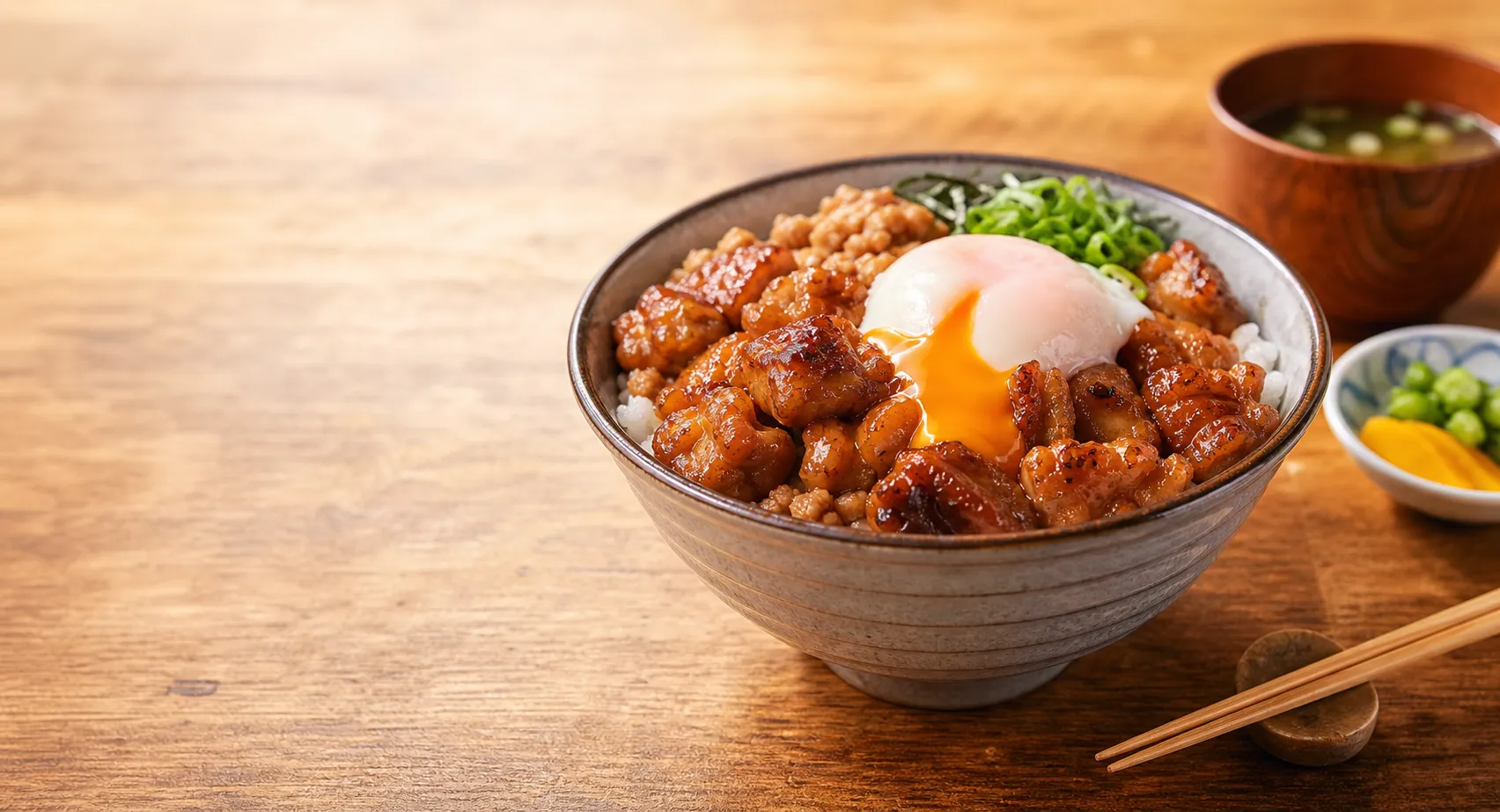
Local FoodTokushima
Tokushima-don (徳島丼)
It's chicken over rice — but it's a very specific chicken, one Tokushima is quietly, competitively proud of, and once you know the backstory you'll never call it 'just a rice bowl' again.
July 5, 2026