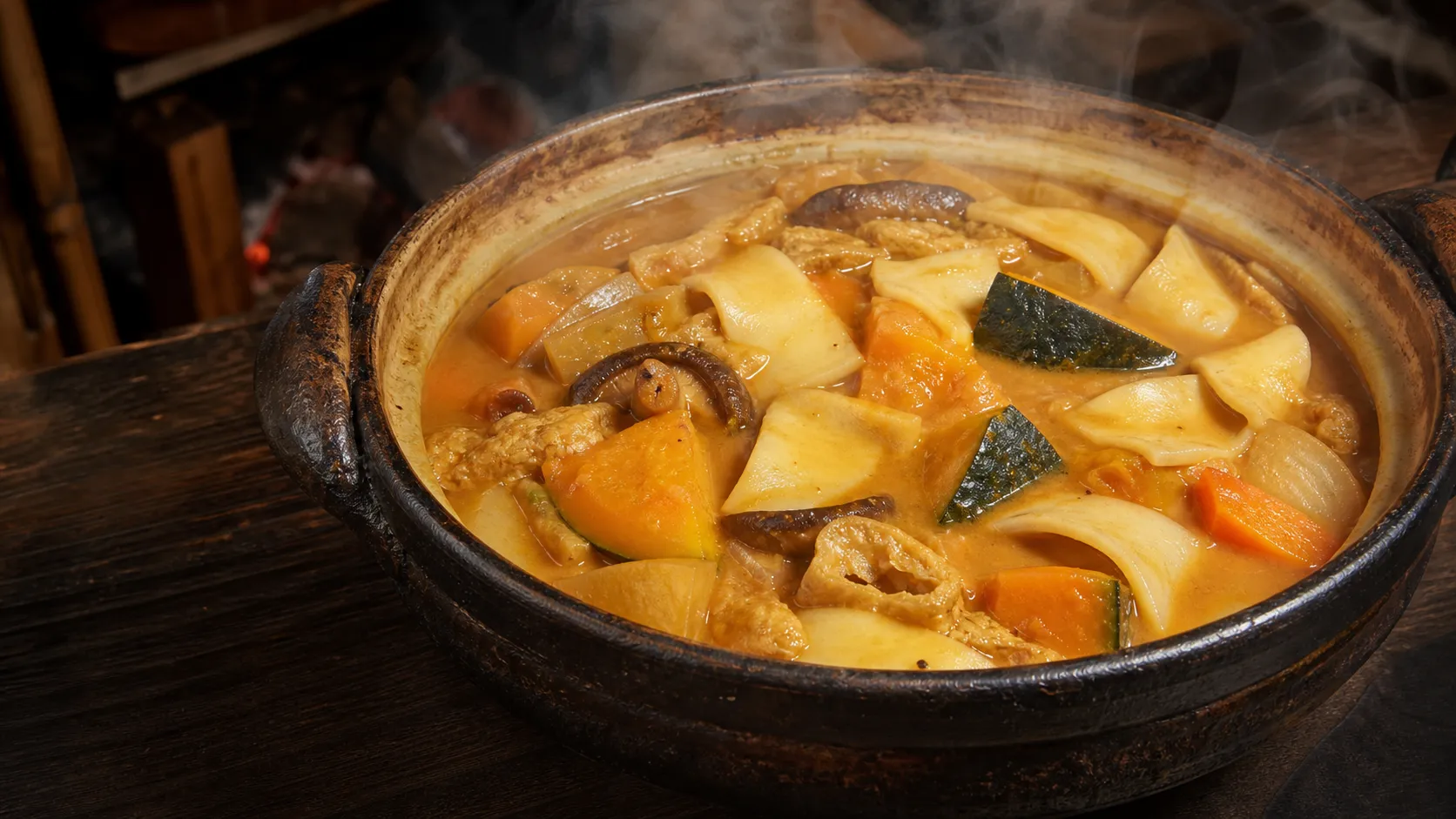
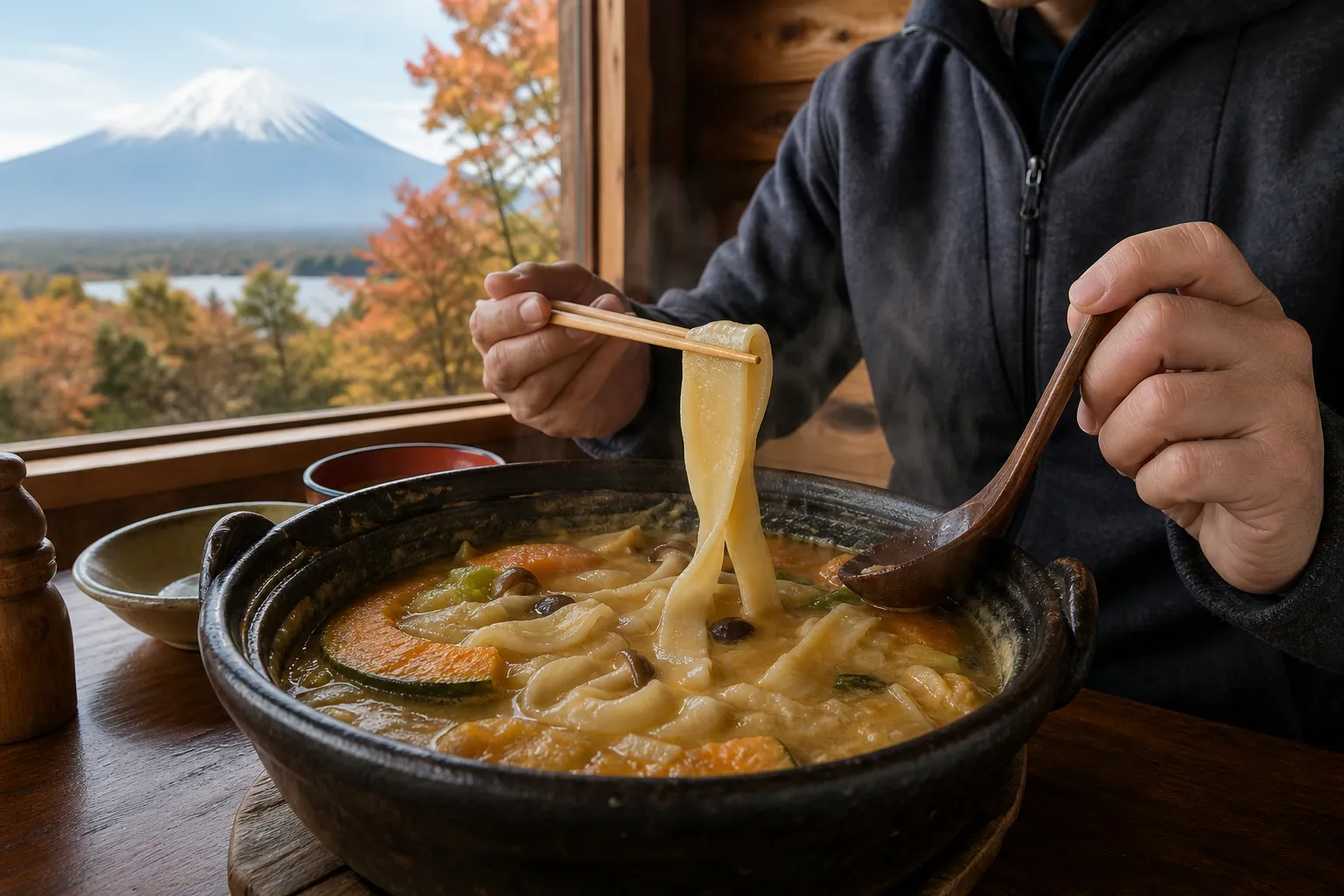
You've been outside. The Southern Alps are visible from the street, still snowcapped. It's October and the cold came early this year. You walk into a small restaurant somewhere in the Fuji Five Lakes area and the server places a cast-iron pot on your table, still actively boiling, steam pouring off a rust-orange broth thick with dissolved pumpkin and wide flat noodles and something deep and miso-dark underneath all of it. The pot makes a sound. You lean forward. The warmth hits your face.
Share this dish


Yamanashi's ancient mountain stew: wide flat noodles made without salt, simmered directly in miso broth with pumpkin until everything thickens into something halfway between soup and casserole. Cold outside. Hot in the pot.
🍜 Planning a food trip to Yamanashi?Add this dish to my Food Trip →
 Add this dish to my Food Trip →
This is hoto (ほうとう), and this is exactly the situation it was designed for.
Yamanashi Prefecture's defining dish is a mountain stew that does not feel like soup and does not feel like pasta — it sits somewhere between them, in its own category, answering only to the mountains that surround the prefecture on every side. Wide, flat, salt-free noodles go into the miso broth raw and uncooked, simmering directly with kabocha pumpkin, mushrooms, root vegetables, and whatever else is around until the pumpkin dissolves and the whole pot thickens into something dense and fortifying and deeply, completely satisfying. It arrives at the table still bubbling in the iron pot. You eat it slowly. The pot stays hot for twenty minutes. The mountains are right there.
The warlord's bowl
Hoto has a story worth telling: it's associated with Takeda Shingen, the feared Tiger of Kai, one of the most powerful warlords of Japan's Sengoku period. The claim — contested by historians, beloved by Yamanashi — is that Shingen fed his armies with hoto because the salt-free noodles were easier on the stomach than rice during long campaigns and required minimal resources. Whether the Tiger of Kai actually invented it doesn't really matter. What matters is that the image is exactly right: this is food for people who need to warm up before something difficult.
Yamanashi is landlocked, boxed in by the Southern Alps and Mount Fuji. Winter is real here. Hoto makes sense here the way that only food that grew from the land and the weather makes sense. You can taste the mountains in it.
Why the noodles cook in the miso
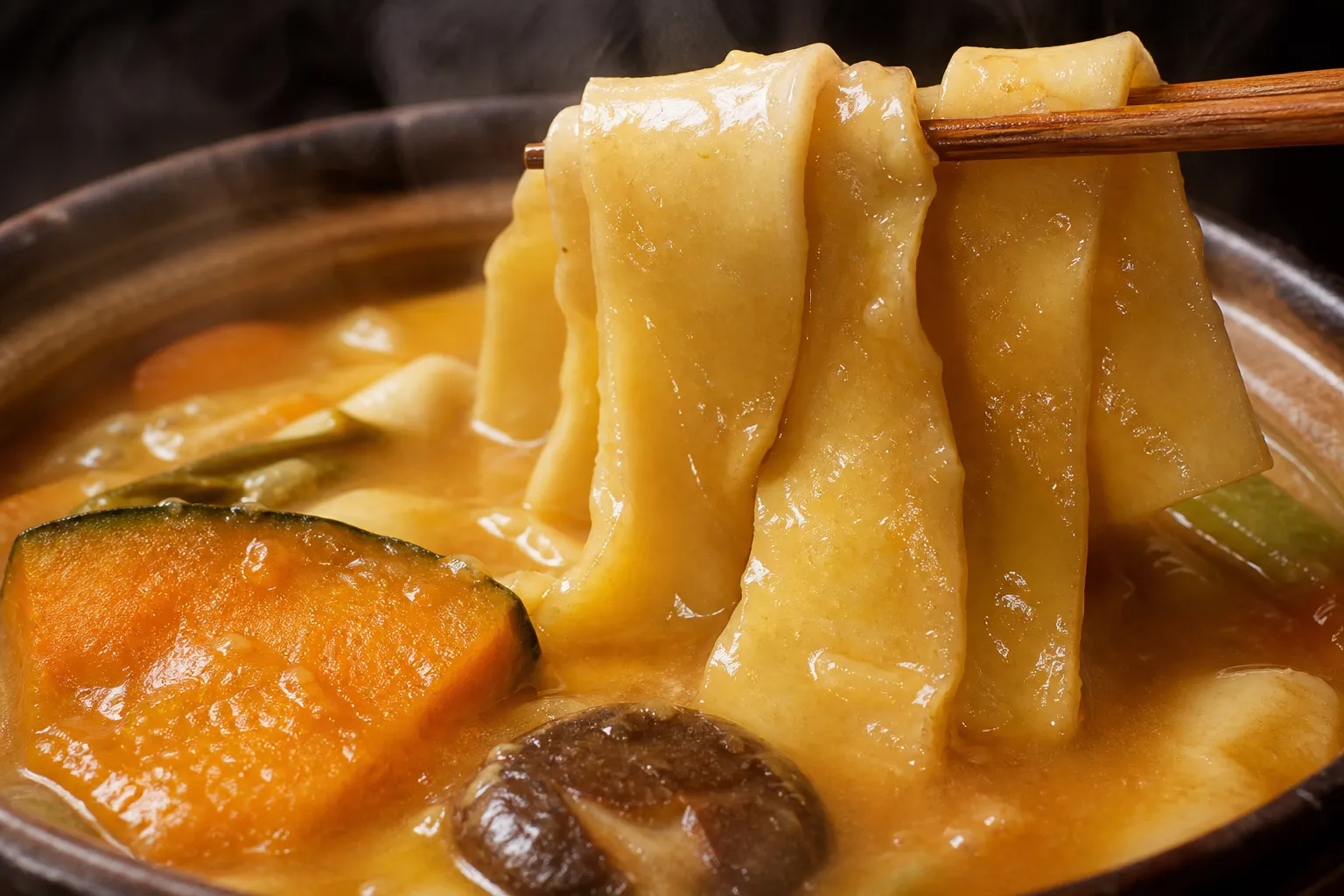
Here's the rule other noodle dishes follow: cook separately, combine at service. Hoto ignores this completely. The flat noodles — made without salt, which matters — go directly into the simmering miso broth and cook there, absorbing flavor from the inside out and releasing starch as they go. The broth thickens naturally. The kabocha does its part too, breaking down slowly until half of it dissolves into the liquid, adding sweetness and a golden-orange color and a richness the miso alone couldn't produce.
The result is something that's all one thing. Not noodles in soup. Not stew with pasta. Hoto. The kabocha is non-negotiable — without it, you have something else. With it, you have the dish that Yamanashi has been eating in cold weather for centuries, and for good reason.
How it's made
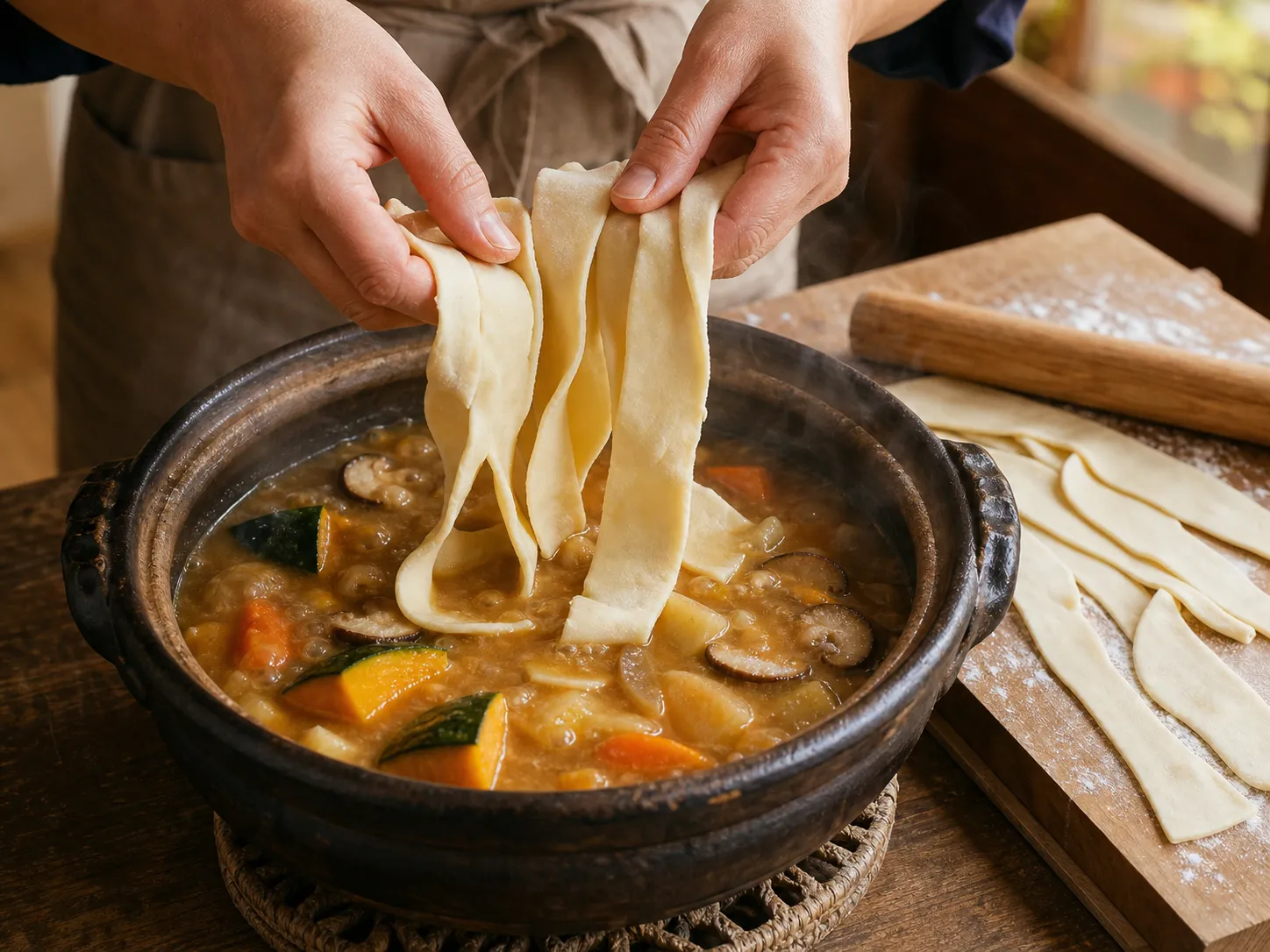
- Mix flour and water to a stiff dough; roll and cut into wide, irregular flat strips — no salt in the dough, ever
- Build a miso broth: dashi base with a generous amount of miso dissolved in
- Add vegetables — kabocha pumpkin first (it takes longest), then mushrooms, aburaage, leek, taro root
- Add the raw noodles directly to the simmering pot
- Cook together, uncovered, until noodles are done and the pumpkin has half-dissolved into the broth
- Serve in the iron pot, still boiling, at the table
Before you go — wait for the pumpkin to melt
Your questions, answered honestly
"Is it heavy?" — Genuinely yes. This is a full meal. One pot is enough for one very hungry person. Don't order side dishes.
"The noodles feel different from ramen — is that right?" — Completely right. No salt in the dough means a softer, more yielding texture — closer to Italian pappardelle than any Japanese noodle you know. If you came expecting al dente, adjust. The softness is the point.
"Can I eat it in summer?" — You can. You won't feel the full magic. Come in autumn or winter, ideally after spending the day near Mount Fuji and walking in from the cold. The temperature differential is part of the experience.
"The kabocha is kind of melted — is that right?" — That's correct and that's ideal. You want some pieces intact for texture, but the broth should be thick and golden-orange from dissolved pumpkin. If it's clear, it needed longer.
"What should I drink with it?" — Koshu white wine from Yamanashi — Japan's best white wine region is right here, and the delicate local grape pairs beautifully with the miso-pumpkin broth. Ask if they have it. They should.
What the staff will ask you
| You'll hear | Romaji | Meaning | Just say |
|---|---|---|---|
| 味噌の種類はいかがしますか? | Miso no shurui wa ikaga shimasu ka? | "Which miso style?" | Osusume wa nan desu ka? (What do you recommend?) |
| ご飯はいりますか? | Gohan wa irimasu ka? | "Do you want rice?" | Kekkō desu (no thank you — you won't need it) |
| 辛口にしますか? | Karakuchi ni shimasu ka? | "Stronger miso?" | Futsū de onegaishimasu (regular is fine) |
To order, just say "Hōtō kudasai" (ほうとうください) — "Hoto, please."
Where to eat it
- Kōshu Hōtō Kosaku (甲州ほうとう小作) — Kofu and several Yamanashi locations. The most famous chain. Lines on weekends are genuine.
- Hōtō Fudō (ほうとう不動) — Several locations near Kawaguchiko (Lake Kawaguchi), with thatched roofs and Mount Fuji views on clear days.
- Roadside stations (michi-no-eki) throughout Yamanashi — local, cheaper, often excellent. The less famous version is sometimes the better one.
Hoto is Yamanashi's food. Don't order it anywhere else and expect the same thing. Come to Kofu, come to the Fuji Five Lakes, come when it's cold, come hungry.
Soul Score
Local Roots5/5
First-Timer Friendly4/5
Adventure Level3/5
Comfort Level5/5
Travel Worthy4/5
These scores are one obsessed eater's gut feeling — not a verdict. A low number isn't a bad mark, just a different kind of adventure.
Know someone planning Japan?
← All Articles
Local Food · Kofu, Yamanashi
Still hungry?
Eat more from Yamanashi
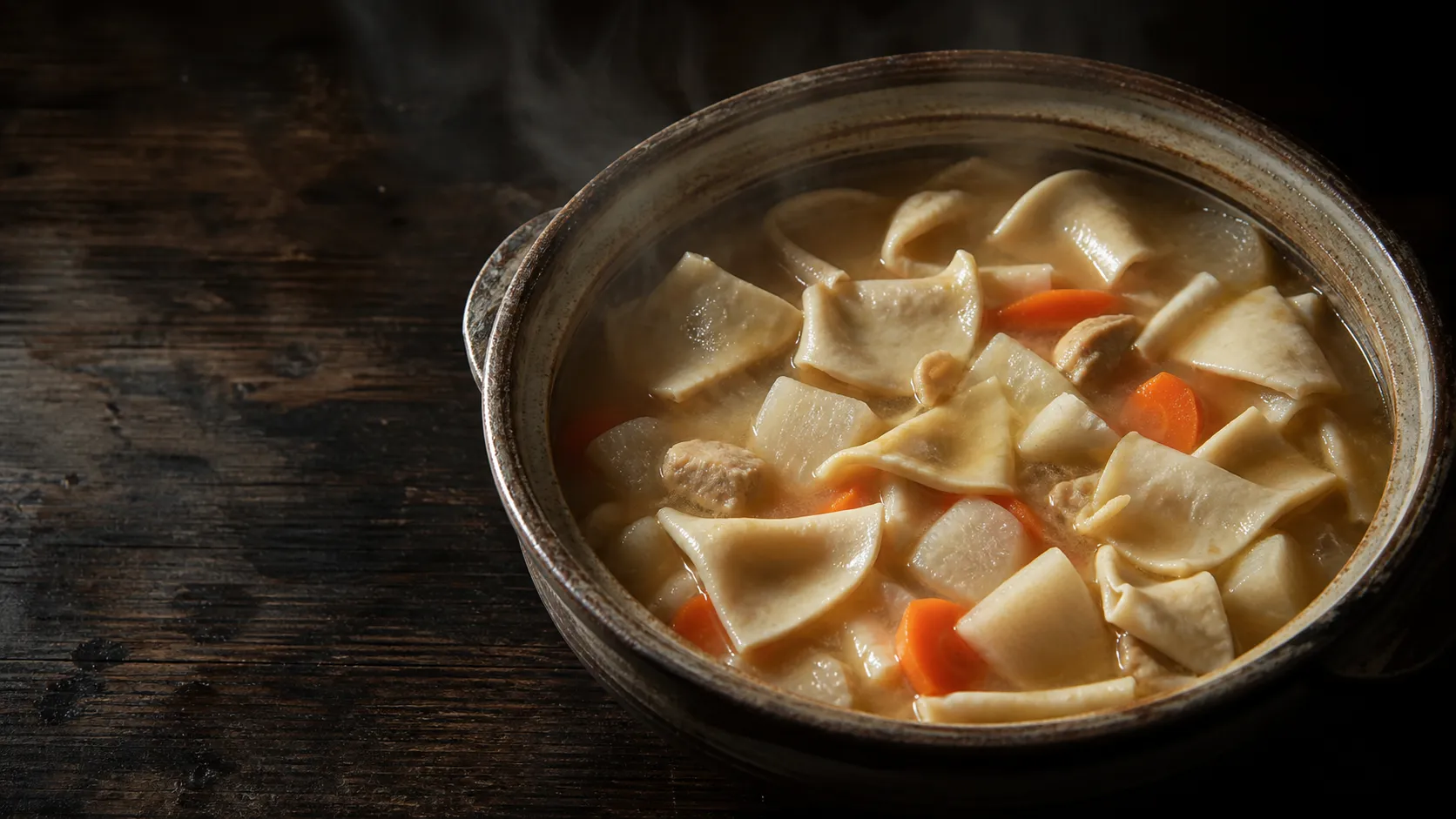
Local FoodFujikawa, Yamanashi
Mimi (みみ)
A grandmother in Fujikawa told me the little dough shapes in my soup were designed to scoop up good fortune, and then watched to make sure I ate every one of them.
September 2, 2026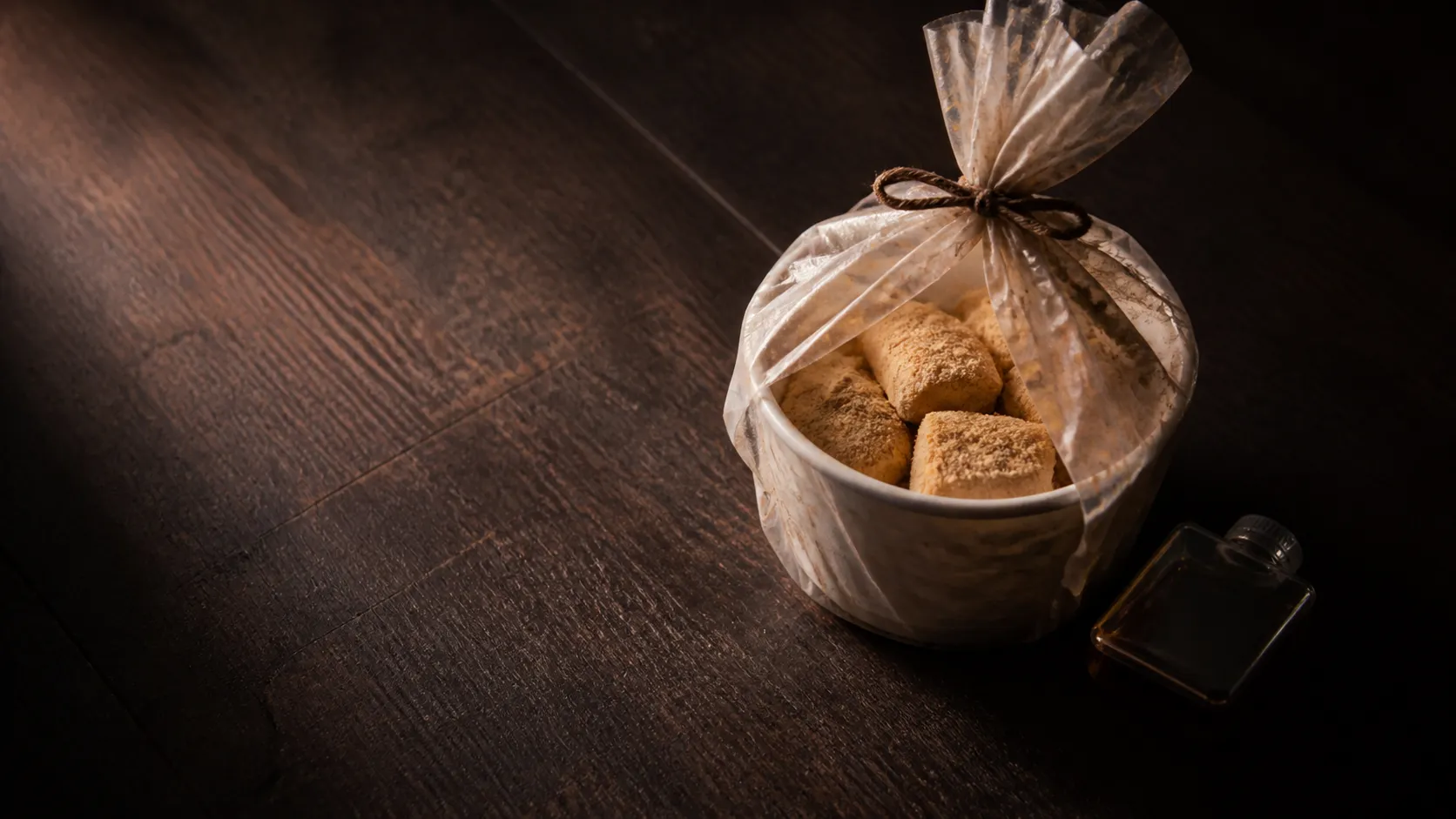
Sweets & SnacksYamanashi
Shingen Mochi (信玄餅)
There is a correct way to eat this and I did not know it, so I made a mess in front of several Yamanashi locals who were extremely kind about it and absolutely watching.
September 2, 2026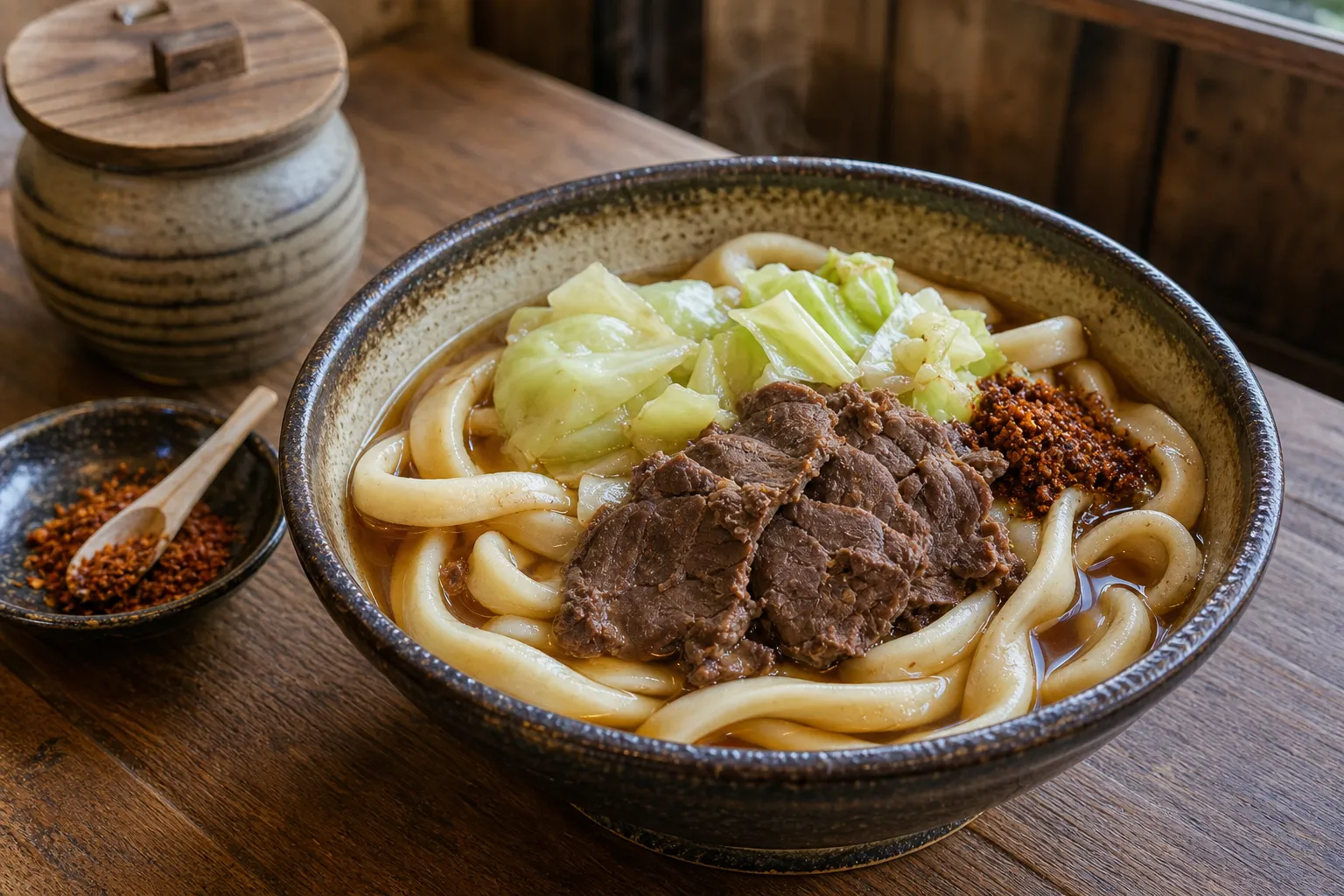
Local FoodFujiyoshida, Yamanashi
Yoshida Udon (吉田うどん)
The udon that fights back. Fujiyoshida's noodles are so thick and stubbornly chewy your jaw gets a workout — served in a soy-miso broth under a fiery red condiment you won't find anywhere else.
July 12, 2026